
Slug: shell-less gastropods, biology, ecology and distinctions
An overview of slugs—land and marine shell-less gastropods—covering anatomy, behavior, evolution, ecological roles, impacts on gardens and agriculture, and distinctions from snails and sea slugs.
Overview
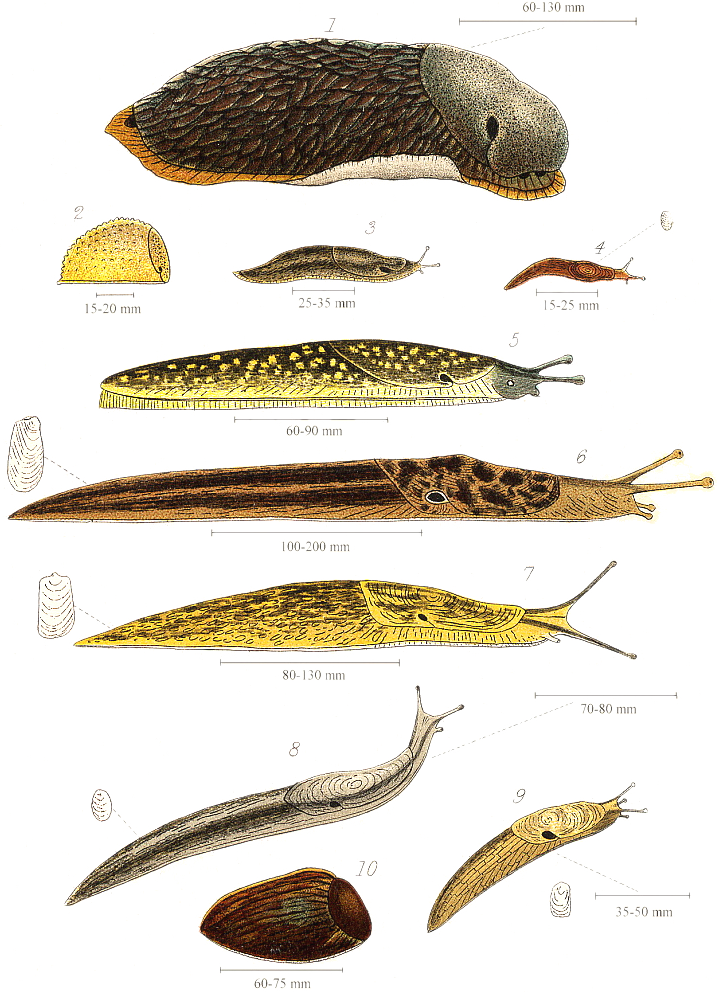
Slugs are gastropod molluscs that either lack an external shell entirely or possess only a greatly reduced internal or vestigial shell. The term "slug" is a descriptive, common-language category rather than a strict scientific one: several different families of gastropods include forms called slugs as well as shelled snails. For a broader perspective on the families that include slug-like species see related gastropod families. By contrast, fully shelled gastropods are commonly called snails.
Image gallery
10 Images



Key characteristics and anatomy
Despite their variety, most terrestrial slugs share a similar basic body plan: a soft, elongate body with a muscular foot used for crawling; a mantle located on the anterior dorsal surface that in some species contains a reduced shell; two pairs of retractable tentacles (upper eyespots and lower sensory tentacles); and a rasping radula used to feed. Slugs produce mucus that lubricates movement, reduces desiccation, and can deter predators. Locomotion typically involves pedal waves of muscular contraction passing along the foot.
Ecology, diet and behavior
Slugs inhabit moist terrestrial habitats—gardens, forests, hedgerows, and fields—where humidity reduces the risk of drying out. Many are detritivores or herbivores, feeding on decaying plant material, fungi, and living vegetation; some are omnivorous or predatory. Slugs are important in nutrient cycling as decomposers and as prey for birds, mammals, amphibians, and invertebrate predators. Their feeding habits can also make some species agricultural pests, especially in damp climates.
Reproduction and life cycle
Most land slugs are hermaphrodites, possessing both male and female reproductive organs. Mating often involves reciprocal exchange of sperm; some species engage in complex courtship behaviors. A few slugs use calcareous "love darts" during mating—an unusual trait shared with certain land snails. Eggs are laid in moist soil or hidden crevices and develop into juvenile slugs without a distinct larval stage.
Evolutionary context and distinctions
The shell-less condition has evolved independently multiple times among gastropods—a classic example of convergent evolution. Because the slug-like form arose in unrelated lineages, "slug" is not a formal taxonomic rank but a functional description. Some terrestrial species retain a small external shell or internal plate; those with a small visible shell that cannot enclose the whole body are often called semislugs. Marine gastropods that lack shells are generally referred to as marine or sea slugs, a diverse set that includes colorful nudibranchs with very different anatomy and life histories from land slugs.
Human interactions, impacts and management
Slugs can be both beneficial and problematic. As decomposers they help recycle organic matter; as prey, they form part of many food webs. Gardeners and farmers may regard certain species as pests when they consume seedlings, leaves, and fruit. Common management approaches include habitat modification to reduce shelter and moisture, physical barriers and traps, targeted hand removal, and encouragement of natural predators. Chemical controls exist but should be used carefully to limit non-target effects and environmental harm.
- Notable examples: banana slugs and the large Limax species are often cited for their size and visibility in temperate forests.
- Semislugs: intermediate forms with partial shells; different from both true slugs and fully shelled snails.
- Sea slugs: marine analogues that include many shell-less groups, often brightly colored and ecologically distinct from terrestrial slugs (see sea slugs).
For more on classification and biology, consult resources on gastropod families and evolutionary studies: families overview, the general distinction between snails and slugs, and explanatory material on convergent evolution and taxonomic practice. For habitat-specific information, see entries on marine molluscs and sea slugs.
Questions and answers
Q: What is a slug?
A: A slug is a type of gastropod mollusc that either has no shell or a very small internal shell.
Q: Are slugs closely related to each other?
A: The families of land slugs are not very closely related, despite looking similar.
Q: What is convergent evolution?
A: Convergent evolution is when two unrelated species evolved similar traits due to similar environmental pressures.
Q: Is "slug" a taxonomic category?
A: No, the category "slug" is not a taxonomic category because slugs belong to several different families.
Q: What is the difference between a snail and a slug?
A: Snails are gastropods with a coiled shell, while slugs either have no shell or just a small internal shell.
Q: What are sea slugs?
A: Sea slugs are the marine form of slugs.
Q: What are semislugs?
A: Semislugs are land gastropods with a shell that is too small to hide the body.
Related articles
Author
AlegsaOnline.com Slug: shell-less gastropods, biology, ecology and distinctions Leandro Alegsa
URL: https://en.alegsaonline.com/art/91161