
Slide rule (slipstick): an analog calculator for scientific use
Overview of the slide rule, its parts and scales, historical origins, typical uses in science and engineering, and why it was superseded by electronic calculators.
The slide rule, often called a slipstick, is a handheld analog calculating instrument that uses logarithmic scales to perform rapid multiplicative and related computations. Instead of arithmetic addition or subtraction, a slide rule translates multiplication and division into additions and subtractions of distances along scales, which makes it especially handy for tasks like multiplication and division. It also provides practical shortcuts for extracting roots, working with logarithms, and solving many trigonometry problems, while ordinary addition and subtraction are generally done by other means.
Image gallery
10 Images


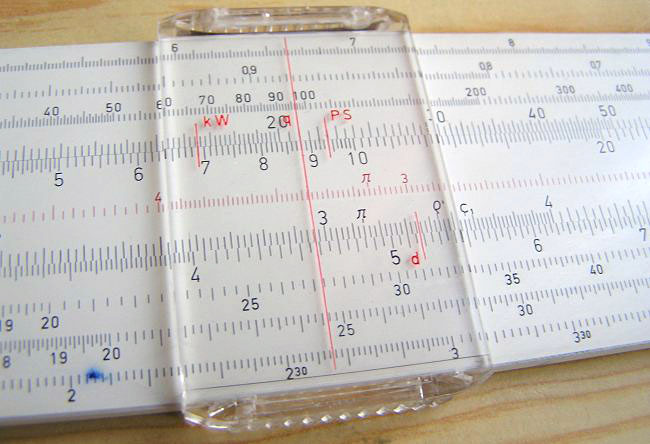


Design, scales and operation
A typical slide rule consists of three main parts: a central sliding strip, a fixed outer body (the stock), and a transparent cursor for alignment. Markings on the device are called scales; these may be labeled C, D, A, B, K, LL, S, T and others, each providing a different transformation or range. Users align numbers on one scale with another using the cursor to read results without performing the arithmetic directly. Some rules are linear, offering a straight sliding action, while others are circular or cylindrical, trading compactness for extended precision.
- Common scales: C and D for basic multiplication/division; A and B for squares and square roots; K for cubes; LL for logarithmic ranges; S and T for sine and tangent values.
- Special-purpose rules: Aviation, finance, electrical and surveying models include tailored scales or conversion tables for those fields.
History and development
The slide rule is rooted in the discovery and popularization of logarithms. That mathematical breakthrough is associated with John Napier and his work on logarithmic relationships, often linked in histories to Napier. The practical concept of a sliding rule was developed and refined by instrument makers; William Oughtred is widely credited with inventing the first two-scale slide device and popularizing the design in the 17th century (Oughtred). Over subsequent centuries the form and scale sets evolved to meet the expanding needs of navigation, surveying, astronomy and later industrial and scientific practice.
For much of the 19th and 20th centuries the slide rule was the principal portable computational tool for professionals. It was standard equipment in laboratories, classrooms and engineering offices and widely used by practitioners in science and engineering. Even as mechanical and early electronic machines appeared, including larger computing devices, the slide rule remained valued for quick, approximate answers and its convenience.
The introduction and rapid miniaturization of electronic calculators during the 1970s, and the broader spread of digital computing devices, led to the decline of the slide rule. Pocket electronic calculators (electronic calculators) provided greater ease of use, higher precision and the ability to perform many operations that a slide rule could not do directly, accelerating the instrument's obsolescence.
Uses, strengths and limitations
Slide rules are best for quick, order-of-magnitude estimates and for calculations where a few significant digits are sufficient. Their tactile operation helps users understand numerical relationships and scale behavior. Limitations include the lack of direct decimal-point placement—users must track magnitude separately—and finite precision, typically two to four significant figures depending on scale length. Collectors and educators value slide rules today for their historical significance and pedagogical role in demonstrating logarithmic thinking.
For additional reading and historical references, see resources on specific functions and models: multiplication examples, division techniques, root extraction, logarithm scales, trigonometric use, why addition is uncommon, subtraction notes, Napier's contribution, Oughtred's inventions, calculator history, scientific applications, engineering use cases, and transition to digital.
Questions and answers
Q: What is a slide rule?
A: A slide rule is a mechanical analog computer used mainly for multiplication and division, as well as scientific functions such as roots, logarithms and trigonometry.
Q: What are the different types of slide rules?
A: Slide rules can be linear or circular and have a standardised set of markings or scales used for mathematical computations. Some special-use slide rules have been made for aviation or finance with special scales for those applications.
Q: Who invented the slide rule?
A: The slide rule was invented by William Oughtred based on the work on logarithms by John Napier.
Q: When were electronic calculators developed?
A: Electronic calculators were developed before the 1970s but around 1974 the pocket calculator made the slide rule largely obsolete.
Q: What did people use most often in science and engineering before electronic calculators were developed?
A: Before electronic calculators were developed, people used the slide rule most often in science and engineering.
Q: How long did people continue to use the slide rule after digital computing devices were introduced?
A: People continued to use the slide rule through the 1950s and 1960s even as digital computing devices were gradually introduced.
Tags
Related articles
Author
AlegsaOnline.com Slide rule (slipstick): an analog calculator for scientific use Leandro Alegsa
URL: https://en.alegsaonline.com/art/91103
Sources
- sphere.bc.ca : sphere.bc.ca
- antiquark.com : "⊙ AntiQuark: Slide Rule Tricks"
- hpmuseum.org : hpmuseum.org/srcirc.htm
- sliderulemuseum.com : sliderulemuseum.com
- mccoys-kecatalogs.com : The Log-Log Duplex Decitrig Slide Rule No. 4081: A Manual
- oldcalculatormuseum.com : "Wang LOCI-2"
- hp9825.com : "The 9100 Project"
- dx.doi.org : J. E. Volder, "The Birth of CORDIC", J. VLSI Signal Processing 25, 101 (2000).