
Sleeping Beauty transposon system
A reconstructed Tc1/mariner DNA transposon platform used for non‑viral stable gene integration and long‑term transgene expression in research and therapeutic development.
Overview
The Sleeping Beauty (SB) transposon system is a synthetic DNA transposon platform developed to enable stable, non‑viral gene transfer into vertebrate genomes. Reconstructed from inactive Tc1/mariner elements, the system was engineered to function efficiently in mammalian cells and has become a widely used tool in basic research, preclinical models and early clinical applications. SB is valued for combining stable genomic integration with relatively simple production and delivery compared with many viral vectors.
Image gallery
4 Images


Components and mechanism
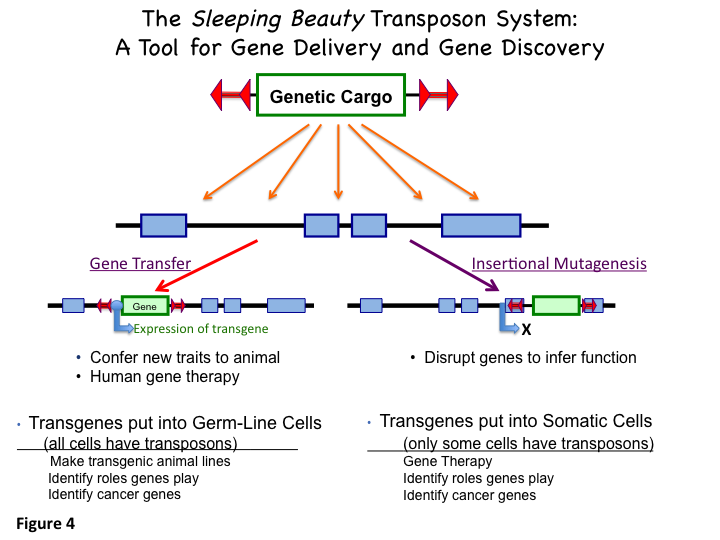
SB operates as a two‑component, cut‑and‑paste system. One component is the transposon: a DNA expression cassette that carries the therapeutic or experimental payload and is flanked by characteristic inverted repeat/direct repeat (IR/DR) sequences. The other component is the SB transposase enzyme, which recognizes the IR/DR motifs, excises the transposon from its donor DNA and integrates it into a new genomic location. Integration occurs specifically at TA dinucleotides in the target genome, producing a defined insertion footprint. Transposase can be provided as plasmid DNA, in vitro‑transcribed mRNA, or purified protein to control the duration of activity.
Variants and engineering
After the initial molecular reconstruction, researchers produced successive transposase variants with improved activity and stability in mammalian cells. Hyperactive versions have been developed to increase integration efficiency and reduce the amount of transposase needed. In parallel, transposon designs have been optimized for cargo capacity, transcriptional control and safety features such as insulator elements. These engineering advances expanded the practical uses of SB from cell culture to animal models and translational research.
Delivery methods
SB transposons and transposase can be delivered by several approaches depending on the application. Common ex vivo methods include electroporation and lipid‑based transfection of primary cells or stem cells. In vivo delivery has been explored with hydrodynamic injection in liver models, nanoparticle formulations and combinations with viral vectors that supply transient transposase. Choice of delivery influences efficiency, cell viability and the duration of transposase exposure, which in turn affects safety and the risk of remobilization.
Applications
- Stable gene transfer for functional studies in primary human cells and pluripotent stem cells.
- Generation of genetically modified animals and insertional mutagenesis screens to identify genes involved in disease.
- Ex vivo engineering of immune effector cells, including non‑viral manufacturing of chimeric antigen receptor (CAR) T cells, with several early clinical investigations reported.
- Tool for long‑term expression where scalable, low‑cost non‑viral production is advantageous.
Advantages and limitations
Advantages of SB include a relatively simple molecular design, scalable production, and the capacity for stable genomic insertion without viral packaging. SB shows a broad cargo tolerance and can support durable transgene expression. Limitations include dependence on efficient delivery into target cells, variable integration efficiency across cell types, and the potential for insertional mutagenesis because integration is targeted to TA dinucleotides throughout the genome rather than to a single safe harbor.
Safety considerations and mitigation
Because SB mediates permanent genomic integration, safety assessments focus on insertion site distribution and the potential to disrupt or activate host genes. Common mitigation strategies include restricting transposase activity through transient expression (mRNA or protein), incorporating insulating sequences or promoter choices that reduce enhancer effects, performing comprehensive insertion site mapping in preclinical studies, and designing transposons to minimize oncogenic risk. Compared with some integrating viral vectors, SB tends to have different genomic preferences and a lower propensity to cluster near gene promoters, but risks remain context dependent.
Comparisons and future directions
SB is one of several transposon systems used for genome engineering; others such as PiggyBac and Tol2 differ in target sequences, excision footprints and cargo characteristics. The choice among systems depends on cargo size, desired excision behavior, target cell type and safety profile. Ongoing work aims to improve targeting specificity, reduce genotoxicity, and integrate SB with newer delivery formats to broaden its therapeutic potential.
Questions and answers
Q: What is the Sleeping Beauty (SB) transposon system?
A: The Sleeping Beauty (SB) transposon system is a non-viral vector for gene therapy that enables high-level stable gene transfer and sustained transgene expression in multiple primary human somatic cell types.
Q: Why is the SB system an attractive gene transfer strategy for clinical use?
A: The SB system is attractive because it enables stable gene transfer and long-term expression of the gene of interest in human cells.
Q: What are the two components of the SB transposon-based transfection system?
A: The two components of the SB transposon-based transfection system are a transposase and a transposon containing inverted repeat/direct repeat (IR/DR) sequences.
Q: How does the SB transposon system ensure precise integration into a TA dinucleotide?
A: The SB transposon system ensures precise integration into a TA dinucleotide because the transposon is designed with an expression cassette of interest flanked by IR/DRs, and the SB transposase mediates stable integration.
Q: What is the role of the transposon in the SB system?
A: The transposon in the SB system contains an expression cassette of interest flanked by IR/DRs and mediates stable integration and reliable long-term expression of the gene of interest.
Q: Can the SB system efficiently mediate gene transfer in human embryonic stem (ES) cells?
A: Yes, recent research has found that the SB system efficiently mediates gene transfer and stable gene expression in human embryonic stem (ES) cells.
Q: What is the source of information for the text about the SB system?
A: The source of information for the text about the SB system includes various research papers published on PubMed and CSH Protocols.
Related articles
Author
AlegsaOnline.com Sleeping Beauty transposon system Leandro Alegsa
URL: https://en.alegsaonline.com/art/91082