
Sirius (Dog Star): Brightest star in the night sky
Sirius, the Dog Star (Alpha Canis Majoris), is a nearby binary system whose bright primary and white-dwarf companion have long astronomical and cultural significance.
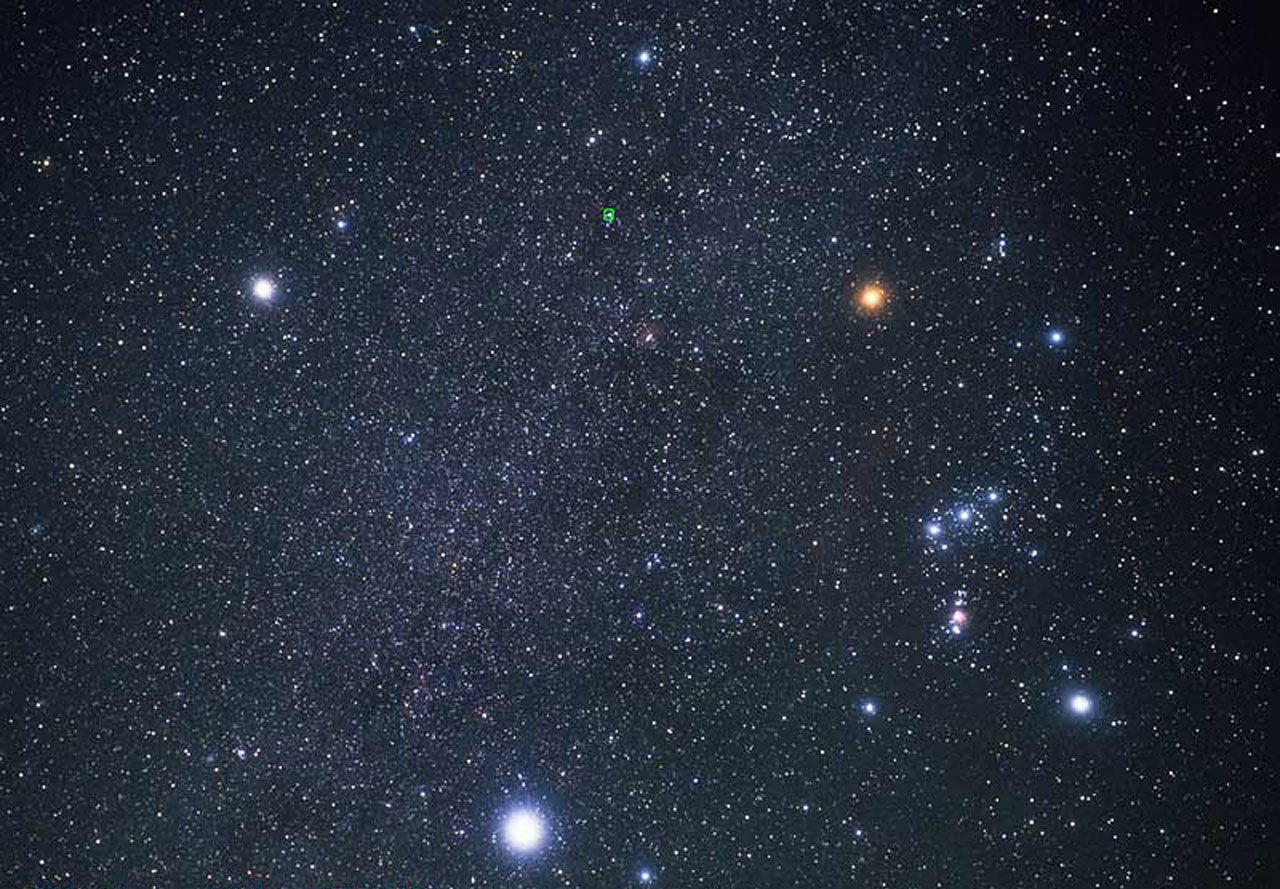
Sirius, commonly called the Dog Star, is the brightest star visible from Earth and the principal star of the constellation Canis Major. Listed as Alpha Canis Majoris, it is notable for both its intrinsic luminosity and its proximity to the Solar System. Seen from mid-latitudes, Sirius outshines all other nighttime stars and has been an important reference point for observers and navigators for millennia.
Image gallery
10 Images





Components and physical characteristics
The Sirius system is a close pair composed of a luminous main-sequence star and a faint white dwarf companion. The primary is a white, A-type main-sequence star that gives the system its bluish-white appearance. Its apparent brightness is measured at about −1.46 magnitude, making it easily visible to the naked eye even from light-polluted areas. The companion is a dense, compact stellar remnant — a white dwarf — that was once the more massive member of the pair and has evolved off the main sequence.
- Type: a bright A-type main-sequence star plus a white dwarf companion (a classic binary star).
- Location: in the constellation Canis Major, close to the bright figures of Orion in the sky.
- Distance: one of the solar neighborhood stars, at roughly 8.6 light-years from Earth.
- Color and magnitude: bluish-white hue and an apparent magnitude near −1.5, a combination of high luminosity and nearby distance.
History and cultural significance
Sirius has played a prominent role across civilizations. In ancient Egypt the star was known as Sopdet and its first pre-dawn (heliacal) rising marked the annual flooding cycle of the Nile and was integral to calendrical reckoning. Classical cultures associated Sirius with dogs and heat: the name "Dog Star" passed into Greek and Latin tradition and gave rise to the phrase "dog days" for the hot period of summer. Because it is so bright and easily located relative to Orion, Sirius has been used for orientation and timing throughout human history.
Astronomical study and discoveries
Astronomers discovered that Sirius did not move across the sky exactly as expected for a single star. In the 19th century the presence of a companion was inferred from perturbations in the primary's motion, and telescopic observation later revealed the faint partner. The companion's identification as a white dwarf provided early, important evidence for theories of stellar evolution and the behavior of matter under extreme densities. As one of the nearest bright systems, Sirius remains a subject for studies of stellar atmospheres, dynamics, and the mass–radius relation for white dwarfs.
Notable facts and distinctions
- Brightest star seen from Earth at night; easily found by following Orion's belt toward Canis Major.
- Often used as a benchmark in cultural, navigational, and astronomical contexts.
- Its proximity means changes in position (proper motion) and orbital motion of the pair can be measured with precision, offering insights into stellar masses and evolution.
- Ancient names and beliefs about Sirius survive in modern references; the Egyptian name Sopdet is one example of its long human significance.
Because of its brightness, proximity, and binary nature, Sirius connects observational astronomy with cultural history. It remains one of the most studied and readily observed stellar systems in the night sky.
Questions and answers
Q: What is Sirius?
A: Sirius is the brightest star in the night sky.
Q: Where is Sirius located?
A: Sirius is located in Canis Major, near Orion.
Q: What is the magnitude of Sirius?
A: The apparent magnitude of Sirius is −1.46.
Q: How old is the Sirius system?
A: The Sirius system is between 200 and 300 million years old.
Q: Why does Sirius appear bright?
A: Sirius appears bright because of its intrinsic luminosity and its position (it is relatively close to Earth).
Q: What did the Egyptians call Sirius?
A: The Egyptians called Sirius 'Sopdet' and relied on it to predict when the flood season would start.
Q: Why is Sirius sometimes called the Dog Star?
A: Sirius is sometimes called the Dog Star because it is located in the constellation Canis Major, which means 'Greater Dog' in Latin. The phrase the dog days of summer means the hottest days of summer.
Related articles
Author
AlegsaOnline.com Sirius (Dog Star): Brightest star in the night sky Leandro Alegsa
URL: https://en.alegsaonline.com/art/90768
Sources
- arxiv.org : astro-ph/0507523
- ui.adsabs.harvard.edu : 2005ApJ...630L..69L
- doi.org : 10.1086/462419
- iopscience.iop.org : iopscience.iop.org/article/10.1086/462419