
Sinodelphys — an Early Cretaceous metatherian from China
Sinodelphys is an Early Cretaceous metatherian mammal known from an exceptionally preserved skeleton from the Yixian Formation (Liaoning, China). It informs early metatherian anatomy and ecology.
Overview
Sinodelphys is an extinct small mammal from the Lower Cretaceous (commonly cited near 125 million years ago) known from the Yixian Formation of Liaoning Province, China. It is assigned to the infraclass Metatheria, the clade that includes living marsupials and their extinct relatives. The single described species, Sinodelphys szalayi, is among the earliest and most complete metatherian fossils discovered to date and is therefore important for studies of early mammal evolution.
Image gallery
8 Images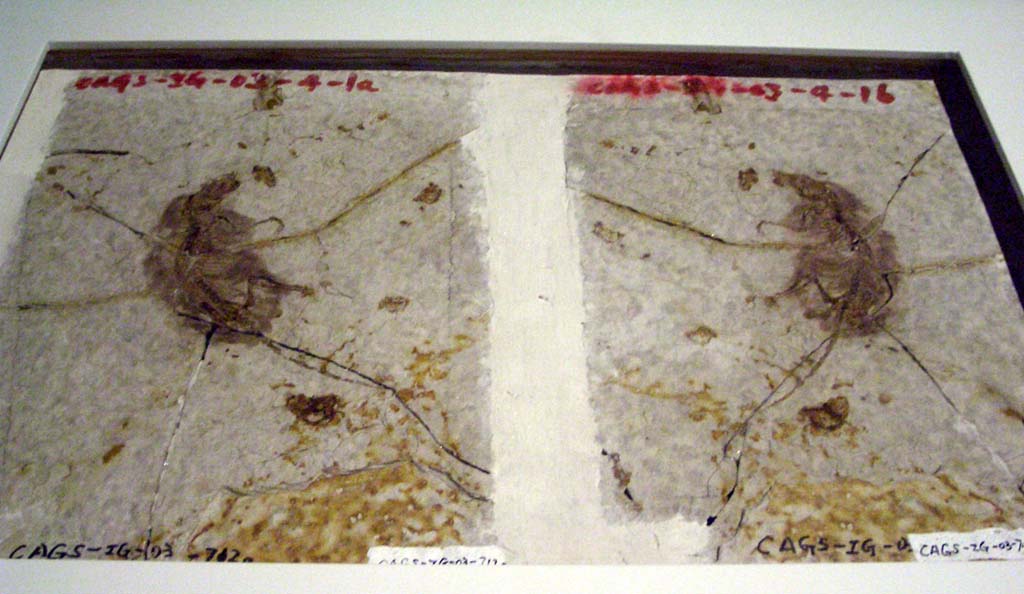


Anatomy and inferred lifestyle
The preserved specimen is small, with an estimated body length on the order of 15 cm and a mass of only a few dozen grams. The skeleton is accompanied by impressions of fur and some soft tissues, providing rare detail. Limb proportions and the morphology of the feet and claws suggest a scansorial or arboreal habit: it likely climbed trees or shrubs and moved with agility among branches. Dental and jaw features indicate an insectivorous diet, probably centered on insects and other small invertebrates, though small vertebrates and plant matter cannot be ruled out.
Discovery, preservation and age
Sinodelphys was described from a specimen recovered in rocks of the Yixian Formation, part of the Jehol Group known for exceptionally preserved fossils. Rapid burial by fine volcanic ash and silt under lacustrine and volcaniclastic conditions helped preserve delicate structures such as fur. The geological setting and radiometric dating of volcanic layers in the region place these deposits in the Lower Cretaceous, providing a relatively precise age for the specimen.
Significance for mammal evolution
This fossil is significant because it provides direct anatomical evidence of an early metatherian from Asia and shows that metatherian-type mammals had diversified by the Early Cretaceous. Its mosaic of characters helps paleontologists distinguish metatherian traits from those of early eutherians (placental-line mammals) and to reconstruct the early stages of the marsupial lineage. While Sinodelphys is not interpreted as a direct ancestor of modern marsupials, it represents an early branch of the broader metatherian radiation.
Comparisons and broader context
Sinodelphys is roughly contemporary with early eutherians known from the same deposits, such as Eomaia, and demonstrates ecological overlap between early mammal groups. Comparisons are often drawn with small modern marsupials (for example, opossums like those in the genus Didelphis) because of similar body size and presumed lifestyle, but important anatomical distinctions—especially in teeth, the pelvis and certain postcranial features—separate metatherians and eutherians. Interpreting evolutionary relationships from single specimens requires caution; additional fossils and broader sampling remain essential.
Fossil record and distribution of early metatherians
Although many later Mesozoic metatherians are known from North America and Asia, the group later diversified widely; metatherians are especially diverse in the Late Cretaceous and in Cenozoic faunas of South America and Australia. The discovery of an Early Cretaceous metatherian in Asia contributes to models of early mammal biogeography and suggests that key metatherian features evolved earlier than previously documented in some regions.
Research history and ongoing questions
The specimen was described in the early 2000s by a team working on Jehol fossils. Ongoing study addresses questions such as the precise placement of Sinodelphys within Metatheria, how representative the single specimen is of early metatherian diversity, and what the anatomy reveals about reproductive and life-history traits that are rarely preserved. New discoveries and reanalyses of existing material continue to refine these interpretations.
Further reading and related topics
- Mammal (general overview)
- Fossil preservation and taphonomy
- Lower Cretaceous time and environments
- Metatheria (clade information)
- Marsupials: modern representatives
- Fossil specimen records and repositories
- Placental mammals and early eutherians
- Yixian Formation geology
- Liaoning Province paleontology
- Fine-grained sedimentary environments
- Eomaia and other early eutherians
- Modern opossums and ecological analogues
- Didelphis and marsupial diversity
- Mesozoic ecosystems and faunal assemblages
- North American Mesozoic metatherians
- Asian fossil mammals
- Upper Cretaceous metatherian record
Questions and answers
Q: What is Sinodelphys?
A: Sinodelphys is an extinct mammal from the Lower Cretaceous that belongs to the infraclass Metatheria, which includes modern marsupials.
Q: How old is Sinodelphys?
A: Sinodelphys is estimated to be 125 million years old, making it almost contemporary to the earliest placental fossils.
Q: Where was Sinodelphys discovered?
A: It was discovered and described in 2003 in rocks of the Yixian Formation in Liaoning Province, China by a team of scientists.
Q: How large was Sinodelphys?
A: It grew only 15 cm (5.9 in) long and possibly weighed about 30 g (1.05 oz).
Q: What type of environment did Sinodelphys live in?
A: From its foot structure it is thought that Sinodelphys was a tree-dweller, like its non-marsupial contemporary Eomaia and modern opossums such as Didelphis.
Q: What did Sinodelphys eat?
A: It probably hunted worms and insects for food.
Q: When did most Mesozoic metatherians live?
A: Most Mesozoic metatherians lived during the Upper Cretaceous between 90-65 million years ago.
Related articles
Author
AlegsaOnline.com Sinodelphys — an Early Cretaceous metatherian from China Leandro Alegsa
URL: https://en.alegsaonline.com/art/90683
Sources
- nature.com : The earliest known eutherian mammal
- sciencemag.org : "An early Cretaceous tribosphenic mammal and metatherian evolution"
- doi.org : 10.1126/science.1090718
- pubmed.ncbi.nlm.nih.gov : 14671295
- news.bbc.co.uk : Oldest marsupial ancestor found
- news.nationalgeographic.com : Oldest marsupial fossil found in China
- carnegiemnh.org : Sinodelphys szalayi