
Barnard's Star: a nearby high–proper-motion red dwarf
Barnard's Star is a nearby, ancient red dwarf about 1.8 pc (≈6 ly) away, notable for the largest known stellar proper motion and for searches for planetary companions.
Overview
Barnard's Star is a very low-mass red dwarf star located in the northern sky within the constellation Ophiuchus. At a distance of roughly 1.8 parsecs (about six light‑years), it is one of the closest individual stellar objects to the Solar System. Despite its proximity, its apparent magnitude is around nine, so it is invisible to the unaided eye and is more readily detected at infrared wavelengths.
Image gallery
10 Images

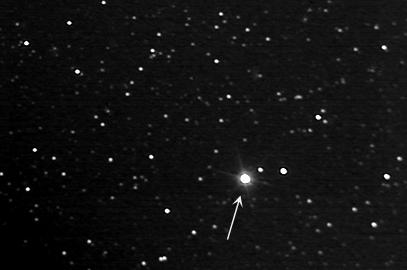






Physical characteristics
Barnard's Star is a cool M‑type dwarf (commonly listed as spectral type M4V) with a tiny fraction of the Sun's luminosity, a low surface temperature, and a mass much smaller than the Sun's. It is often described as an old or ancient star: chemical and kinematic indicators suggest it is significantly older than the Sun and relatively metal‑poor, implying formation early in the Galaxy's history. Its low intrinsic brightness makes it a classic example of the common, long‑lived stars that dominate the Milky Way by number.
Motion and discovery
The star is famed for its rapid apparent motion across the sky. In 1916 the American astronomer E. E. Barnard first measured its unusually large proper motion, about 10.3 arcseconds per year — the largest known for any star relative to the Sun. That high angular speed reflects both its proximity and its substantial space velocity compared with nearby stars. The distance to Barnard's Star is conventionally given as about 1.8 parsecs, placing it among the nearest stellar neighbors and making it the fourth-closest known individual star to the Sun after the components of the Alpha Centauri system.
Searches for planets
Because of its nearness and stability, Barnard's Star has been a frequent target in the search for planets. Mid‑20th century astrometric claims of companions were later attributed to instrumental effects. Modern precision radial-velocity surveys announced a candidate super‑Earth in 2018, but the detection has been debated and follow‑up work continues. The star remains an attractive target for ongoing planet searches and for studies of low‑mass planetary systems around M dwarfs.
Observational importance and notable facts
- Brightest in infrared relative to its visible light output, making infrared instrumentation particularly useful.
- Its large proper motion makes it useful for astrometric calibration and historical studies of stellar motion.
- Long lifespan of red dwarfs means Barnard's Star preserves information about an earlier era of the Galaxy.
Barnard's Star continues to be important for stellar astrophysics, nearby‑star catalogs, and exoplanet searches. Amateur and professional observers alike study it to refine its motion, measure its spectrum, and test techniques that may be applied to other faint, nearby stars.
References and further reading are available from catalogs and dedicated articles using the following pointers: red dwarf overview, stellar classification, constellation guide, Ophiuchus, E. E. Barnard, Barnard biography, proper motion studies, Solar System context, distance measures, nearby star lists, and Alpha Centauri system.
Questions and answers
Q: What is Barnard's Star?
A: Barnard's Star is a very low-mass red dwarf star located in the constellation of Ophiuchus, approximately six light-years away from Earth.
Q: How old is Barnard's Star?
A: Barnard's Star is very old.
Q: How fast is Barnard's Star moving?
A: Barnard's Star is moving relatively fast.
Q: What is the proper motion of Barnard's Star?
A: In 1916, the American astronomer E. E. Barnard measured Barnard's Star's proper motion as 10.3 arcseconds per year, which is the largest-known proper motion of any star relative to the Sun.
Q: Is Barnard's Star visible to the naked eye?
A: No, Barnard's Star is not visible with the unaided eye.
Q: How close is Barnard's Star to the Solar System?
A: Barnard's Star is about 1.8 parsecs away from the Solar System or just under six light-years away.
Q: Where does Barnard's Star rank among the nearest known individual stars to the Sun?
A: Barnard's Star is the fourth-closest known individual star to the Sun, after the three components of the Alpha Centauri system.
Related articles
Author
AlegsaOnline.com Barnard's Star: a nearby high–proper-motion red dwarf Leandro Alegsa
URL: https://en.alegsaonline.com/art/9034
Sources
- ui.adsabs.harvard.edu : 1917Natur..99..293.
- doi.org : 10.1038/099293a0
- ui.adsabs.harvard.edu : 1916AJ.....29..181B
- doi.org : 10.1086/104156
- ui.adsabs.harvard.edu : 2004AJ....127.2909D
- doi.org : 10.1086/383289
- ui.adsabs.harvard.edu : 2005AAS...206.0904R
- astronomy.com : "A Flare for Barnard's Star"
- astro.uiuc.edu : "Barnard's Star (V2500 Ophiuchi)"
- ui.adsabs.harvard.edu : 2001A&A...379..634G
- doi.org : 10.1051/0004-6361:20011330
- ui.adsabs.harvard.edu : 1994QJRAS..35....1M