
Barnacle (Cirripedia)
Barnacles are sessile crustaceans with hard calcareous plates that attach to submerged surfaces; they have a distinctive larval cycle and significant ecological and economic impacts.
Overview
Barnacles are a group of sessile crustaceans in the subclass Cirripedia. Unlike familiar free-moving crustaceans such as crabs or shrimp, adult barnacles are permanently attached to hard surfaces and are encased in hard plates made mostly of calcium carbonate. Their unusual appearance and stationary lifestyle once led naturalists to mistake them for molluscs, but anatomical and developmental studies place them firmly among arthropods.
Image gallery
10 Images



Form and anatomy
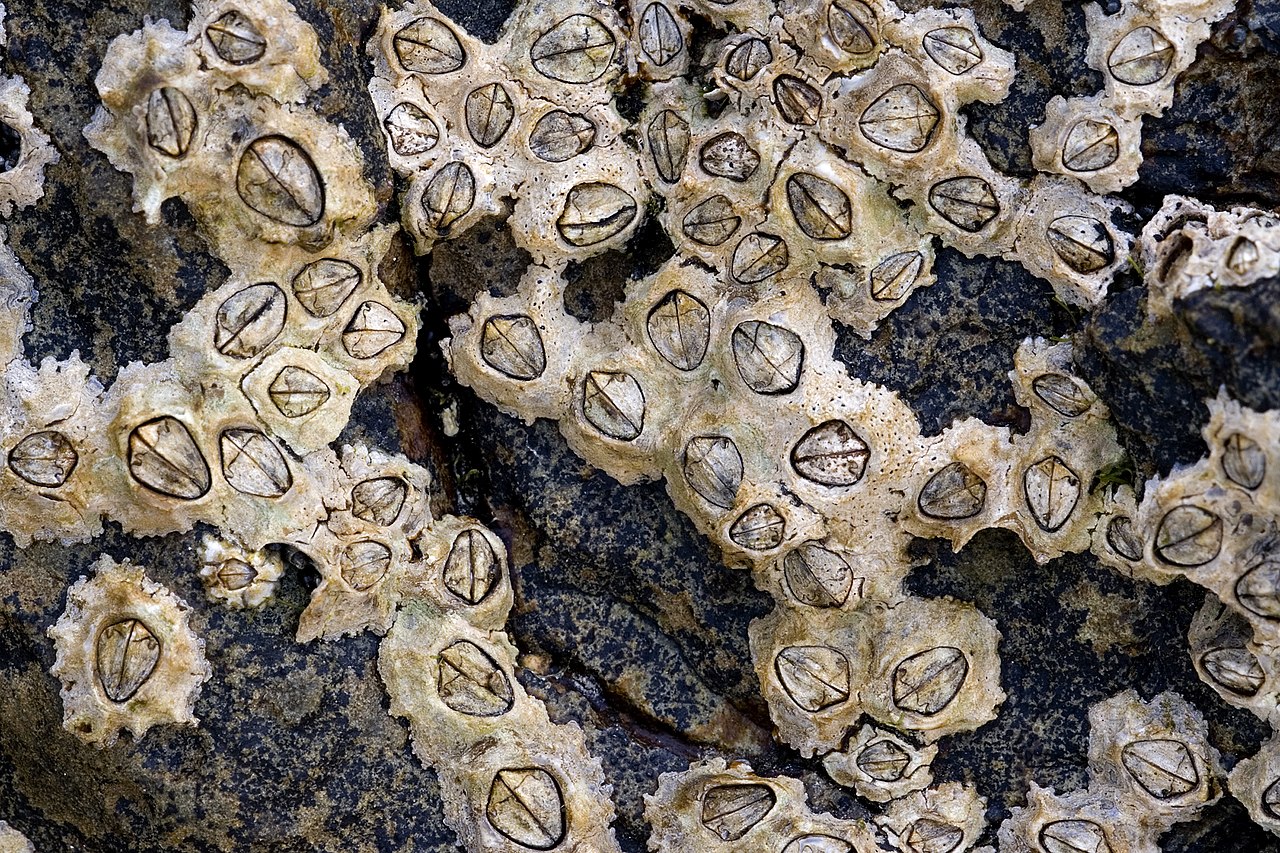
Most barnacles have a low, conical shell formed by overlapping plates; these are often called acorn barnacles. A minority are stalked and flexible, known as goose or lepadomorph barnacles. Inside the shell, the body uses feathery appendages called cirri to capture plankton and detritus from passing water. The base adheres extremely strongly to substrates through a proteinaceous cement that has attracted interest for biomimetic adhesives.
Life cycle and development
The barnacle life cycle includes free-swimming larval stages and a dramatic settlement phase. Early planktonic nauplius larvae molt several times, then transform into a non-feeding cypris (or cyprid) stage whose purpose is to find a suitable spot to attach. After attachment the cypris undergoes metamorphosis into the sessile adult. Observations of these larval stages in the 19th century by biologists such as J.V. Thompson, and later intensive studies by Charles Darwin, clarified their crustacean affinities.
Habitat, ecology, and interactions
Barnacles colonize a wide range of hard substrates: rocks, pier pilings, ship hulls, and the skins or shells of living animals like turtles and whales. They are common in intertidal zones but are also found in subtidal and deep-sea environments. As epibionts they may benefit from elevated feeding positions but can harm hosts by increasing drag or acting as vectors for other organisms. Predators and competitors, such as whelks, sea stars and some fish, help control barnacle populations in natural settings.
Human significance and notable facts
In human contexts barnacles are best known for biofouling: heavy barnacle growth on vessel hulls increases drag and fuel consumption, making control important for shipping and recreational boating. Management includes mechanical removal, smooth coatings, and antifouling paints. Beyond nuisance value, barnacles are studied for their tough adhesive and as ecological indicators of marine conditions. Historically, popular misconceptions included beliefs that some birds grew from barnacles; such stories reflect how unfamiliar life histories puzzled earlier observers.
Resources and further reading
- Classification and taxonomy
- Shell structure and composition
- Historical misidentifications
- Early larval observations
- Nauplius larvae
- Charles Darwin's barnacle research
- Intertidal ecology
- Barnacles on boats and ships
- Rocky shore communities
- Epibionts on turtles
- Whale barnacles and hosts
- Differences from crabs and shrimps
- Management and antifouling approaches
Questions and answers
Q: What is a barnacle?
A: A barnacle is a kind of crustacean that lives stuck to hard surfaces.
Q: What does a barnacle look like?
A: A barnacle does not look like a typical crustacean, as it is covered with hard plates of calcium carbonate.
Q: What was the initial misconception about barnacles?
A: For many centuries, barnacles were thought to be a mollusc instead of a crustacean.
Q: Who discovered the larvae of barnacles?
A: J.V. Thompson discovered the larvae of barnacles in the 1830s.
Q: What is the typical larva of crustaceans?
A: Crustaceans typically have a nauplius larva, which barnacles also have.
Q: Who confirmed Thompson's discovery about barnacles?
A: Charles Darwin confirmed J.V. Thompson's discovery that barnacles are a kind of crustacean.
Q: Where do barnacles grow?
A: Barnacles grow on hard surfaces like piers, boats, rocks, and on other animals such as turtles and whales.
Related articles
Author
AlegsaOnline.com Barnacle (Cirripedia) Leandro Alegsa
URL: https://en.alegsaonline.com/art/9027
Sources
- museum.vic.gov.au : "Biology of Barnacles"