
Siarnaq: Saturn's prograde irregular moon and largest member of the Inuit group
Siarnaq (Saturn XXIX) is a small, non-spherical prograde irregular moon of Saturn, discovered in 2000. It is the largest member of the Inuit group and is notable for its reddish color and likely collisional origin.
Siarnaq (Saturn XXIX, originally designated S/2000 S 3) is a small irregular satellite of Saturn. Discovered in late 2000, it orbits far beyond the planet's major regular moons and is classed as a prograde irregular satellite. Siarnaq is non-spherical, only a few dozen kilometres across, and is the brightest and largest known member of the so-called Inuit group of Saturnian satellites.
Image gallery
6 Images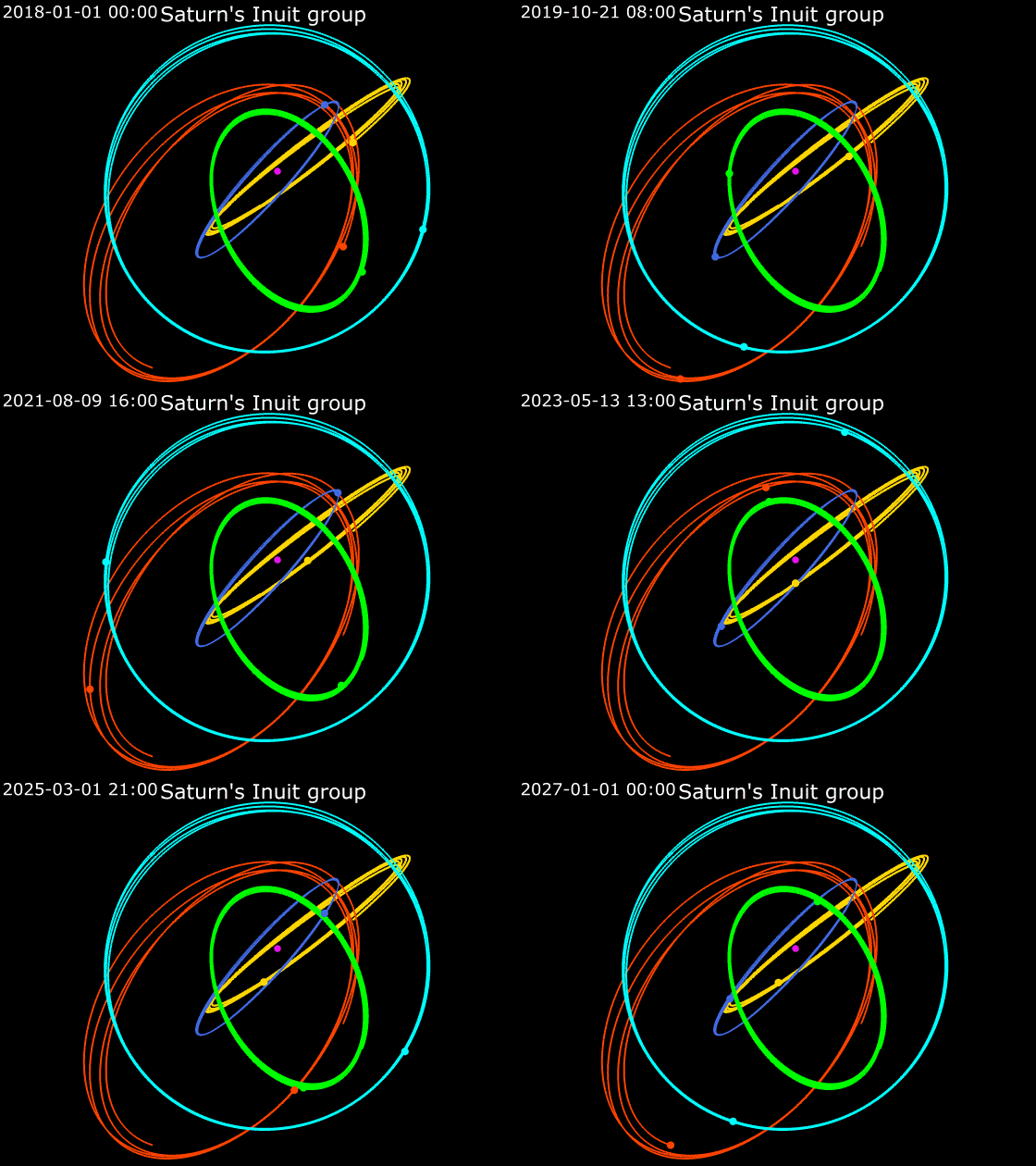


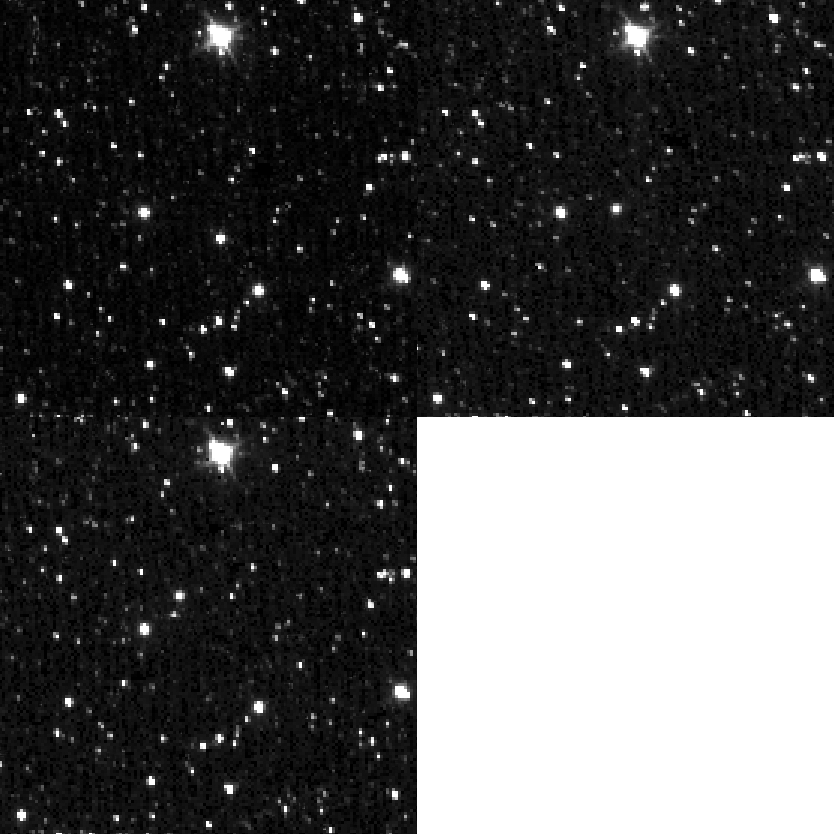

Physical characteristics
Siarnaq is estimated to be roughly 40 kilometres in diameter, though exact dimensions are uncertain because the object is small, distant and faint. Its shape is irregular rather than spherical, indicating it lacks sufficient gravity to pull itself into a rounded form. Photometric observations show a light-red surface color, a trait it shares with several other members of the Inuit group. Such coloration suggests a surface dominated by complex organics or irradiated ices, rather than the neutral or blue tones seen on some other irregular moons.
Orbit and dynamical group
The moon follows a distant, prograde orbit around Saturn at an average radius of about 17.5 million kilometres and completes one orbit in roughly 895 days. Its orbit is eccentric and inclined compared with Saturn's regular satellites, characteristics common to irregular moons that likely formed through capture or by break-up of a larger body. Siarnaq is the largest fragment in the Inuit dynamical family, a cluster of prograde irregular satellites that share similar orbital elements.
Discovery and name
Siarnaq was discovered by Brett J. Gladman and colleagues in 2000 and was provisionally designated S/2000 S 3. The name Siarnaq, adopted in 2003, derives from Inuit mythology, where Siarnaq (also associated with the deity Sedna in some accounts) figures as a powerful figure of the sea. The official naming reflected the convention of using names from northern indigenous cultures for members of this satellite group. For the discovery announcement and related data see discovery report and the classification as a non-spherical moon.
Origin and scientific significance
Siarnaq's reddish hue and orbital similarity to Paaliaq and Kiviuq have led researchers to propose a common origin: a larger progenitor body that was disrupted by a collision, producing multiple fragments that became the present-day Inuit satellites. Comparative studies of color and orbital dynamics support this collisional-family hypothesis. Investigating Siarnaq and its relatives helps astronomers understand capture processes, collisional evolution in the outer Saturn system, and the composition of small bodies in the giant-planet region. Visualizations of the orbits and eccentricity ranges are often shown in diagrams highlighting pericentre and apocentre differences; see a sample orbit illustration at orbit diagram.
Observing and notable facts
- Largest known member of Saturn's Inuit group and one of the brighter irregular satellites.
- Light-red surface colors match those of Paaliaq and Kiviuq, supporting a shared origin hypothesis.
- Small size and distant orbit make Siarnaq a challenging target for ground-based telescopes, but it remains important for studies of satellite families and outer-planet environments.
Continued photometry, spectral measurements and improved orbit determinations are the principal tools for refining knowledge of Siarnaq's composition, origin and relationship to other irregular satellites of Saturn.
Questions and answers
Q: What is Siarnaq?
A: Siarnaq is a non-spherical moon of Saturn.
Q: Who discovered Siarnaq?
A: Siarnaq was discovered by Brett J. Gladman, et al. in 2000.
Q: How was Siarnaq designated?
A: Siarnaq was given the designation S/2000 S 3.
Q: What is Siarnaq named after?
A: Siarnaq was named after the giant Siarnaq (also known as Sedna) in Inuit mythology.
Q: How big is Siarnaq?
A: Siarnaq is thought to be about 40 kilometres in diameter.
Q: What is the orbit of Siarnaq?
A: Siarnaq orbits Saturn at an average distance of 17,500,000 km in 895 days.
Q: What is the color of Siarnaq?
A: Siarnaq has light-red colors very similar to Paaliaq and Kiviuq, supporting that the moons formed during a break up of a bigger body.
Related articles
Author
AlegsaOnline.com Siarnaq: Saturn's prograde irregular moon and largest member of the Inuit group Leandro Alegsa
URL: https://en.alegsaonline.com/art/90153