
Shyok River — glacier-fed tributary of the Indus in Ladakh and Gilgit‑Baltistan
Glacier‑fed river rising from the Rimo/Siachen icefields, the Shyok flows through high Karakoram valleys of Ladakh and Gilgit‑Baltistan, joins the Indus and carries heavy seasonal sediment loads.
Overview
The Shyok River is a high‑altitude, glacier‑fed river of the eastern Karakoram. It originates from the Rimo ice tongues associated with the Siachen Glacier and flows through territories administered in the region of Ladakh and parts of the Pakistani‑administered Northern Areas, including sections of Ghanche District. The Shyok is one of the principal tributaries of the Indus system, contributing meltwater, sediment and seasonal flows to the lower Indus basin.
Image gallery
6 Images



Course and tributaries
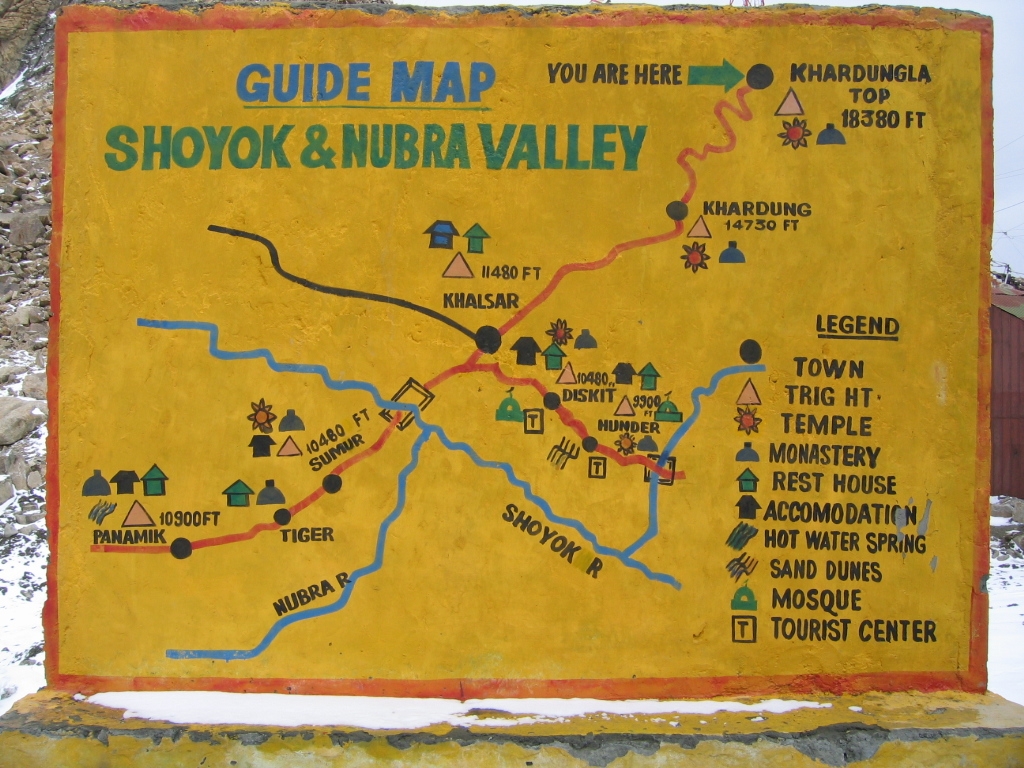
From its headwaters at the Rimo/Siachen icefields the Shyok initially flows broadly southeast. At the foot of adjacent ranges it performs a marked northwestward turn, so that its middle reaches run roughly parallel to the upper course. The river alternates between wide braided reaches and confined, steep gorges: after settlements such as Chalunka the valley narrows abruptly into a canyon before the river continues toward the confluence with the Indus near the Skardu area. A major tributary, the Nubra River, also drains from the Siachen region and joins the Shyok downstream, reinforcing its glacial character.
Geomorphology and sediments
The Shyok valley shows strong glacial and fluvial signatures. Heavy seasonal sediment transport from active headwall erosion and glacial abrasion produces thick Quaternary alluvial deposits in the wider valley floors. The unusual SE–then‑NW course of both the Shyok and the Nubra has been interpreted as reflecting inherited structural controls, possibly palaeofault lines trending NW–SE that influenced valley incision and river capture over geological time. These sediments and structures make the basin valuable for studies in geomorphology and tectonics.
Hydrology and climate
Glacier melt dominates the Shyok's discharge regime. Flows rise strongly in late spring and summer as seasonal melting accelerates; winters are cold and baseflow is low. This seasonality drives braided channel patterns in broad reaches and concentrates erosive power during melt pulses. The area is subject to arid to semi‑arid continental climate at valley floor elevations, with much of the river's water supplied from high‑altitude ice and seasonal snow.
Ecology and land use
Despite the harsh environment, the Shyok corridor supports riparian meadows, willow and poplar scrub where irrigation and seasonal grazing are possible. Local pastoralists and small farming communities use river water for limited cultivation and livestock. Vegetation and wetlands along the river are important seasonal habitats for birds and high‑altitude wildlife. Human settlement is sparse because of elevation, climate and limited arable land.
Human, strategic and infrastructure context
Settlements along the river are few — villages such as Chalunka and Tirit lie within the corridor — and the valley has long been a route between mountain passes. The basin's strategic sensitivity is heightened by proximity to contested frontiers and the Siachen area. Proposals for hydropower and irrigation are periodically discussed, but large‑scale development is constrained by remoteness, steep terrain, glacial dynamics and cross‑border political issues.
Research, hazards and conservation
Scientists study the Shyok for its glaciology, sedimentary records and regional tectonic history; the thick sequences of Quaternary deposits preserve information about past glacial advances and climate. The river system also presents hazards common to high mountain environments, including rapid flood rises during melt seasons and the potential for glacial lake outburst floods (GLOFs) where conditions permit. Conservation and risk‑reduction efforts emphasize monitoring of glaciers, sediment transport and community preparedness.
Key points
- Origin: fed by the Rimo tongues of the Siachen Glacier and other high icefields.
- Course: unusual SE then NW alignment, alternating braided valleys and narrow gorges.
- Tributary: receives the Nubra and contributes to the Indus system.
- Regions: flows through parts of Ladakh and the Northern Areas, including Ghanche District.
- Importance: significant sediment supply, geomorphological record and local water resource.
Readers seeking detailed maps, hydrological records or current research can consult specialized publications and regional authorities for up‑to‑date data and operational guidance. The Shyok remains a focus for multidisciplinary study because it links glacial processes, mountain tectonics and human adaptation in a politically complex frontier region.
Questions and answers
Q: Where does the Shyok River flow through?
A: The Shyok River flows through the Disputed Area Ladakh and the Northern Areas of Pakistan.
Q: From where does the Shyok River originate?
A: The Shyok River originates from the Rimo glacier, which is one of the tongues of the Siachen Glacier.
Q: What happens to the Shyok River at the confluence with the Nubra River?
A: The Shyok River becomes very wide at the confluence with the Nubra River, which is a tributary of Shyok and originates from Siachen Glacier.
Q: In which direction does the Shyok River flow from the Rimo glacier?
A: The Shyok River flows in a southeast direction from the Rimo glacier.
Q: Where does the Shyok River join the Indus?
A: The Shyok River joins the Indus at Skardu in Pakistan.
Q: What geological significance do the Indus and Shyok rivers have?
A: The importance of the Indus River and the Shyok rivers is in the deposition of a huge thickness of Quaternary sediments, which is a treasure trove for geology researchers.
Q: How does the similarity in the courses of the Shyok and Nubra rivers indicate a series of fault lines?
A: The similarity in the courses of the Shyok and Nubra rivers probably indicates a series of palaeo fault lines trending northwest-southeast, delimiting the upper courses of the rivers.
Related articles
Author
AlegsaOnline.com Shyok River — glacier-fed tributary of the Indus in Ladakh and Gilgit‑Baltistan Leandro Alegsa
URL: https://en.alegsaonline.com/art/90135