
Shushi Massacres (Shusha), March 1920
Violent intercommunal attack on the Armenian population of Shusha (Shushi) in March 1920; contested casualty figures and major consequences for the town and Nagorno‑Karabakh.
The Shushi massacres refer to a wave of violent attacks against the Armenian residents of Shusha (Armenian: Shushi) in the Karabakh region during March 1920. Accounts agree that the events took place over several days and resulted in the deaths of many civilians, extensive damage to the Armenian quarter of the town, and a substantial outflow of survivors. Different sources offer widely varying casualty estimates and contrasting interpretations of responsibility and sequence.
Image gallery
4 Images


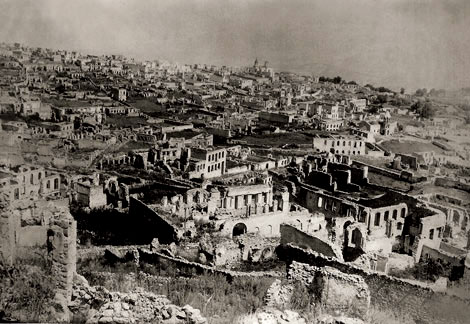
Background
The violence occurred in the chaotic aftermath of World War I and the collapse of imperial authority in the South Caucasus, when competing national claims and armed groups operated in the area. Shusha was a mixed town with significant Armenian and Azerbaijani (Azeri) communities and had been a focal point of earlier ethnic tensions. Political developments in 1918–1920, rising communal tensions, and the presence of military units and irregular fighters contributed to an environment in which large-scale violence became possible.
Events and immediate effects
Contemporary and later narratives describe attacks on Armenian neighborhoods, looting, burning of homes and businesses, and killings of civilians. Many residents were killed or fled; Armenian cultural and religious sites in parts of the town were damaged. Estimates of fatalities vary by source; some Armenian accounts cite figures as high as 20,000, while other studies and contemporaneous reports produce lower numbers. The exact scale is debated among historians.
Aftermath and significance
The massacres changed the demographic and political character of Shusha and are frequently cited in accounts of the long-running Armenian–Azerbaijani dispute over Nagorno‑Karabakh. The events of March 1920 are remembered differently in Armenian and Azerbaijani narratives and have been referenced in later intercommunal disputes and diplomatic discussions. They also preceded the Sovietization of the region later in 1920–1921, which altered local governance and borders.
Key points and perspectives
- Location: Shusha (Shushi), Nagorno‑Karabakh region; known in Armenian as Shushi and in Azerbaijani as Shusha.
- Timing: March 22–26, 1920 is the commonly cited period in many accounts; see March 22 and March 26 references in period reports.
- Victims: primarily Armenian civilians; the event is often described as a pogrom or massacre in scholarship and memorial accounts.
- Allegations: contemporary accounts attribute participation to Azerbaijani (Azeri) forces and allied irregulars; some narratives also mention involvement of Ottoman or Turkish elements and various local groups; see links for differing perspectives: Azeri, Turkish, and local actors.
- Contextual sources: scholars reference the wider Armenian–Azerbaijani conflicts of 1918–1920 and earlier communal violence in the region; general background is available under 1920-era studies and regional histories.
Because the historical record includes conflicting eyewitness reports, political claims, and differing archival materials, researchers treat casualty figures and responsibility with caution. The Shushi massacres remain a significant and contested episode in Caucasus history and are frequently cited in discussions of memory, minority protection, and the roots of later conflicts over Nagorno‑Karabakh. For broader context and primary documents, readers may consult regional histories and archival compilations indicated by the following references: pogrom studies, Nagorno‑Karabakh, and other specialized works (Armenian and dated accounts).
Questions and answers
Q: What were the Shushi massacres?
A: The Shushi massacres were anti-Armenian pogroms during the Armenian-Azerbaijani war in 1920, when Azeri and Turkish army soldiers with participation of Kurdish gangs attacked the inhabitants of Shusha (Shushi).
Q: When did the Shushi massacres take place?
A: The Shushi massacres took place between March 22-26, 1920.
Q: How many Armenian deaths resulted from the Shushi massacres?
A: The Shushi massacres resulted in more than 20,000 Armenian deaths.
Q: Why did the Shushi massacres occur?
A: The Shushi massacres occurred during the Armenian-Azerbaijani war, as Azeri and Turkish army soldiers, along with participation of Kurdish gangs, attacked the inhabitants of Shusha (Shushi) in an anti-Armenian pogrom.
Q: What was the result of the Shushi massacres?
A: The result of the Shushi massacres was the destruction of the town of Shusha in Nagorno-Karabakh.
Q: What is Nagorno-Karabakh?
A: Nagorno-Karabakh is a region in the South Caucasus, internationally recognized as part of Azerbaijan but controlled by ethnic Armenians since the early 1990s.
Q: Who were the perpetrators of the Shushi massacres?
A: The perpetrators of the Shushi massacres were Azeri and Turkish army soldiers, along with participation of Kurdish gangs.
Related articles
Author
AlegsaOnline.com Shushi Massacres (Shusha), March 1920 Leandro Alegsa
URL: https://en.alegsaonline.com/art/90118
Sources
- magazines.russ.ru : magazines.russ.ru
- publications.parliament.uk : publications.parliament.uk/pa/ld199798/ldhansrd/vo970701/text/70701-19.htm
- nesl.edu : nesl.edu
- klassika.ru : klassika.ru