
A Brief History of Time — book overview and significance
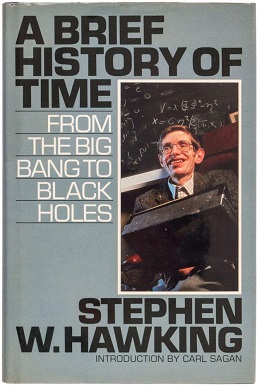
A Brief History of Time (1988) by Stephen Hawking popularized cosmology for general readers, explaining the big bang, black holes, time's arrow and efforts to find a unified theory.
Overview
A Brief History of Time is a popular science book first published in 1988 that introduces key ideas in modern cosmology to a general audience. Written by Stephen Hawking, a prominent theoretical physicist and cosmologist, the book aims to explain complex subjects—such as the origin and fate of the universe, space-time, and black holes—without requiring a technical background. Its clear, conversational tone and broad scope helped bring concepts from academic physics into public discussion.
Image gallery
9 Images



Main themes and content
The book surveys a sequence of fundamental topics in cosmology and theoretical physics, blending history, conceptual explanation and basic equations. Readers encounter:
- Models of the universe and the big bang as the prevailing cosmological framework.
- The nature of space and time, including the idea of space-time as described by general relativity.
- Black holes, their properties and the surprising theoretical result that they can emit radiation in a quantum mechanical context.
- The interplay between quantum mechanics and gravity, and why a single unified description remains a major scientific goal.
- Questions about the arrow of time, the role of entropy, and the conditions that set the universe’s large-scale behavior.
Style, structure and approach
Hawking wrote with the explicit intent of reaching readers without specialized training. The book minimizes technical derivations while offering conceptual sketches and a few readable equations to indicate how scientists reason about deep questions. This approach balances accessible narrative, historical anecdotes about earlier pioneers, and brief technical remarks that invite curious readers to explore further in textbooks or scholarly papers.
Editions, adaptations and related works
Because of its popularity, the original text has seen updated and alternative editions. An Illustrated A Brief History of Time adds diagrams and photographs to clarify ideas, and A Briefer History of Time is a more concise edition intended for readers seeking a shorter introduction. Collectively these versions have been used in classrooms, public lectures and introductory reading lists to present foundational concepts in modern cosmology.
Reception, influence and notable facts
The book reached a wide international readership and contributed significantly to public interest in cosmology and theoretical physics. It spent a prolonged time on bestseller lists (notably the London Sunday Times), brought scientific themes into mainstream conversation, and helped establish the author as an important public scientist. While praised for clarity and ambition, the work has also attracted critical discussion over the inevitable simplifications involved when complex mathematics is translated into popular prose.
Legacy and distinctions
Beyond sales and recognition, the book is often cited as a landmark in science communication: it demonstrated that advanced scientific topics could be presented engagingly to broad audiences. Readers who wish to pursue the subjects introduced there can follow up with technical texts, lectures, or online materials; the book remains a frequent starting point for those curious about the ongoing search for a more complete understanding of the universe.
For more background on the author and related material see: biographical and mathematical context, and additional explanatory resources at cosmology introductions.
Questions and answers
Q: Who wrote A Brief History of Time?
A: The book was written by the scientist and mathematician Stephen Hawking.
Q: What is the subject of the book?
A: The subject of the book is cosmology, or the story of the universe.
Q: Are there other versions of this book?
A: Yes, there are two other versions - The Illustrated A Brief History of Time and A Briefer History of Time.
Q: How does The Illustrated A Brief History of Time differ from the original version?
A: The Illustrated A Brief History of Time has pictures to help explain its ideas, and it was also updated with new information that had been found since its initial publication.
Q: How is A Briefer History of Time different from the first version?
A: A Briefer History of Time is shorter than the original version, and it was also updated with new information that had been found since its initial publication.
Q: Is this book popular and well-known?
A: Yes, this book is very popular and well-known. It was on the London Sunday Times bestseller list for over 4 years.
Q: How long did this book stay on London Sunday Times bestseller list?
A: This book stayed on London Sunday Times bestseller list for over 4 years.
Tags
Related articles
Author
AlegsaOnline.com A Brief History of Time — book overview and significance Leandro Alegsa
URL: https://en.alegsaonline.com/art/9