
Plant shoots: definition, structure, development and uses
A shoot is the above-ground new growth of a plant — stems with their leaves, buds and flowers. This article explains shoot structure, development from seed, seasonal growth, uses and distinctions.
Overview: In botany, a shoot is the above-ground axis of a vascular plant that includes the stem together with its leaves, lateral buds, flowering stems and flower buds. The term covers both the first upward growth after a seed begins germination and the new stems or flower primordia produced each season on established plants. In casual speech people often use "shoot" and "stem" interchangeably, but in technical contexts a shoot is a composite structure that carries leaves and buds as well as the supporting stem.

Image gallery
9 Images


Development and seasonal growth
The earliest shoot of a seedling develops from embryonic tissues and differentiates into the parts that will form foliage and reproductive structures. During germination the shoot emerges and grows toward light, forming nodes, internodes and leaves; this stage may be described with terms such as hypocotyl or epicotyl in seedlings. In many temperate species perennial shoots appear in spring as renewed herbaceous growth from the ground or as new woody stems and flowering shoots on shrubs and trees. Gardeners and growers monitor shoot growth to time pruning, training and protection from frost.Structure and parts
Key components of a shoot include:- Stem: the central axis that conducts water, nutrients and sugars (stem).
- Nodes and internodes: points where leaves and buds attach, and the segments between them.
- Leaves and petioles: the photosynthetic organs borne by the shoot.
- Buds: apical and lateral buds that can form branches, leaves or flowers (flower buds).
- Apical meristem: a concentrated region of dividing cells at the shoot tip that drives elongation.
Uses, examples and importance
Shoots are central to plant growth, reproduction and human use. Young shoots are harvested as vegetables in some cultures (for example bamboo or certain tuberous plants), and shoots are the focus when propagating plants by cuttings because they contain active meristems. In agriculture and horticulture management of shoot number and vigor affects yield and form—for instance, training shoots of fruit trees encourages fruiting spurs. Practical examples include the upward cucumber shoot with tendrils (cucumber), seedling shoots of the sunflower, and young shoots of orchard trees such as avocado.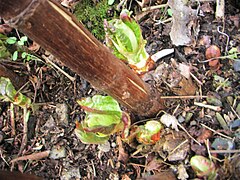
Distinctions and notable facts
Botanical and everyday usage differ: scientifically a shoot comprises stems plus their attached organs, while casually it may simply mean a new stem. Shoots contrast with roots because they principally capture light and produce leaves, whereas roots absorb water and anchor the plant. Some shoots are edible, others can be toxic if raw, so identification matters for foragers. For more on growth and anatomy, see introductory resources: botany overview, seedling development at germination, perennial growth notes at perennial references, and cultivation guidance for common examples such as cucumber and sunflower.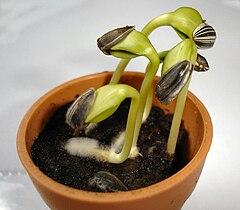
 Seed biology and stem structure are useful follow-ups for readers who want more technical detail.
See also
- Offspring
- Sapling
Questions and answers
Q: What is a shoot in botany?
A: In botany, shoots are stems plus the leaves and lateral buds, flowering stems and flower buds.
Q: What is an example of a shoot?
A: Examples of shoots include the new growth from seed germination that grows upward on herbaceous plants or the new stem or flower growth on woody plants.
Q: Are shoots and stems synonymous?
A: Yes, in everyday speech, shoots are often synonymous with stems.
Q: What is an example of an edible shoot?
A: Edible shoots of Sachaline are one example.
Q: How do sunflower seedlings germinate?
A: Sunflower seedlings germinate by sprouting from their seeds into small plants.
Q: What does a young hass avocado shoot look like? A: A young hass avocado shoot looks like a small plant with leaves growing from its stem.
Related articles
Author
AlegsaOnline.com Plant shoots: definition, structure, development and uses Leandro Alegsa
URL: https://en.alegsaonline.com/art/89969