
Shikasta (1979): Doris Lessing’s speculative novel and the Canopus sequence
Shikasta (1979) is the first novel in Doris Lessing’s Canopus in Argos sequence: a documentary‑style, mythic science fiction work that reframes human history, spiritual themes and 20th‑century catastrophe.
Shikasta, first published in 1979, is a major and controversial work by British novelist Doris Lessing and the opening volume of her five‑book Canopus in Argos cycle. Written after Lessing had established herself in realist fiction and shortly before she received the Nobel Prize in Literature, the book marks a deliberate turn toward speculative writing and is commonly classified as a science fiction piece. The title names both the fictional world the volume chronicles and the particular mode of presentation Lessing adopts: a compilation of reports, transmissions and administrative documents produced by higher intelligences observing and intervening in the planet’s affairs.
Image gallery
2 Images
Narrative structure and synopsis
Rather than following a single hero, Shikasta is assembled from fragmentary material presented as the archival records of a Canopean emissary, Johor (also named George Sherban in parts of the text), and other observers. The book frames planetary history as shaped by contact with three interstellar powers — Canopus, Sirius and their rival, Puttiora — who influence social, spiritual and biological developments on Shikasta. The narrative traces the planet’s arc from formative prehistory through long decline to the disruptive twentieth century, which Lessing labels the "Century of Destruction," and toward an apocalyptic crisis sometimes framed in the text as a global war or cataclysmic breakdown of civil order.
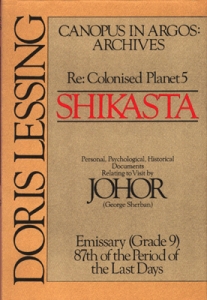
The book’s formal subtitle presents the material as "personal, psychological, historical documents" associated with an emissary’s mission. This documentary device allows Lessing to compress stories of individuals, families and societies into a broad, often allegorical history. Episodes range from intimate case studies of moral and psychological disintegration to panoramic accounts of imperial policy and cosmic management. The result is a text that reads partly as science fiction, partly as mythic retelling and partly as a set of philosophical meditations on decline and recovery.
Themes and sources
Shikasta interweaves religious imagery, psychoanalytic ideas and mystical thought. It borrows patterns and episodes from traditions associated with the Old Testament and other scriptural materials and reframes them within a bureaucratic, interstellar cosmology. At the same time, Lessing drew on spiritual and mystical currents she had been exploring, including strands of Sufism and broader spiritual inquiry, to address questions of human agency, the nature of evil and the possibility of transformation.
Central thematic concerns include colonial and post‑colonial power dynamics, the psychology of mass society, the effects of technological and ideological change, and the tension between externally imposed order and human autonomy. The book presents a recurring moral: long‑term decline can be both a historical process and the result of decisions by powerful external actors, a formulation that prompted debate about whether Lessing was denying human free will or offering a metaphor for structural forces that shape behavior.
Publication, reception and controversy
Alfred A. Knopf issued the novel in the United States in October 1979; Jonathan Cape published it in the United Kingdom the following month. The book’s departure from Lessing’s earlier realism provoked mixed reactions. Some critics praised its ambition, breadth and the boldness of its imaginative framework; others found it bleak, heavy‑handed or didactic. Interpretations differed over the status of the novel’s apocalyptic material, which some readers likened to a depiction of a global conflict sometimes referred to in commentary as a vision of World War III or an explicitly stated Apocalypse. Debates also focused on Lessing’s engagement with non‑Western spiritual traditions and whether that engagement enhanced or undermined the narrative.
Place in the Canopus in Argos sequence
Shikasta is the first volume in a loosely connected five‑book sequence that explores the same events from differing cosmic viewpoints and extends the project of speculative historical reconstruction. The other volumes address related experiments and parables, and several revisit events or concepts introduced in Shikasta:
- The Marriages Between Zones Three, Four and Five (1980) — a parable about cultural contact and transformation;
- The Sirian Experiments (1980) — which retells parts of Shikasta’s story from Sirius’s perspective;
- The Making of the Representative for Planet 8 (1982) — a shorter, elegiac account of duty and loss;
- The Sentimental Agents in the Volyen Empire (1983) — a satirical exploration of propaganda and perception.
Interpretation and legacy
Shikasta continues to attract scholarly attention because of its hybrid form and its willingness to mix myth, social critique and speculative cosmology. Readers and critics have examined the book as a political allegory about twentieth‑century violence and colonialism, as a metaphysical parable about spiritual decline and redemption, and as an experiment in narrative form that tests the limits of what a novel can do. Lessing’s use of an archival mode invites interpretive work: the book rewards close reading, comparative study and attention to its shifting perspectives.
Although the novel remains polarizing, it is widely acknowledged as an ambitious attempt to bring together large historical questions and intimate human stories. For readers interested in Lessing’s later career, in mid‑century experiments with allegory and parable, or in the intersections of spiritual inquiry and speculative fiction, Shikasta offers a densely layered, provocative text whose echoes appear throughout the subsequent volumes in the Canopus in Argos series.
For further contextual reading and critical commentary, consult resources and introductions associated with editions of the novel and the Canopus cycle; these materials often address Lessing’s intellectual influences, her engagement with Islamic mystical sources, and continuing spiritual and philosophical debates about the work. Academic and critical discussions also consider the role of narrative form and genre boundaries in shaping how Shikasta has been received over time, and how its themes continue to resonate with contemporary readers.
Questions and answers
Q: What is the full title of Shikasta?
A: The full title of Shikasta is Re: Colonised Planet 5, Shikasta.
Q: Who wrote the novel?
A: British Nobel Prize in Literature-winner Doris Lessing wrote it as the first book in her five-book Canopus in Argos series.
Q: When was the novel published?
A: Alfred A. Knopf published it first in the United States in October 1979 and Jonathan Cape published the book in the United Kingdom in November 1979.
Q: What are some themes explored by Lessing in this novel?
A: The novel explores prehistory, how things became worse, a "Century of Destruction" (the 20th-century), and an Apocalypse (World War III). It also uses stories and images from Old Testament and is influenced by spiritual and mystical themes from Sufism.
Q: How did readers respond to this shift away from realism to science fiction?
A: Many readers were unhappy with this change away from realism to science fiction. Critics gave mixed reviews; some were impressed by its wide view of humanity while others disliked it because it was depressing and showed that humanity had no free will.
Q: What other books are part of this series?
A: Other books part of this series include The Marriages Between Zones Three, Four and Five (1980), The Sirian Experiments (1980) and The Making of the Representative for Planet 8 (1982).
Q:What is Shikasta about ? A:Shikasta is a 1979 science fiction novel about a fictional planet featured under influence of three galactic empires - Canopus, Sirius, Puttiora - which are recorded by Canopean visitors .
Related articles
Author
AlegsaOnline.com Shikasta (1979): Doris Lessing’s speculative novel and the Canopus sequence Leandro Alegsa
URL: https://en.alegsaonline.com/art/89773
Sources
- time.com : "Visit to a Small Planet"