
Sherman's March to the Sea (Savannah Campaign, November–December 1864)
Union General William T. Sherman's 1864 campaign from Atlanta to Savannah that used deep raids and destruction of infrastructure to undermine the Confederacy's war capacity.
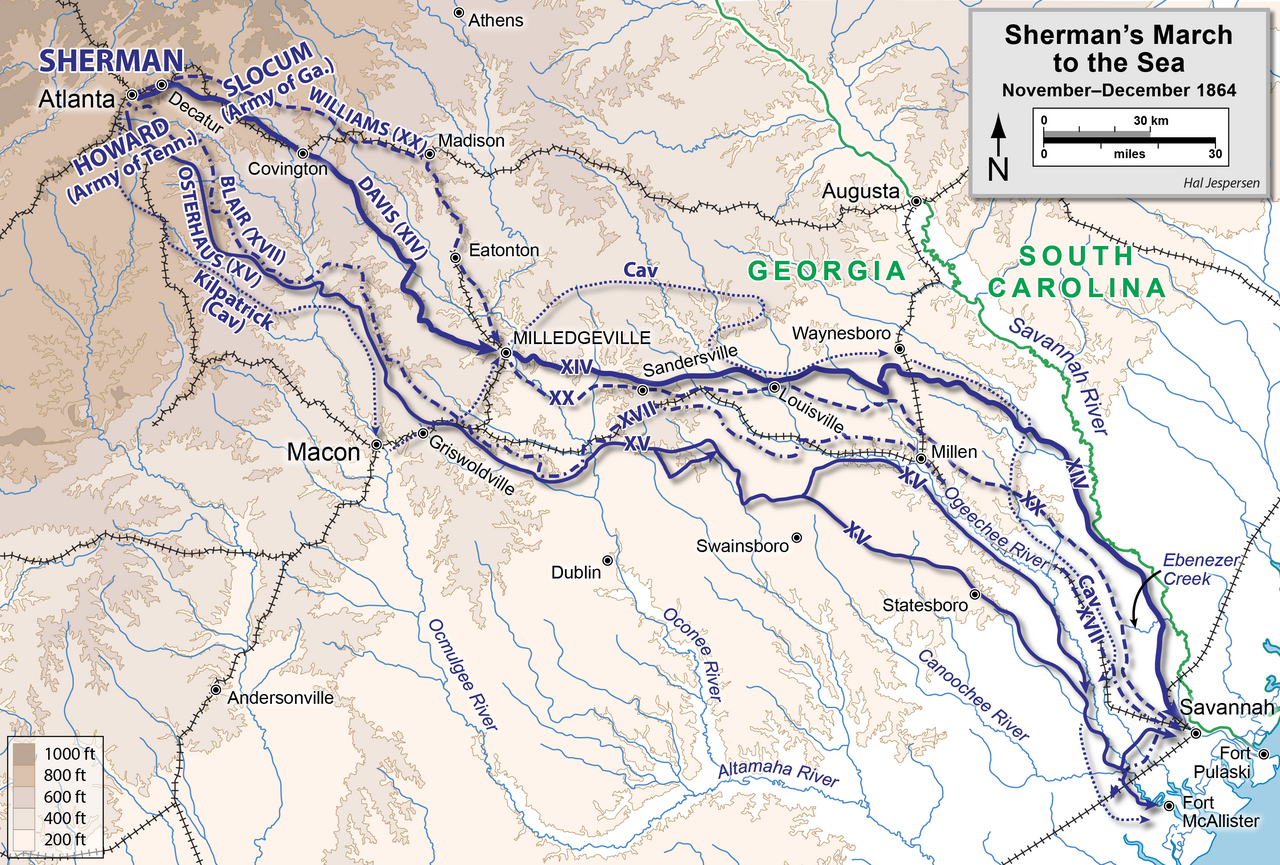
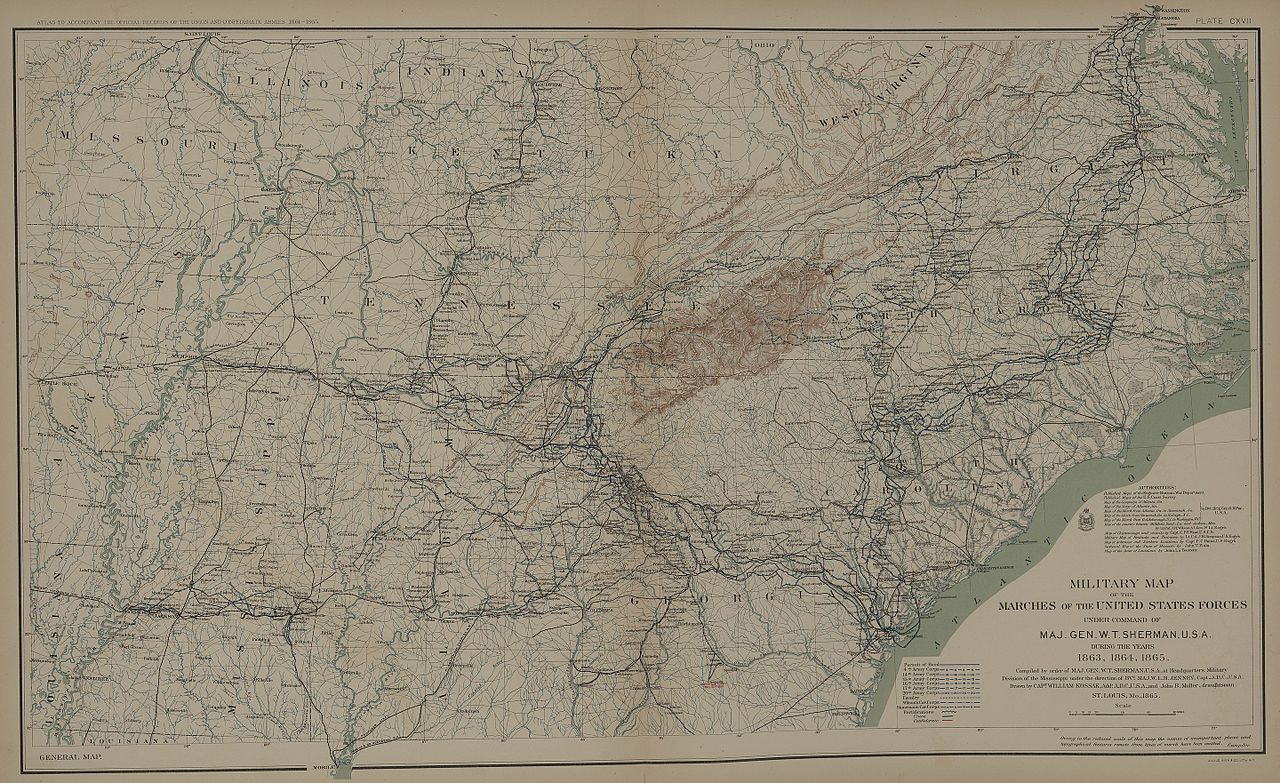
The campaign commonly called Sherman's March to the Sea was a decisive Union operation in late 1864 that ran from mid-November until the capture of Savannah on December 21. Often referred to in military histories as the Savannah Campaign, it took place during the wider conflict of the American Civil War and moved across large portions of Georgia. The expedition was led by Maj. Gen. William T. Sherman commanding elements of the Union Army, and it combined maneuver, scorched-earth tactics, and the seizure of supply points to hasten Confederate collapse.
Image gallery
8 Images




Background and objectives
After capturing Atlanta, Sherman decided to advance southeastward rather than pursue Confederate forces conventionally. His aims were both military and psychological: to destroy railroads, warehouses and other infrastructure that supported the Confederacy; to cut supply lines; and to demonstrate that large-scale operations deep in enemy territory were feasible. Rather than carry long supply trains, Sherman's columns lived off the land and relied on foraging supported by cavalry screens and smaller infantry detachments.
Methods and actions
Sherman's forces targeted both obvious military targets and economic resources — depots, factories, mills and transportation hubs — while avoiding protracted sieges. They tore up railroad tracks, burned bridges and confiscated food and livestock. This approach is often associated with the doctrine labeled by contemporaries and later historians as a form of strategy of total war, though Sherman framed much of the action as necessary to defeat the enemy's capacity to wage war rather than to punish civilians indiscriminately.
Immediate results and effects
The operation culminated with the Union occupation of the port city of Savannah, which provided a valuable logistical and political prize. The march severely disrupted Confederate transportation and supply networks, weakened morale in the Deep South, and freed Union forces for further operations in the Carolinas. It also stimulated debate about the ethics and military utility of hard-hitting raids into civilian hinterlands and the deliberate destruction of economic resources.
Legacy and notable aspects
- Military innovation: The campaign is a prominent example of deep-penetration raids that rely on mobility rather than extended supply lines.
- Economic impact: Systematic disruption of logistics and supply lines contributed to shortening the war by denying materiel to Confederate armies.
- Controversy: Sherman’s methods provoked enduring debate over civilian suffering, property destruction, and the limits of acceptable wartime measures.
Historians continue to assess Sherman's March in the context of military effectiveness, social consequences and its symbolic place in American memory. The campaign demonstrated how destruction of infrastructure and control of territory could be used to achieve strategic ends in a continent-wide civil war, and it influenced later discussions of modern warfare, logistics and the relationship between armies and civilian populations.
Questions and answers
Q: What was the name of the military campaign led by Maj. Gen. William Tecumseh Sherman during the American Civil War?
A: The name given to the military campaign was Sherman's March to the Sea.
Q: When did Sherman's March to the Sea take place?
A: The military campaign lasted from November 15 to December 21, 1864.
Q: Where did Sherman's troops leave from at the start of the campaign?
A: Sherman's troops left the captured city of Atlanta, Georgia, at the start of the campaign.
Q: How did Sherman's March to the Sea end?
A: The campaign ended with the capture of the port of Savannah on December 21.
Q: What did Sherman's army do during the March to the Sea?
A: His army burned military targets along with stores, other businesses, and the homes of the people who lived in their path.
Q: What was the impact of Sherman's March to the Sea on the Confederacy?
A: Sherman's March to the Sea ruined the Confederacy's economy and its means of traveling.
Q: How did Sherman's strategy change American war strategy?
A: Sherman's plan of action of fighting deep inside enemy territory without any extra supplies changed American war strategy.
Related articles
Author
AlegsaOnline.com Sherman's March to the Sea (Savannah Campaign, November–December 1864) Leandro Alegsa
URL: https://en.alegsaonline.com/art/89703
Sources
- ebooks.library.cornell.edu : Savannah Campaign Union order of battle (Official Records, Series I, Volume XLIV, pages 19-25)
- ebooks.library.cornell.edu : Effective strength of the army in the field under Maj. Gen. William T. Sherman, November and December, 1864 (Official Records, Series I, Volume XLIV, page 16)
- ebooks.library.cornell.edu : Abstract from return of the Department of South Carolina, Georgia and Florida, Lieut. Gen. W.J. Hardee commanding, November 20, 1864 (Official Records, Series I, Volume XLIV, page 874)