
She-Hulk
She-Hulk (Jennifer Walters) is a Marvel Comics superhero and lawyer who gains Hulk-like powers. Known for retaining her personality, legal career, and meta-humor, she has appeared in comics and on-screen adaptations.
Overview
She-Hulk is the alter ego of Jennifer Walters, a fictional superhero appearing in American comic books. She first emerged in the early 1980s and is most commonly associated with Marvel Comics. Unlike many comic characters who begin as ordinary citizens, Walters combines a professional life as an attorney with the exceptional physical strength and resilience usually associated with the Hulk family of characters.
Image gallery
6 Images


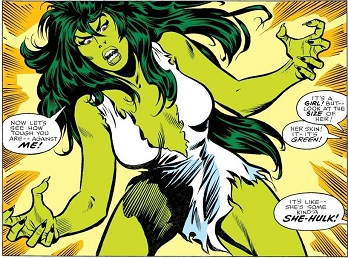

Origin and transformation
Jennifer Walters is introduced as a lawyer and cousin to Bruce Banner (the Hulk). Following a severe injury in which she suffers major blood loss, her life is saved when Banner provides a transfusion of his blood. Because Banner's blood carries the effects of gamma radiation, the transfusion produces a form of the same condition that transforms Bruce into the Hulk. However, Jennifer’s reaction is typically portrayed as milder: she becomes powerful and frequently green, but largely retains her intelligence, emotional control, and speech.
Characteristics and powers
She-Hulk shares many physical attributes with other Hulk-derived characters—enhanced strength, stamina, durability, and accelerated healing—but several traits set her apart. She often maintains her personality and legal acumen while transformed, and many writers present her as confident and self-aware. Over decades of stories, authors have varied how permanent or controllable her transformation is, sometimes portraying her as shifting between identities and other times as living primarily in her super-powered form.
- Superhuman strength and resilience
- Accelerated healing and resistance to injury
- Retention of intellect, legal expertise, and speech when transformed
- Variable control over transformations depending on story and writer
Publication history and media adaptations
Created by notable comic-book talents such as Stan Lee and John Buscema, She-Hulk debuted as part of a period when publishers explored new spins on established heroes. She has headlined multiple comic series, guest-starred in ensemble titles, and been used by creators to blend action with legal drama and humor. In recent years the character has been adapted for television and other media; a live-action portrayal by Tatiana Maslany introduced her to a broader audience in a series that emphasized both courtroom scenes and superheroics.
Role, themes, and cultural impact
She-Hulk stories often intersect superhero action and legal ethics. As Jennifer Walters, she practices law, frequently representing superhumans and handling cases that highlight legal questions unique to a world of powered individuals. Creators have used the character to examine identity, autonomy, and gendered expectations of strength. In comics, she has at times addressed readers directly, breaking the fourth wall and using meta-commentary to playfully critique genre conventions.
Notable distinctions and legacy
Distinct from Bruce Banner’s Hulk, She-Hulk is usually depicted as more socially integrated and professionally accomplished while transformed. Her combination of legal expertise and superhuman capability makes her unique among superhero archetypes. Over time she has become a recognizable figure in comic-book history and a vehicle for blending legal drama, humor, and action. For further reading on the character and her appearances, consult publisher profiles and character histories via official pages and fan resources here, here, and here.
Additional background and analyses are available through creator interviews and retrospective essays; see references beginning with early creator notes and continuing through modern adaptations summarized at media guides and series materials.
Questions and answers
Q: Who created She-Hulk?
A: She-Hulk was created by Stan Lee and John Buscema for Marvel Comics in 1980.
Q: What is She-Hulk's alter ego?
A: She-Hulk's alter ego is Jennifer Walters.
Q: How is She-Hulk related to Bruce Banner?
A: She-Hulk is the cousin of Bruce Banner (The Incredible Hulk).
Q: What happened to Jennifer Walters that caused her to become She-Hulk?
A: Jennifer Walters was injured in a shooting at her home and needed an emergency blood transfusion from Bruce Banner, which caused her to get a milder form of his condition.
Q: Does She-Hulk retain her personality when she transforms?
A: Yes, She-Hulk mostly retains her emotional stability and personality when she transforms.
Q: Who played She-Hulk in the television show She-Hulk: Attorney at Law?
A: Tatiana Maslany played She-Hulk in the television show She-Hulk: Attorney at Law.
Q: What is She-Hulk's power?
A: She-Hulk is large, green and powerful when she transforms, and she has the same abilities as the Hulk.
Related articles
Author
AlegsaOnline.com She-Hulk Leandro Alegsa
URL: https://en.alegsaonline.com/art/89560