
Sexagesimal (base 60) numeral system
Sexagesimal is a base‑60 positional numeral system developed in ancient Mesopotamia that survives today in measuring time, angles and geographic coordinates.
Sexagesimal refers to the numeral system that uses sixty as its base. In a positional sexagesimal system each place represents a power of 60 and digits range from 0 up to 59. Because 60 has many divisors, the system makes certain fractional divisions simpler than in base 10, and remnants of the system remain in modern timekeeping, angular measurement and geographic coordinates.
Image gallery
1 Image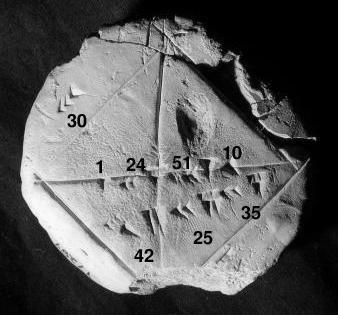
Basics and notation
As a positional notation, sexagesimal counts 1, 2, 3, …, 59, then 10 to mean sixty in that base. In modern descriptions the digits are usually written using familiar decimal numerals for convenience, but conceptually each digit represents a multiple of 60n. Fractions in this system are handled by negative powers of 60 (for example 1/60, 1/602), which makes many common rational subdivisions short and exact.
Mathematical properties
Sixty is highly composite: it has many divisors which are useful for partitioning units. Its positive divisors include:
- 1, 2, 3, 4, 5, 6,
- 10, 12, 15, 20, 30, 60.
This divisor structure explains why 60 is the least common multiple of 1 through 6 and why many time and angle subdivisions (half, third, quarter, fifth, sixth, etc.) are integral. The factors relate to simple primes 2, 3 and 5, which combine to give the composite structure of sixty.
Historical development
The sexagesimal system traces back to ancient Mesopotamia. Scholars attribute its initial development to the Sumerians in the third millennium BCE and its transmission and elaboration to later Mesopotamian cultures such as the Babylonians. Those civilizations used a place‑value system that combined base‑60 counting with some mixed‑radix conventions; traces of that heritage survive in units and measurements used today.
Uses and legacy
Although base 60 is no longer used for general arithmetic, it persists in several important domains. It underpins the division of an hour into 60 minutes and a minute into 60 seconds, the splitting of a circle into 360 degrees (6×60), and the sexagesimal representation of geographic coordinates (degrees, minutes, seconds). These applications use a slightly modified, mixed‑radix practice rather than a pure base‑60 numeral system.
Advantages, limitations and notable facts
Advantages of sexagesimal include the ease of expressing many common fractions and the convenience of divisibility by many small integers. Limitations include larger digit sets (0–59) compared with base 10 and practical awkwardness for general computation in modern contexts. Notable facts: 60 is the smallest number divisible by all integers from 1 through 6, and historical sexagesimal notation required context to resolve ambiguous place values.
For further reading see historical surveys and mathematical treatments of numeral systems: base 60 overview, Sumerian numeration, Babylonian mathematics, time measurement, angular units, geographic coordinates, composite numbers, factors of 60, prime factors 2 3 5, fractions in sexagesimal, numeral representation.
Questions and answers
Q: What is sexagesimal?
A: Sexagesimal is a number system with 60 as its base, invented by the ancient Sumerians in the 3rd millennium BC.
Q: Who passed down sexagesimal to the ancient Babylonians?
A: Sexagesimal was passed down to the ancient Babylonians by the ancient Sumerians.
Q: What is the significance of the number 60 in sexagesimal?
A: The number 60 is a composite number with twelve factors, including 1, 2, 3, 4, 5, 6, 10, 12, 15, 20, 30, and 60, with 2, 3, and 5 being prime numbers.
Q: Why are fractions simplified using sexagesimal numbers?
A: Fractions are simplified using sexagesimal numbers because 60 is the smallest number that is divisible by every number from 1 to 6, making it easy to divide time, angles, and geographic coordinates into even sections.
Q: What are some examples of how time can be divided using sexagesimal numbers?
A: One hour can be divided evenly into sections of 30 minutes, 20 minutes, 15 minutes, 12 minutes, 10 minutes, 6 minutes, 5 minutes, 4 minutes, 3 minutes, 2 minutes, and 1 minute using sexagesimal numbers.
Q: Is sexagesimal still used today?
A: Yes, sexagesimal is still used today in a modified form for measuring time, angles, and geographic coordinates.
Q: How are sexagesimal digits represented in this article?
A: In this article, all sexagesimal digits are represented as decimal numbers. For example, 10 means the number ten and 60 means the number sixty.
Related articles
Author
AlegsaOnline.com Sexagesimal (base 60) numeral system Leandro Alegsa
URL: https://en.alegsaonline.com/art/89276