
Sex Pistols (British punk band)
British punk band formed in 1975, noted for the 1977 album Never Mind the Bollocks, incendiary singles, confrontational image and outsized influence on punk and alternative music scenes.
Overview
The Sex Pistols were an English punk rock band that emerged in London in 1975 and became the most visible face of the first British punk movement. Their aggressive sound, deliberately provocative lyrics and theatrical public behaviour made them a lightning rod for controversy and debate about popular music and youth culture. The group existed in its original, creative form for only a few years but left a disproportionate cultural footprint.
Image gallery
10 Images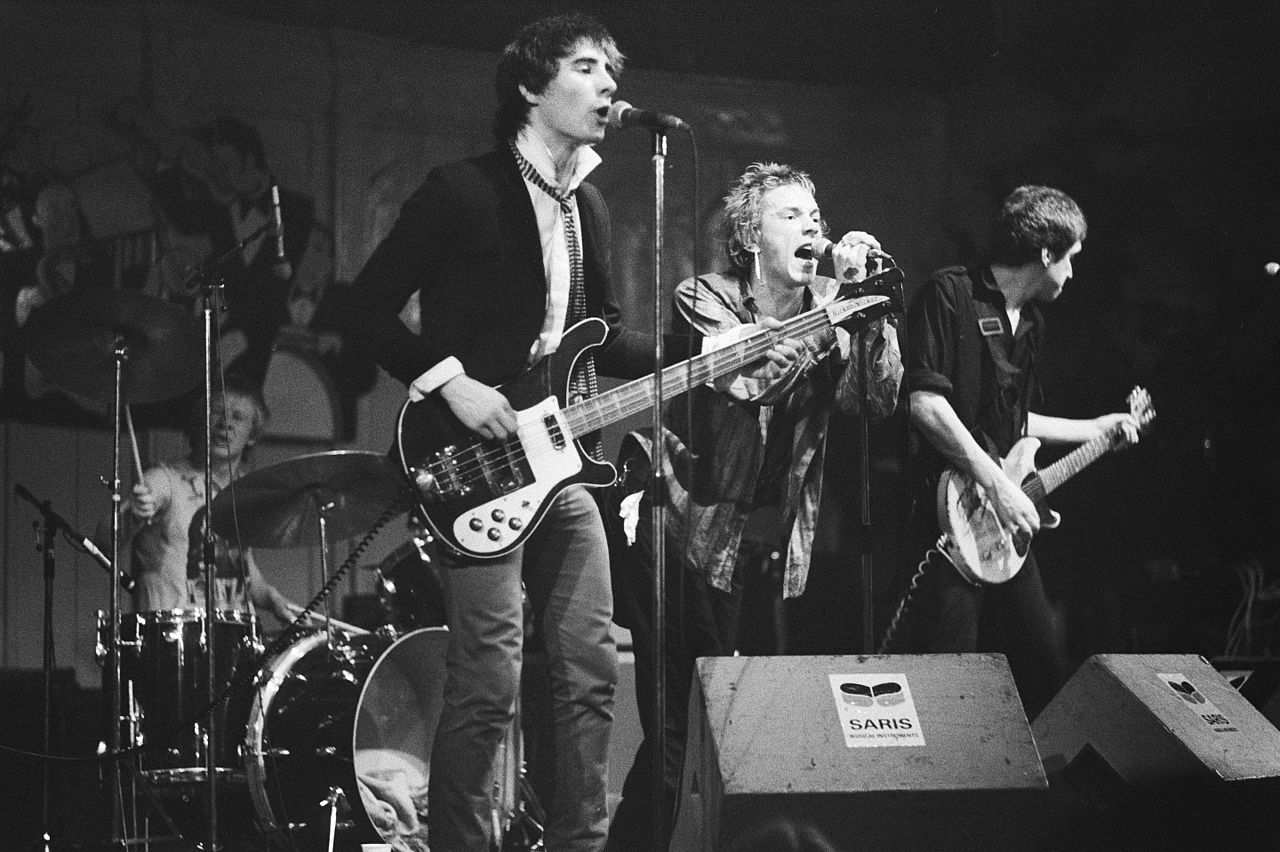


Members and lineup
The classic lineup that recorded the group's best–known studio work included a distinctive frontman, a tight rhythm section and a raw, single‑minded guitarist. Key figures were:
- John Lydon (stage name Johnny Rotten) — lead vocals.
- Paul Cook — drums.
- Steve Jones — guitar.
- Glen Matlock — original bass player; later replaced by Sid Vicious.
Matlock left (or was dismissed) in early 1977 and Sid Vicious—already a punk icon—took over bass duties. Vicious became a public symbol of the band’s chaos, though his musical skills were limited. The group was managed and promoted by Malcolm McLaren, whose publicity strategies amplified their notoriety.
Music, releases and controversies
Musically the Sex Pistols combined short, loud songs with confrontational lyrics and an abrasive stage presence. Their most famous studio release is the 1977 album Never Mind the Bollocks, Here's the Sex Pistols, which collected singles and new material produced during a turbulent period. Notable singles include “Anarchy in the U.K.” and “God Save the Queen.” The latter single, issued during Queen Elizabeth II’s Silver Jubilee year, attracted censorship and bans from parts of the British media and some retailers because of its provocative content and cover art; the disputes helped ensure wider attention.
Public image and key events
The band’s public life was punctuated by shock tactics, confrontations with journalists, cancelled shows and arrests. These episodes were as central to their reputation as the records themselves. One of the band’s final high‑profile performances took place in San Francisco’s Winterland on 14 January 1978; the chaotic show and disagreements around touring and management contributed to the group’s collapse. After the breakup, relations between members remained strained; Sid Vicious died in 1979 amid legal and personal troubles.
Influence and legacy
Although their recorded output is small compared with many contemporary acts, the Sex Pistols are widely credited with accelerating the spread of punk aesthetics and do‑it‑yourself attitudes in popular music. Their blend of simplicity, anger and spectacle influenced subsequent punk bands as well as a range of alternative and independent artists in later decades. Contemporary references to their impact can be found in discussions of late 20th‑century popular music and in the careers of artists who cite them as an inspiration—examples range from punk revival groups to mainstream acts who embraced a rawer sound or anti‑establishment rhetoric. For further reading on the band’s influence see resources on alternative music and modern punk scenes and profiles that draw lines from the Pistols to later acts such as Green Day.
Notable facts and distinctions
- The band’s only studio album, Never Mind the Bollocks, Here's the Sex Pistols, remains a landmark of British punk.
- Media clashes and censorship helped propel the group’s notoriety beyond the usual pop channels; the controversy around "God Save the Queen" is a frequently cited example.
- The Sex Pistols’ short, intense career is often used as an example of cultural impact that far outlasts commercial longevity.
Many articles and documentaries examine their story in greater detail, tracing how a band active for only a few years shaped music, fashion and youth culture in Britain and beyond.
History
Prehistory (1973-1975)
The band's origins date back to 1973, when college friends Steve Jones, Paul Cook and Warwick Nightingale decided to form a band with stolen equipment. Glen Matlock joined as a permanent bassist in June 1974, and the as-yet-unnamed group made its first appearance with this line-up at a party in early 1975.
In June 1975, guitarist Nightingale, who had written the band's first original song Did You No Wrong, was kicked out of the band, Steve Jones switched from vocals to guitar, and a new singer was found in John Lydon in late August 1975.
Sex Pistols (1975-1977)
The band spent the autumn rehearsing intensively and performed for the first time under the new name Sex Pistols on November 5, 1975. Most of the songwriting was done by Glen Matlock, while Steve Jones' job was to compress Matlock's ideas into the most concise and aggressive arrangements possible. John Lydon took over writing lyrics (except for the song Pretty Vacant, which came entirely from Glen Matlock).
After their performance at the "100 Club Punk Festival" (September 1976) they got a contract with the record company EMI. Their first single, Anarchy in the U.K., was released in November 1976. After a provocative television appearance on ITV, EMI withdrew the single and terminated the band's contract on 6 January 1977. Due to constant squabbles with John Lydon, Glen Matlock left the group in February 1977 and was replaced by Sid Vicious, who had the right image but only rudimentary skills as a bass player. Consequently, the bass parts were played in the studio by guitarist Steve Jones.
The second single, God Save the Queen, was first supposed to be released on A&M, where the band had been signed since March 10. The single was scrapped before it was released, and the label terminated that contract as well. Rich in severance pay but with no record releases available, the band eventually signed with what should have been the hated hippie label Virgin, where God Save the Queen was released on May 27, 1977, in time for the Queen's Silver Jubilee. The single reportedly hit number 1 in the UK charts, but was only listed at number 2 on official lists, allegedly due to royalist loyalties of those responsible. The single also gained a lot of attention when, for the Queen's birthday in 1977, the band hired a boat (which was named "Queen Elizabeth", of all things) on which they gave a concert at full volume in the middle of the Thames in front of journalists and invited guests. The boat was broken up by the water police and most of the passengers arrested, but the band itself managed to escape. The publicity took its revenge in the following weeks, however, when members of the band were attacked by Royalists.
To escape the heated atmosphere in England, the Sex Pistols went on a short Scandinavian tour. An England tour followed, but under the pseudonym SPOTS (Sex Pistols On Tour Secretly) to avoid performance bans. In November 1977 the only studio album Never Mind the Bollocks, Here's the Sex Pistols was released. A lawsuit alleging obscenity of the title was dismissed.
In the British society of the 1970s, the memory of the Second World War was still very present. For this reason, the Sex Pistols - like other punk bands - also resorted to Nazi symbolism in their attempt to provoke, for example by wearing swastikas. Although it is clear today that the band did not adhere to Nazi ideology at any time, these irritations continue to have an effect today; for example, in 2007 the Bell Canada company withdrew an advertising campaign that featured a pin with the title of the Sex Pistols' song Belsen Was a Gas.
After a few concerts in the Netherlands - the start of a planned multinational tour - the band set off on a Never Mind the Bans tour of the UK in December 1977. Of eight scheduled dates, four were cancelled due to illness or political pressure. On Christmas Day, the Sex Pistols played two shows at Ivanhoe's in Huddersfield. Before the regular evening concert, the band staged a benefit matinee for the children of "local firefighters, redundant workers and single parent families". They played 6 songs and left out the naughty words because of the children. These were the band's last UK performances for over 18 years.
Dissolution (1978)
In early 1978, the Sex Pistols went on tour in the USA, at the end of which Johnny Rotten left the band after a falling out with manager Malcolm McLaren. Subsequently, the rest of the band held together for a short time before finally breaking up.
After the Sex Pistols
Rotten, who went back to calling himself Lydon, formed Public Image Ltd. (1978-1992), Jones and Cook formed the band The Professionals (1979-1982). Before that they had tried to play together with Jimmy Pursey, the singer of Sham 69, in a band called Sham Pistols, which failed very soon.
Malcolm McLaren adapted the band's story into the partly fictional, partly autobiographical mockumentary film The Great Rock 'n' Roll Swindle. He was successfully sued by the surviving band members in the 1980s. He later used the beginnings of rap and hip-hop to launch a solo career.
Glen Matlock formed the Rich Kids (1977-1979), and Sid Vicious aimed for a solo career and became part of the New York heroin scene. He even achieved chart success with his version of the Frank Sinatra song My Way. However, in late 1978 he was charged in New York with murdering his girlfriend Nancy Spungen, but died of a heroin overdose before the hearings on February 2, 1979.
On 25 December 1979, Steve Jones and Paul Cook, along with Billy Idol (vocals) and Martin Glover (bass), played four songs live (Slippin And Slidin/Roadrunner/No Fun/Bodies) as
part of a Christmas party at London's Studio 21, with promoter Jock McDonald announcing them as Sex Pistols. In 1986 McDonald released a Bollock Brothers studio album 77-78-79, which he falsely claimed was a recording of this final "Sex Pistols" performance.
Reunion (since 1996)
On 16 March 1996, the four original members of the Sex Pistols held a press conference in London and announced their intention to perform together again. A world tour followed (72 concerts between July and December 1996), after which the band split up again.
On 27 July 2002, the Sex Pistols gave a concert to celebrate the 50th anniversary of the Queen's throne, followed by a festival appearance in California on 14 September 2002.
In August and September 2003 they gave eleven concerts in the USA and Canada.
On March 13, 2006, they were officially inducted into the Rock and Roll Hall of Fame against their will. The band strictly refused to participate in the ceremony.
In June 2007, John Lydon, Steve Jones and Paul Cook went into The Boat Recording Studio in Los Angeles with producer Chris Thomas and recorded new studio versions of the songs "Anarchy in the U.K." and Pretty Vacant for the video game Guitar Hero III.
To celebrate the 30th anniversary of the album Never Mind The Bollocks, the Sex Pistols performed eight shows in Los Angeles and the UK in October and November 2007. One of the concerts was filmed by director Julien Temple and released as a DVD under the title Sex Pistols - There'll Always Be An England.
In an interview with journalist Clive Prior (MOJO magazine, January 2008), John Lydon and Steve Jones no longer ruled out the possibility of a new studio album. Steve Jones: "I personally would like to record some new songs. I've been pushing for it for years. I think it could be soon." John Lydon: "I used to say that I would never record any more material with this band. But if things keep going this well and we keep getting along, I wouldn't say no again, because it's really exciting." Paul Cook expressed to WENN.com on January 16, 2008, "We might not get a whole album together yet, but hopefully there'll be some new stuff in time for the summer." John Lydon reaffirmed the possibility of a new studio album to the press on June 16, 2008.
In the summer of 2008, the Sex Pistols completed a world tour of 31 concerts.
Cast


Appreciation
The Sex Pistols are considered one of the essential bands of English punk. However, the band itself rejected the label "punk" for itself. Simple chords, straight bass lines, fast, hard drumming, as still found as a musical form in today's punk bands, were rather developed by other bands like the Ramones or the Buzzcocks from Manchester. In addition to the music, the provocative lyrics and shocking appearance of the Sex Pistols in particular contributed to punk becoming the defining music and cultural movement of the late 1970s, and they themselves became its icon.
Rolling Stone listed the Pistols as number 60 on the list of the 100 greatest musicians of all time.
Related articles
Author
AlegsaOnline.com Sex Pistols (British punk band) Leandro Alegsa
URL: https://en.alegsaonline.com/art/89266