
Sex determination: mechanisms, examples, and evolutionary context
Overview of biological sex determination: genetic and environmental systems, hermaphroditism, examples across animals and plants, and developmental and evolutionary implications.
Overview
Sex determination is the biological process by which an organism develops as one sex or another, a key aspect of its development. The term sex here refers to reproductive roles that produce gametes of different types, and it is expressed within each species in a variety of ways. Although many familiar animals have separate males and females, nature presents many distinct systems that control whether an individual develops male, female, or both reproductive structures.
Image gallery
5 Images


Major mechanisms
Biologists broadly group sex-determination systems into genetic and environmental categories, but some species combine elements of both. Genetic systems rely on inherited factors such as genes and chromosomes, while environmental systems use external cues that alter developmental pathways.
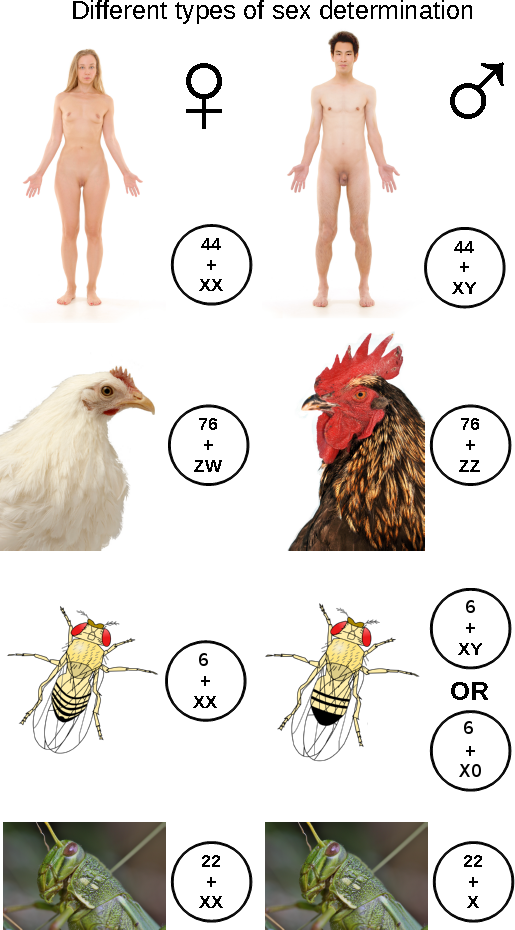
- Genetic determination — In many organisms sex is set by chromosomes or specific genes inherited from the parents. Examples include systems where one sex has two different sex chromosomes and the other has two of the same (commonly called XY and ZW systems). Particular genes can act as triggers for male or female development, and broader networks of genetic regulators establish sexual differentiation. The role of individual genes and the structure of chromosomes differ widely across taxa.
- Environmental determination — In other species, external factors such as temperature, social environment, or chemical signals influence which sexual pathway is followed. For example, temperature-dependent sex determination is common in some reptiles, and social context can cause sex change in certain fish. These are often categorized as environmental systems.
Hermaphroditism and mixed systems
Where both male and female reproductive organs occur in the same individual, organisms are called hermaphrodites. Many plants and several animal groups display hermaphroditism: flowering plants often carry both stamens and carpels, while some invertebrates such as the common snail are simultaneous hermaphrodites. Other species exhibit sequential hermaphroditism, changing sex during their lifetime. Many plants and animals therefore do not fit a simple binary model.
History, development, and evolutionary significance
Understanding sex determination has been central to developmental biology and evolutionary theory because it connects genes, environment, and reproductive strategy. Over evolutionary time, different systems have evolved independently, shaped by selective pressures like mating systems, population structure, and ecological conditions. Research links molecular pathways to broader life-history traits and shows how flexibility in sex determination can be advantageous in variable environments.
Practical examples and notable distinctions
Practical examples include humans and many mammals with an XY chromosome-based system, birds with a ZW pattern in which the heterogametic sex is the female, insects with diverse mechanisms, reptiles where incubation temperature can bias sex ratios, and social fish that change sex in response to group composition. In plants, most flowering species produce bisexual flowers, although separate-sexed plants also exist. It is important to distinguish biological sex determination from cultural or personal concepts of gender: the former describes developmental pathways and reproductive roles, while the latter encompass identity, roles, and social meaning.
For further reading on developmental processes, genetics, ecological examples, and comparative biology, consult resources that cover molecular regulators, temperature effects, and reproductive strategies across taxa. Additional material on the topic is available through introductory texts and specialized reviews in evolutionary biology and developmental genetics.
Related topics and resources: development, sex, species, genetics, genes, chromosomes, environmental triggers, hermaphroditism, snails and invertebrates, plants and flowers.
Questions and answers
Q: What is sex determination?
A: Sex determination is the process by which an individual's sex is established.
Q: How is sex determined genetically?
A: Sex can be determined genetically by the genes and chromosomes an organism inherits from its parents.
Q: Can sex be determined environmentally?
A: Yes, sex can be determined environmentally by some outside factor that triggers development.
Q: Are the sexes usually separate in living beings?
A: Yes, in most living beings, the sexes are separate.
Q: What is a hermaphrodite?
A: A hermaphrodite is an individual that has both male and female reproductive organs.
Q: In which animals can hermaphrodite systems be found?
A: Hermaphrodite systems can be found in some animals, such as snails.
Q: Where else can hermaphrodite systems be found?
A: Hermaphrodite systems can also be found in most flowering plants.
Related articles
Author
AlegsaOnline.com Sex determination: mechanisms, examples, and evolutionary context Leandro Alegsa
URL: https://en.alegsaonline.com/art/89260
Sources
- doi.org : 10.2307/3869777
- faculty.bennington.edu : faculty.bennington.edu
- doi.org : 10.1105/tpc.016667
- pubmed.ncbi.nlm.nih.gov : 15084718
- doi.org : 10.1095/biolreprod.102.007294
- pubmed.ncbi.nlm.nih.gov : 12533420
- learner.org : "Evolution of the Y chromosome"
- doi.org : 10.1111/j.1479-8298.2005.00118.x
- ncbi.nlm.nih.gov : 9.II. Sexual Dimorphism
- doi.org : 10.1016/S0092-8674(03)00610-X