
Seven Days Battles (Peninsula Campaign, June 25 – July 1, 1862)
A concise encyclopedia article on the Seven Days Battles: a series of engagements around Richmond that ended the Union Peninsula Campaign and elevated Robert E. Lee's leadership.
Overview
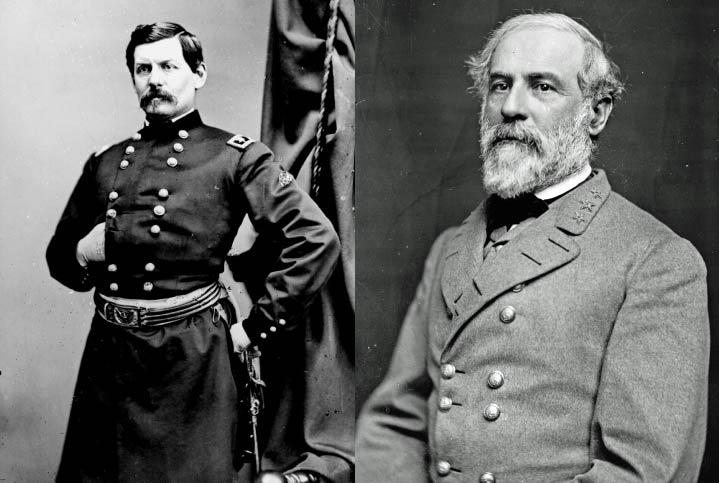
The Seven Days Battles were a sequence of large engagements fought from June 25 to July 1, 1862, on the approaches to Richmond, Virginia, during the American Civil War. They marked the climax of the Union Peninsula Campaign, in which Major General George B. McClellan attempted to take the Confederate capital after moving his Army of the Potomac up the Virginia Peninsula from Hampton. The fighting forced the Union army to withdraw to the James River and denied McClellan a direct capture of Richmond, while helping establish the aggressive reputation of Robert E. Lee as a Confederate leader.
Image gallery
10 Images


Campaign sequence and principal engagements
The Seven Days was not a single pitched battle but a series of encounters over seven days. Command decisions, rushed attacks, and difficult terrain contributed to a chaotic, mobile campaign. The principal engagements are commonly listed as:
- June 25 – Oak Grove (opening movement toward Richmond)
- June 26 – Beaver Dam Creek (Mechanicsville)
- June 27 – Gaines's Mill (major Confederate attack)
- June 28 – Garnett's & Golding's Farm
- June 29 – Savage's Station
- June 30 – Glendale (Frayser's Farm)
- July 1 – Malvern Hill
Each day offered different tactical problems — from river crossings and broken roads to piecemeal assaults — and none produced a decisive breakthrough for either side on the battlefield, although the strategic result favored the Confederates.
Commanders, armies and context
The Union effort was led by McClellan, commanding the Army of the Potomac, while the Confederate defense was nominally the Army of Northern Virginia. In late May, the Confederates had fought the Battle of Seven Pines, during which General Joseph E. Johnston was wounded. Confederate President Jefferson Davis then appointed Robert E. Lee as the new commander of the forces opposing McClellan. Lee reorganized the Confederate defenses and initiated offensives that drove the Union army back from Richmond's doorstep.
Aftermath and significance
Although many individual attacks during the Seven Days inflicted substantial casualties and sometimes failed due to coordination problems, Lee's campaign accomplished its strategic aim: it ended McClellan's immediate threat to Richmond and prompted a Union retreat to the James River. The battles bolstered Confederate morale, changed perceptions about Confederate leadership, and became regarded among the more decisive episodes of the Peninsula Campaign. For the Union, the campaign highlighted problems of timidity, logistics, and command that would be examined in later operations.
Notable facts and distinctions
The Seven Days Battles illustrate the distinction between tactical and strategic outcomes: Confederate attacks often failed to annihilate isolated Union forces in detail, yet the cumulative pressure and Union caution produced a strategic Confederate victory. The campaign also demonstrated the difficulty of coordinating large movements across poor roads and dense country, and it served as an early test of Lee's offensive style. Further reading and maps of the campaign and individual fights can be found via regional summaries and specialized studies of the McClellan and Confederate operations, contemporary battlefield reports, and campaign overviews at archival and interpretive sites (Richmond area resources, Hampton landing accounts, and broader Peninsula studies).
For focused biographies and unit histories, consult resources on Johnston, Lee, and McClellan's command decisions; for operational detail see orders of battle for the Army of the Potomac and the Army of Northern Virginia, and annotated timelines of the Seven Pines engagement that preceded the Seven Days. Contemporary analyses also examine the role of leadership selection by Jefferson Davis and the consequences of Johnston's wounding for Confederate command arrangements.
Questions and answers
Q: What were the Seven Days Battles?
A: The Seven Days Battles were a series of six major battles fought near Richmond, Virginia during the American Civil War.
Q: When did the Union army land at Hampton, Virginia?
A: The Union army landed at Hampton, Virginia in early 1862.
Q: What was the goal of the Union army in Richmond, Virginia?
A: The Union army's goal in Richmond, Virginia was to capture the city and end the war.
Q: Who defended the city of Richmond, Virginia during the Seven Days Battles?
A: The Confederate Army of Northern Virginia defended the city of Richmond, Virginia during the Seven Days Battles.
Q: Who was appointed as the new commander of the Confederate Army of Northern Virginia?
A: General Robert E. Lee was appointed as the new commander of the Confederate Army of Northern Virginia.
Q: What was the outcome of the Seven Days Battles?
A: General Robert E. Lee's victory in the Seven Days Battles proved to be among the most decisive battles of the Peninsula Campaign.
Q: Why were the Seven Days Battles significant?
A: The Seven Days Battles were significant because they marked a major turning point in the war and established General Robert E. Lee as a skilled military leader.
Related articles
Author
AlegsaOnline.com Seven Days Battles (Peninsula Campaign, June 25 – July 1, 1862) Leandro Alegsa
URL: https://en.alegsaonline.com/art/89195
Sources
- nps.gov : "1862 Seven Days' Battles"
- encyclopediavirginia.org : "Seven Days' Battles"
- historynet.com : "Seven Days Battle"