
Seti I (Menmaatre) — Egyptian pharaoh of the 19th Dynasty
Seti I, son of Ramesses I and father of Ramesses II, was a 19th Dynasty pharaoh noted for military campaigns in the Levant, major building projects and a richly decorated tomb in the Valley of the Kings.
Overview
Seti I, known by his throne name Menmaatre, was a pharaoh of Egypt's 19th Dynasty who reigned near the end of the 14th and start of the 13th century BC. His birth name, often rendered Sety or Seti Merenptah, identifies a traditional relationship to the god Set while emphasizing devotion to the creator god Ptah. In later Greek sources he appears as Sethos. Modern chronologies vary; many scholars place his reign within a roughly fifteen-year span commonly given as c. 1294–1279 BC or c. 1290–1279 BC.
Image gallery
10 Images




Names, family and succession
Seti was the son of the short-reigning founder of the dynasty, Ramesses I, and Queen Sitre. He secured the throne and was succeeded by his son, the famous Ramesses II. As with other rulers of ancient times, our understanding of his life and rule comes from a mix of inscriptions, temple reliefs and later king lists that reflect both official propaganda and administrative records. Ancient Egyptian titulary and naming practices also underscore religious affiliations; Seti's nomen indicates consecration to Set while his prenomen proclaims reverence for Re.
Political and military activity
Seti I is best known for campaigns beyond Egypt's borders intended to secure the kingdom's frontiers and influence in the Levant and Nubia. His military records emphasize the capture of Kadesh and influence over regions such as Amurru and parts of Syria, territories long contested with the powerful Hittite Empire. He defeated forces that opposed him at Kadesh and commemorated this on victory stelae; nevertheless, Egyptian control in the far north proved difficult to sustain and many border towns returned to Hittite or local rule soon afterwards. Historians caution that older views of a complete loss and later complete restoration of empire are too simplistic; instead, Seti's expeditions were part of ongoing competition for regional dominance.
Monuments, art and burial
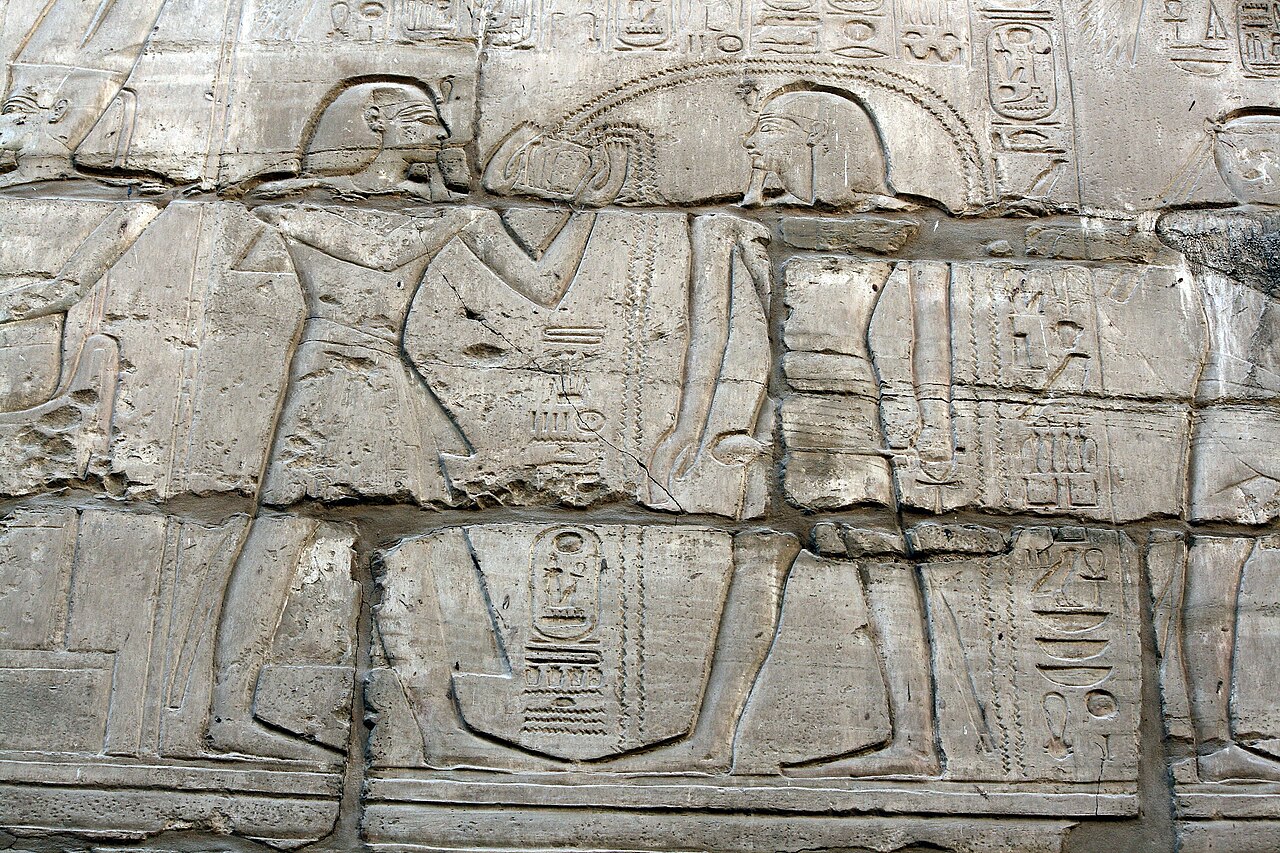
Seti I invested heavily in monumental architecture and temple decoration, helping to restore and renew traditions disrupted during previous decades. His largest surviving works include the temple complex at Abydos — which contains an important king list of predecessors — and significant additions at the temple precinct of Karnak. He left a conspicuous war monument celebrating his campaigns and victories in relief and inscription form. Many of his reliefs are notable for high-quality carving and careful finish, a stylistic revival after the Amarna period.
- Notable constructions: the Abydos temple with the royal list, additions to the Karnak complex, and other temples and stelae across Upper Egypt. War monuments record his foreign campaigns.
- Tomb: Seti I's burial in the Valley of the Kings (tomb KV17) is among the most elaborately decorated tombs, famous for its detailed reliefs and well-preserved painting.
Legacy and scholarly perspective
Scholars treat Seti I as a ruler who reaffirmed royal authority, religious practice and artistic standards after a period of political and theological upheaval tied to the Amarna interlude. He engaged in both military and diplomatic efforts with neighbors, notably the Hittite Empire, and confronted regional polities of Syria and the coastal territories of the eastern Mediterranean. His era witnessed continued interaction with states and peoples to the north and northeast, including areas of modern Lebanon. Ancient sources and modern studies caution against simplistic narratives: Seti's actions appear as part of an extended policy of defense and assertion rather than a single sweeping reconquest.
Sources and inscriptions
The surviving picture of Seti I is built from temple inscriptions, reliefs, stelae and the archaeological record. Textual and material evidence from his reign, including king lists and official inscriptions, inform debates about chronology and the extent of Egypt's power during his rule. For general background on Egyptian chronology and the context of historic dating see studies of Ancient Egypt. For references to gods and local cults mentioned in his titulary, see entries on Ptah and the god Set; for discussion of the Amarna period and its predecessors see works associated with Akhenaten. Individual inscriptions and later classical references sometimes refer to Seti in Greek or Roman sources under names like pharaoh or Sethos, terms that preserve a fragmented but important record of his image abroad.
Seti I remains a central figure for understanding the consolidation of the early Ramesside state: a pharaoh who combined military activity, large-scale building, and religious restoration to reinforce royal ideology and Egypt's presence in a complex international landscape.
Questions and answers
Q: Who was Menmaatre Seti I?
A: Menmaatre Seti I (or Sethos I as in Greek) was a pharaoh of the New Kingdom 19th Dynasty. He was the son of Ramesses I and Queen Sitre, and the father of Ramesses II.
Q: What is the meaning behind his name?
A: The name 'Seti' means "of Set", which indicates that he was consecrated to the god Set (or "Seth"). As with most pharaohs, Seti had several names. Upon his ascension, he took the prenomen "mn-m3‘t-r‘ ", usually vocalized as Menmaatre, in Egyptian, which means "Eternal is the Justice of Re." His better known nomen, or birth name, is transliterated as "sty mry-n-ptḥ" or Sety Merenptah, meaning "Man of Set, beloved of Ptah".
Q: What were some of his achievements?
A: The greatest achievement of Seti I's foreign policy was the capture of the Syrian town of Kadesh and neighboring territory of Amurru from the Hittite Empire. He also successfully defeated a Hittite army that tried to defend Kadesh and entered it in triumph together with his son Ramesses II. Additionally, traditional view holds that he restored Egypt's empire after it had been lost during Akhenaten's reign.
Q: How long did he rule for?
A: As with all dates in Ancient Egypt, the actual dates of his reign are unclear. Various historians claim different dates but 1294 BC to 1279 BC and 1290 BC to 1279 BC are commonly used by scholars today.
Q: Where did he win a battle against a Hittite army?
A: He won a battle against a Hittite army at Kadesh which is located in Syria.
Q: Did Egypt maintain control over Kadesh after this victory?
A: No - Kadesh soon reverted back to Hittite control because Egypt could not maintain permanent military occupation there due its proximity to their homelands.
Related articles
Author
AlegsaOnline.com Seti I (Menmaatre) — Egyptian pharaoh of the 19th Dynasty Leandro Alegsa
URL: https://en.alegsaonline.com/art/89162
Sources
- digitalegypt.ucl.ac.uk : "Sety I Menmaatre (Sethos I) King Sety I"
- djeserkara-royalty.blogspot.com : "Ancient Egyptian Royalty"