
Serbia and Montenegro: the State Union (2003–2006) and its dissolution
Overview of the State Union of Serbia and Montenegro (2003–2006): composition, constitutional arrangement, geography, referendum and independence, and its political legacy.
Overview
The State Union of Serbia and Montenegro was a loose political union that existed from 2003 until 2006. It succeeded the Federal Republic of Yugoslavia and represented a transitional arrangement through which two former Yugoslav republics maintained common institutions while retaining considerable autonomy. The union formalized a joint state for foreign affairs and defence but left most domestic matters to the constituent republics.
Image gallery
10 Images


Geography and neighbours
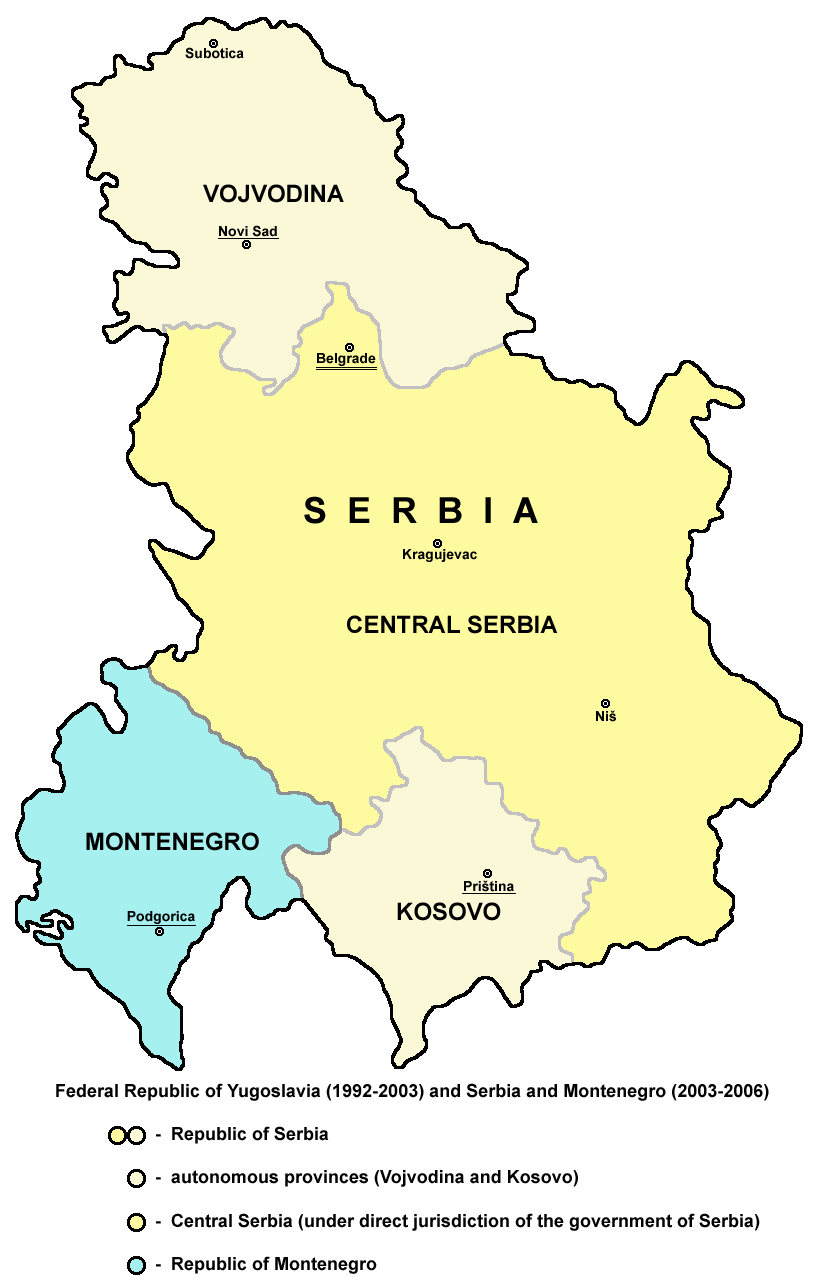
Located in the central-western Balkans, the union occupied a part of the Balkan Peninsula bordering several countries: to the west were Bosnia and Herzegovina and Croatia, to the north Hungary, to the east Romania and Bulgaria, to the south North Macedonia and to the southwest Albania. The union’s territory had a short coastline on the Adriatic Sea, almost entirely associated with Montenegro.
Constitutional arrangement and institutions
Under the constitutional charter that created the State Union, the two republics retained their own governments, legal systems and most economic policy powers. Only a small set of competencies were exercised at the federal level, principally common foreign policy, collective defence and certain international obligations. The 2003 arrangement was intended to be durable but allowed either republic the option to hold a referendum on independence after a set period.
Economy, currencies and practical differences
The two republics operated largely separate economic systems. Serbia used the Serbian dinar as its currency, while Montenegro used common currencies in practice and later the euro unilaterally. Differences in taxation, social policy and administration were handled by the republic governments rather than joint institutions. This semi-detached structure meant cooperation focused on diplomacy and external representation while everyday governance was decentralized.
Referendum and dissolution
Montenegro held a referendum on 21 May 2006 on whether to become an independent state. The result narrowly met the threshold set by the European Union and Montenegrin authorities, with a majority voting for independence. Montenegro declared independence on 3 June 2006, and Serbia declared itself an independent continuing state on 5 June 2006. After those declarations both republics proceeded to obtain international recognition and to join international organizations in their separate capacities.
Legacy and notable facts
- The State Union represents a post-Yugoslav attempt to combine shared sovereignty with extensive decentralization.
- Its short life—roughly three years—underscored enduring national identities and differing political priorities between the two republics.
- After dissolution, both states pursued independent foreign policies and European integration paths.
For more contextual information on the predecessor state and neighbouring countries see: Federal Republic of Yugoslavia, Bosnia and Herzegovina, and the list of neighbouring states above. Additional resources on the union’s formation and end are available through historical and diplomatic overviews at Serbia and Montenegro.
Questions and answers
Q: What was Serbia and Montenegro?
A: Serbia and Montenegro was the name of the state union of Serbia and Montenegro.
Q: What were Serbia and Montenegro before becoming a state union?
A: Serbia and Montenegro were two separate Yugoslav republics before becoming a state union.
Q: When did Serbia and Montenegro become their own countries?
A: Serbia and Montenegro became their own countries in 2006.
Q: Which countries bordered Serbia and Montenegro?
A: Bosnia and Herzegovina and Croatia on the western sides, Hungary to the north, Romania and Bulgaria to the east, North Macedonia to the south and Albania to the southwest bordered Serbia and Montenegro.
Q: Did Serbia and Montenegro have separate economic policies and currencies?
A: Yes, Serbia and Montenegro had separate economic policies and currencies.
Q: Were Serbia and Montenegro a Sovereign State united under one government?
A: Yes, Serbia and Montenegro were still a Sovereign State united under one government.
Q: What happened after the people of Montenegro held a vote on May 21st, 2006?
A: After the people of Montenegro held a vote on May 21st, 2006, the independence vote was won by 55.5%, and on June 3rd, 2006, Montenegro declared independence. Two days later, on June 5th, 2006, Serbia declared independence.
Related articles
Author
AlegsaOnline.com Serbia and Montenegro: the State Union (2003–2006) and its dissolution Leandro Alegsa
URL: https://en.alegsaonline.com/art/88974