
Semitone: the smallest interval in Western tonal music
A semitone (half step) is the smallest standard interval in Western music—one twelfth of an octave in equal temperament—used in scales, tuning, and notation to measure adjacent pitches.
Overview
A semitone, often called a half step or half tone, is the smallest standard pitch interval used in much of Western music. It describes the distance between two pitches that are adjacent in the chromatic order of notes. In common keyboard layout and staff notation, semitones appear where two notes lie next to one another in pitch with no intervening step: for example, C to C sharp (C#) or C# to D are each a semitone.
Image gallery
10 Images


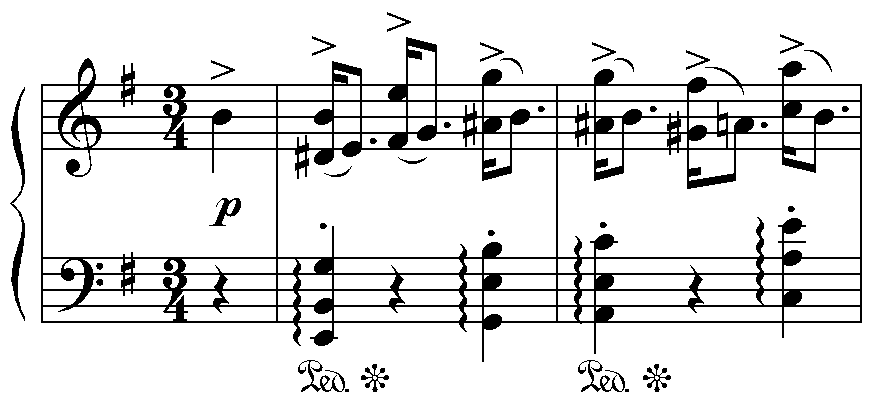


Physical and mathematical meaning
In the widely used system called 12-tone equal temperament the octave is divided into twelve equal parts. Each semitone therefore represents a constant frequency ratio of the twelfth root of two. In numeric terms that ratio is approximately 2^(1/12) ≈ 1.05946, so two notes a semitone apart differ in frequency by about 5.946%. Intervals are also measured in cents, a logarithmic unit: one equal-tempered semitone equals 100 cents and an octave equals 1200 cents.
Tuning systems and ratios
Although equal temperament is the most common tuning for modern Western instruments, other historical or theoretical systems treat the semitone differently. In just intonation a small-step interval can be approximated by simple integer ratios such as 16:15, while in Pythagorean tuning a semitone appears as the limma with ratio 256:243. These variants produce semitones of slightly different sizes, so enharmonically equivalent notes (for example C# and D flat) may not be identical outside equal temperament.
Notation, keyboard layout, and terminology
On a piano keyboard a semitone occurs between any adjacent keys. Where a black key lies between two whites (for example C and D) each white–black or black–white step is a semitone; where two white keys are adjacent (for example E and F or B and C) that white–white step is also a semitone. Musicians distinguish chromatic semitones (same letter, altered by a sharp or flat) from diatonic semitones (different letter names); the distinction matters in classical voice-leading and theoretical analysis.
Musical role and examples
Semitones are fundamental to melody and harmony in tonal music. The chromatic scale is formed by a sequence of twelve semitones and underlies modulation, chromaticism, and full chromatic harmony. Many expressive effects—such as the leading tone resolving to the tonic, or short, dissonant appoggiaturas—depend on semitone relationships. Instruments and singers use semitones when tuning, adjusting intonation, or ornamenting lines.
Related concepts and distinctions
- Whole tone: an interval of two semitones (e.g., C to D).
- Enharmonic equivalence: in equal temperament C# and Db are the same pitch; in other tunings they can differ.
- Microtones: many musical cultures use intervals smaller than a semitone; such divisions are outside the standard Western semitone framework.
For concise reference about language or regional terminology see British English usage and other English variants. Background on how semitones function in Western music contexts and the idea of adjacent pitch are useful for practical study. Visual learners often consult a piano keyboard diagram. The semitone's relation to the octave, to mathematical frequency ratios, and to raw frequency values (via the twelfth root of two) is central; see notes on equal temperament and the factor 2^(1/12) for technical detail.
Understanding the semitone clarifies how scales are built, why tuning matters, and how small pitch differences produce large musical effects.
Questions and answers
Q: What is a semitone in music?
A: A semitone is the smallest musical interval used in Western music, which is the distance between two notes next to each other in pitch.
Q: What is the difference between a whole tone and a semitone?
A: A whole tone means a distance of two semitones, while a semitone is the distance between two notes that are next to each other in pitch.
Q: How can one determine the distance between two notes in a keyboard?
A: One may determine the distance between two notes in a keyboard by looking at whether there is a black note in between them. If there is a black note, the distance is a whole tone, but if there is no black note, the distance is a semitone.
Q: What is an octave in music theory?
A: An octave is a distance between two pitches where the higher pitch has twice the frequency of the lower one. It is divided into twelve equal semitones.
Q: What is the ration of frequencies for an octave in music?
A: An octave has a ratio of 2:1 in frequencies. For example, from 100 Hz to 200 Hz or from 200 Hz to 400 Hz are both octaves.
Q: What is the ratio of frequencies for a semitone in music?
A: The ratio of frequencies for a semitone in music is 1.05946:1, which is the 12th root of 2 to 1.
Q: What is just intonation and why is it important in music?
A: Just intonation is an approach for tuning musical intervals to find small integer ratios between the frequencies of two notes. It is important in music because it provides a more pleasing sound to listeners.
Related articles
Author
AlegsaOnline.com Semitone: the smallest interval in Western tonal music Leandro Alegsa
URL: https://en.alegsaonline.com/art/88768