
Second Anglo-Mysore War (1780–1784): Mysore vs British East India Company
Overview of the Second Anglo-Mysore War (1780–1784) between Mysore under Hyder Ali and Tipu Sultan and the British East India Company, its campaigns, stalemate and the peace terms of the Treaty of Mangalore.
The Second Anglo-Mysore War (1780–1784) was an armed conflict fought on the Indian subcontinent between forces of the Kingdom of Mysore and the British East India Company. The fighting took place mainly in southern India and ended without a decisive victory for either side; peace was concluded with the Treaty of Mangalore, which largely returned relations to their pre-war condition.
Image gallery
10 Images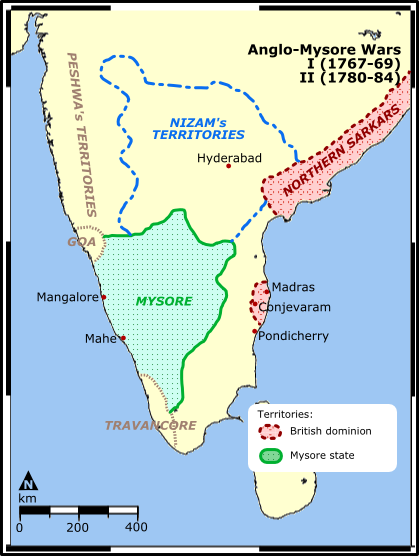




Background and causes
The war grew out of long-term rivalry for influence in southern India. Mysore, a major state in the region, had developed political and military ties with the French, while the East India Company represented British commercial and territorial interests. Tensions increased as both powers competed for allies, territory, and control of trade routes. Hyder Ali, who led Mysore at the time, sought external support to check Company expansion and to strengthen his position in the region.
Course of the war
Hostilities began in 1780 and included sieges, pitched battles, and mobile campaigning across several fronts. Both sides experienced successes and setbacks. Mysore's forces, under Hyder Ali and later his son Tipu Sultan, inflicted notable reverses on Company troops, while the British used their naval and financial resources to sustain long campaigns and support allied native states.
Outcome
After four years of intermittent warfare and negotiation, the belligerents agreed to end the fighting. The 1784 treaty re-established the status quo ante bellum: territories captured during the war were exchanged, and neither party achieved lasting territorial gains. The conflict, however, set the stage for further Anglo–Mysore confrontations later in the century.
- Dates: 1780–1784
- Main belligerents: Kingdom of Mysore and the British East India Company
- Result: Treaty of Mangalore; no decisive winner
Questions and answers
Q: What was the Second Anglo-Mysore War?
A: The Second Anglo-Mysore War was a conflict that occurred on the Indian Subcontinent from 1780 to 1784.
Q: Was there a clear winner in the war?
A: No, the war ended without a clear victory on either the British East India Company side or the Kingdom of Mysore's.
Q: What brought about the war between the Kingdom of Mysore and the British East India Company?
A: Hyder Ali, the ruler of Mysore, committed himself to a French alliance to seek revenge against the British. The British had problems with Mysore because it had an alliance with the French.
Q: Where was the Kingdom of Mysore located?
A: The Kingdom of Mysore was situated in the South of India.
Q: Who were the Kingdom of Mysore's allies?
A: The Kingdom of Mysore was an ally of the French.
Q: Who was on the side of the British in the Second Anglo-Mysore War?
A: The East India Company was on the side of the British.
Q: What did the Treaty of Mangalore do?
A: The Treaty of Mangalore restored the situation to the state before the war broke out, hence bringing the Second Anglo-Mysore War to an end.
Related articles
Author
AlegsaOnline.com Second Anglo-Mysore War (1780–1784): Mysore vs British East India Company Leandro Alegsa
URL: https://en.alegsaonline.com/art/88403