
Seaweed: types, ecology, uses, and cultural importance
Overview of seaweed—marine macroalgae groups, physical traits, ecological roles, common uses in food and industry, and notable cultural and environmental significance.
Overview
Seaweed is a common name for several groups of macroscopic marine algae that live attached to or floating in the ocean. Unlike true plants, these organisms lack roots, stems and leaves, but many perform photosynthesis and produce oxygen and organic matter from sunlight and dissolved nutrients. The term covers a wide variety of forms and sizes—from tiny filaments to large, leaf-like fronds that can form dense underwater forests.
Image gallery
10 Images

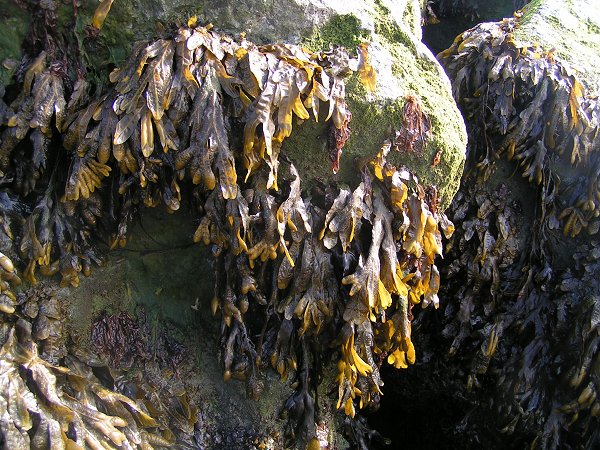


Types and characteristics
Seaweeds belong to different evolutionary lineages rather than a single taxonomic group. The three broad categories commonly recognized are red algae, green algae, and brown algae. Each group has distinctive pigments, reproductive strategies, and preferred habitats. For example, brown algae often dominate cold temperate rocky shores and can form large kelp forests, while many red algae thrive in deeper or tropical waters where different light wavelengths penetrate.
Ecology and life processes
Seaweeds obtain chemical energy through photosynthesis and from nutrient uptake in surrounding water; they convert light energy into carbohydrates that support local food webs and contribute to primary production in coastal ecosystems. The term "seaweed" encompasses organisms that play key roles as habitat engineers—providing shelter, food, and nursery grounds for fishes, invertebrates and other marine life. Their distribution is influenced by light, temperature, salinity, wave action and nutrient availability.
Uses and importance
Humans have harvested seaweed for centuries. Uses include direct consumption as food, extraction of hydrocolloids (such as agar, carrageenan and alginate) used in food processing and industry, fertilizer and soil conditioners, animal feed supplements, and emerging applications in biofuel, bioplastics and biotechnology. Seaweed aquaculture is a growing sector due to low-input cultivation and multiple ecosystem benefits.
- Food: edible species used fresh, dried, or processed.
- Industrial: gelling and stabilizing agents derived from algal polysaccharides.
- Environmental: shoreline protection, carbon sequestration and nutrient remediation.
History, culture and notable facts
Coastal cultures worldwide have incorporated seaweeds into diets, medicine and rituals. Scientific interest has expanded from traditional uses to conservation and sustainable farming. Seaweeds can indicate water quality and are studied for their rapid growth and capacity to take up dissolved nutrients and thus mitigate eutrophication. Their diversity and ecological roles make them important subjects for marine science and resource management; for general background on marine algae see algae, and for further reading on energy and metabolism consult related resources.
For specialized or regional information about particular species, habitats and cultivation methods, consult authoritative guides or local marine research institutions via links such as green algae overview and brown algae resources.
Questions and answers
Q: What is seaweed?
A: Seaweed is a term used for several kinds of algae that live in the ocean.
Q: What kinds of algae are commonly considered to be seaweed?
A: Red algae, green algae, and brown algae are commonly considered to be seaweed.
Q: How does seaweed get its energy?
A: Seaweed gets its energy from photosynthesis just as plants do.
Q: Does seaweed only live in the ocean?
A: Yes, seaweed only lives in the ocean.
Q: Can seaweed photosynthesize like plants do?
A: Yes, seaweed can photosynthesize like plants do.
Q: Is seaweed a single species of algae?
A: No, seaweed is a term used to refer to several different kinds of algae.
Q: Are there other places besides the ocean where algae can live?
A: Yes, algae can also live in freshwater environments such as lakes, ponds, and rivers.
Related articles
Author
AlegsaOnline.com Seaweed: types, ecology, uses, and cultural importance Leandro Alegsa
URL: https://en.alegsaonline.com/art/88381
Sources
- sunstar.com.ph : "Seaweed farmers get better prices if united"
- lifeandhealth.guardian.co.uk : "Springtime's foraging treats"
- abs-cbnnews.com : "Albay folk promote seaweed 'pansit'"
- seaweed.ucg.ie : Iodine in Seaweed
- timesonline.co.uk : timesonline.co.uk/tol/life_and_style/food_and_drink/article2472720.ece
- doi.org : 10.1016/j.bbrc.2005.05.002
- pubmed.ncbi.nlm.nih.gov : 15896707
- dailymail.co.uk : dailymail.co.uk/health/article-1134430/So-diet-pills-CAN-trim-tum-Our-expert-brands-test.…
- foxnews.com : foxnews.com/
- news.softpedia.com : news.softpedia.com/news/Appesat-the-Seaweed-Diet-Pill-that-Expands-in-the-Stomach-101227.…
- dsc.discovery.com : Ireland Taps New Energy Source : Discovery News : Discovery Channel
- amazon.com : Seaweed Biofuels: Production of Biogas and Bioethanol from Brown Macroalgae