
Season
A season is a recurring division of the year marked by characteristic weather, daylight and ecological changes, produced mainly by Earth's axial tilt; different regions use different seasonal schemes.
Overview
A season is a recurring portion of the year characterized by typical weather patterns, changing daylight and effects on plants and animals. Most temperate regions recognize four broad seasons: spring, summer, autumn (often called fall in American English) and winter. The pattern and intensity of seasons vary widely across different areas of the Earth, and some cultures and climates classify seasons differently.
Image gallery
10 Images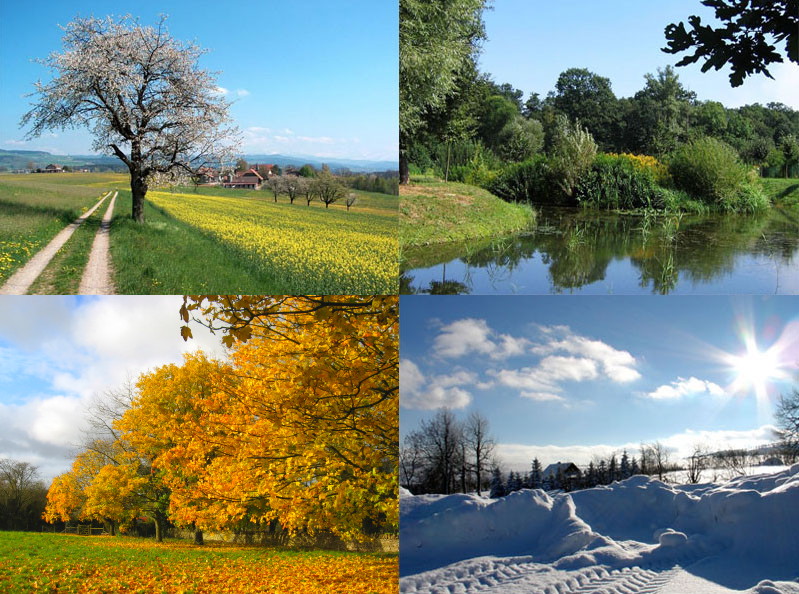


Cause and astronomical basis
The principal physical cause of seasons in most parts of the world is the tilt of the Earth's rotation axis relative to the plane of its orbit around the Sun. This axial tilt changes the Sun's apparent altitude at noon and the length of daylight through the year, producing warmer summer conditions when sunlight strikes the surface more directly and cooler winter conditions when the Sun is lower in the sky. Because the hemispheres are tilted in opposite directions, the northern and southern hemispheres experience opposite seasons at the same time.
Regional patterns and variations
Not all places follow the four-season pattern. Tropical and some subtropical regions are dominated by changes in precipitation rather than temperature. There, people often speak of a rainy or monsoon season and a dry season. For example, northern Australia, including parts of Queensland, Western Australia and the Northern Territory, is commonly described in terms of wet and dry seasons rather than spring, summer, autumn and winter. Polar regions have extreme seasonal contrasts such as prolonged daylight in summer and long nights in winter.
Definitions and the calendar
There are different ways to define when a season begins and ends. Astronomical seasons are marked by solstices and equinoxes, tied to Earth's orbit, while meteorological seasons divide the year into four three-month blocks for statistical and practical purposes. Local traditions and agricultural calendars may follow other schemes based on phenology (the timing of natural events) or religious and cultural observances.
Ecological, economic and cultural importance
Seasons shape ecosystems: many plants and animals time reproduction, migration and dormancy to seasonal cues. Human activities such as farming, tourism, construction and energy use are also season-dependent. Cultural life reflects seasons through festivals, clothing, cuisine and work rhythms—harvest celebrations in autumn, winter holidays, spring festivals, and summer vacations are common examples across many societies.
Notable distinctions and facts
- In some climates, the most significant seasonal change is rainfall rather than temperature; local names like "dry season" or "monsoon" reflect that difference.
- Meteorological and astronomical definitions can differ by several weeks; this is important for climate records and agricultural planning.
- Seasonal intensity depends on latitude: mid-latitudes experience pronounced four-season cycles, tropics have minimal temperature change, and high latitudes show extreme light variation.
- Language and usage vary: British English commonly uses the term autumn, while American English more often uses fall.
For further reading on how seasons are defined and observed in different disciplines, see entries on annual cycles and regional climate patterns: solar geometry, calendar conventions and practical guides to local seasonal calendars are useful starting points.
Additional regional and scientific resources can provide more detail: general introductions, meteorological summaries and cultural overviews are available through many educational outlets (regional summaries, phenology, climate descriptions, agricultural calendars, polar studies, Australian climatic zones). These perspectives help explain why human societies have developed diverse seasonal frameworks to match local environments.
Questions and answers
Q: What is a season?
A: A season is a part of a year.
Q: How many seasons are there in most areas of the Earth?
A: Most areas of the Earth have four seasons in a year: spring, summer, autumn (British English) or fall (US English), and winter.
Q: Are there different numbers of seasons in some places?
A: Yes, some places have a different number of seasons. For example, the tropical parts of Australia (the northern parts of Queensland, Western Australia and the Northern Territory) have wet and dry seasons which are in addition to or replace the regular season names. In tropical and subtropical places there are two seasons - rainy (or wet, or monsoon) season and dry season.
Q: What causes summer to be warm?
A: Summer is warm because the days are longer and the Sun is high in the sky giving direct light to the ground.
Q: Why is winter cold?
A: Winter is cold because days are shorter and Sun is low in sky giving indirect light to ground. Both changes in length of day and height of sun at noon are caused by tilt of Earth's spin axis with respect to plane of Earth's path around Sun.
Q: Does one hemisphere experience opposite seasons from another hemisphere?
A: Yes, at any time during any season, northern and southern hemispheres will experience opposite seasons from each other.
Related articles
Author
AlegsaOnline.com Season Leandro Alegsa
URL: https://en.alegsaonline.com/art/88358
Sources
- australia.gov.au : "Australian weather and the seasons"