
Principality of Sealand (HM Fort Roughs)
A short encyclopedia entry on the self‑declared Principality of Sealand, the offshore platform HM Fort Roughs, its history, legal status, and notable events from 1967 to the present.
The Principality of Sealand is a self‑declared, unrecognised micronation that claims the former World War II sea fort HM Fort Roughs as its territory. The platform sits on a Maunsell Sea Fort structure located in the southern North Sea; its approximate coordinates are often cited in accounts of the site. Since the late 1960s the installation has been associated with independent occupancy and a persistent claim to sovereignty, which places it among the best‑known examples of a micronation in popular discussion (micronation, related topics).
Image gallery
7 Images



Location and structure
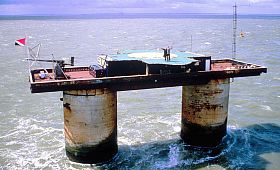
Roughs Tower, sometimes called HM Fort Roughs, is a steel and concrete platform originally built as a defensible sea fort. It stands in the North Sea at a distance offshore of the English coast near Suffolk. Constructed during wartime, the installation is typical of small, isolated maritime fortifications and is commonly described using terms such as sea fort. Its isolated position and sturdy construction allowed it to be occupied after the conflict ended when it was no longer needed for coastal defence.
History of occupation
The site was reclaimed for private use in the mid‑1960s when occupiers took advantage of the platform's remoteness. At that time many such platforms lay outside the recognised territorial limits and were treated as international waters by those who used them. The fort has its origins in coastal defence efforts during World War II, after which it passed through several uses and owners.
Claim to statehood and notable events
In 1967 an occupant declared the platform to be an independent entity. The man most associated with Sealand is Paddy Roy Bates, a former soldier who had served in the British Army; he and his associates established ongoing control of the structure and its community (Paddy Roy Bates, major is sometimes noted in contemporary accounts). In 1978 an armed confrontation occurred when a group of invaders attempted to seize the platform; the incident ended with the occupants retaining control. Later changes in maritime law brought the platform within the expanded United Kingdom jurisdiction when the state adjusted its territorial waters, affecting the legal context of Sealand's claims.
Legal status, culture and legacy
Sealand remains unrecognised by established states and international organisations, and its claim to sovereignty is treated as a curious legal and cultural phenomenon rather than a state with diplomatic recognition. Over the years the community associated with the platform has issued symbolic documents and titles, engaged in small‑scale commerce, and been the subject of media stories, academic commentary, and public fascination. While not a state under international law, Sealand illustrates issues about jurisdiction, maritime law, and the social dynamics of invented communities.
Quick facts and references
- Site name: HM Fort Roughs / Roughs Tower
- Region: North Sea off Suffolk
- Associated person: Paddy Roy Bates
- Historical context: World War II coastal defences
- Legal notes: issues involving international waters and later territorial waters of the United Kingdom
For further reading on concepts related to small self‑declared polities and maritime jurisdiction see general treatments of micronations and maritime sovereignty issues at introductory resources (coordinates and mapping, fort structures, military ranks and history, army service).
Questions and answers
Q: What is the Principality of Sealand?
A: The Principality of Sealand is an unrecognized micronation that claims HM Fort Roughs (also known as Roughs Tower) as its territory.
Q: Where is Roughs Tower located?
A: Roughs Tower is an offshore platform in the North Sea around twelve kilometres (6+1/2 nautical miles) off the coast of Suffolk.
Q: Who occupies Roughs Tower?
A: Since 1987, the tower has been occupied by the family and associates of Paddy Roy Bates, a former British Army major.
Q: Why was Roughs Tower used during World War II?
A: Roughs Tower was used as a sea fort in international waters during World War II.
Q: How was Sealand founded?
A: Bates took the tower from pirate radio broadcasters in 1967 and declared it as the independent Principality of Sealand.
Q: Was Sealand invaded?
A: Yes, Sealand was invaded by mercenaries in 1978, but they were defeated.
Q: Is Sealand considered part of British territory?
A: The platform has been in British territory since 1987, when the United Kingdom made its territorial waters larger, but Sealand claims to be an independent state.
Related articles
Author
AlegsaOnline.com Principality of Sealand (HM Fort Roughs) Leandro Alegsa
URL: https://en.alegsaonline.com/art/88320
Sources
- muu.fi : "Information on the Principality of Sealand"
- sealandgov.org : History Of Sealand
- sealandgov.org : "Official History of Sealand"
- news.bbc.co.uk : "Offshore and offline?"
- sealandnews.com : "Information on Sealand's royal family"
- sealandgov.com : "The Principality of Sealand statutory notices"
- david.national-anthems.net : "Sealandic National Anthem"
- abc.net.au : abc.net.au