
Sea spider (Pycnogonida)
Sea spiders are marine arthropods of the class Pycnogonida, with long legs and small bodies. Found worldwide from coasts to deep sea, they have unusual anatomy, male parental care and an unclear evolutionary position.
Overview
Sea spiders are small to large, primarily benthic marine arthropods placed in the class Pycnogonida. About 1,300 species are described, occurring worldwide from shallow coastal zones to abyssal depths. Typical coastal species have a modest leg span of a few centimetres, while several deep-sea species reach leg spans measured in tens of centimetres. Despite their common name and superficial resemblance, sea spiders are not true spiders and differ in many fundamental ways from land-dwelling arachnids.
Image gallery
10 Images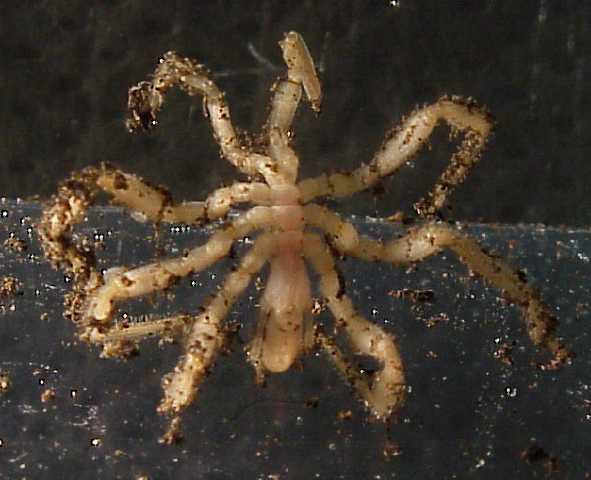


Anatomy and physiology
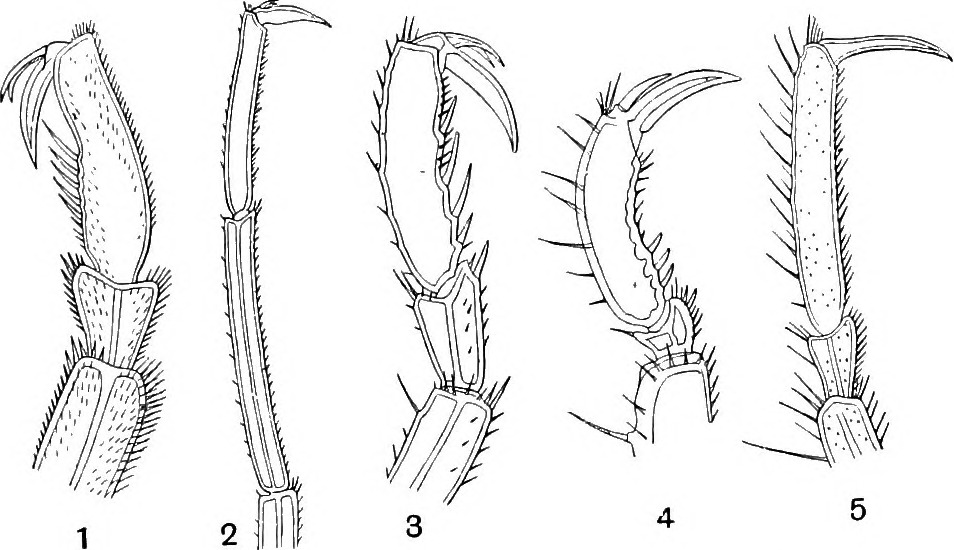
Sea spiders show a distinctive body plan: a compact central trunk bearing a proboscis used for feeding, and multiple long, jointed legs that provide locomotion and a large surface for gas exchange. The trunk is small relative to leg length, and the digestive and reproductive tissues extend into the limbs. They lack obvious gills or lungs; respiratory exchange occurs across the thin body surface and legs, a strategy that works well because of their generally low metabolic rates and high surface-area-to-volume ratio.
Common anatomical features include:
- Proboscis — tubular mouthpart for sucking fluids from prey or host organisms.
- Ovigers — specialized appendages (often on males) used to carry eggs and young.
- Reduced abdomen — the posterior body is small compared with other arthropods.
Distribution and habitat
Sea spiders inhabit all major oceans and seas, from temperate and tropical waters to polar regions. They are recorded in the Mediterranean Sea, Caribbean Sea and the Arctic Ocean, as well as in deep-ocean basins. Species composition changes with depth and region: shallow-water forms are generally smaller and cryptic among algae and sponges, while deep-sea species often show larger leg spans and adaptations for low-temperature, high-pressure environments.
Ecology, feeding and life cycle
Most sea spiders are predators or ectoparasites that feed on sessile or slow-moving invertebrates such as cnidarians, bryozoans, sponges and soft-bodied animals. They use the proboscis to pierce and suck out fluids. Reproduction often involves elaborate mating behaviour and parental care: in many species the male broods eggs on his ovigers until they hatch, a notable reversal of parental roles compared with many other arthropods.
Classification, evolution and scientific interest
Traditionally, pycnogonids were grouped with chelicerates, a lineage that includes horseshoe crabs and spiders; this reflects some superficial similarities in appendage arrangement. Modern molecular studies, however, have produced differing results and sparked debate: some evidence supports Pycnogonida as highly derived chelicerates, while other analyses suggest they may represent an ancient sister group to the rest of the living arthropods. Their unusual morphology and uncertain phylogenetic position make sea spiders important subjects in research on arthropod evolution and development.
Sea spiders are also of interest for studies of deep-sea gigantism, respiration without gills, and male parental care. For general background and regional species lists see resources on species diversity, on arachnids and chelicerates, and comparative material about other arthropod groups such as insects and crustaceans.
Notable facts
- Although called "spiders," their biology and internal anatomy set them apart from terrestrial spiders.
- Male brooding is common and easy to observe in many shallow-water species.
- Some deep-sea species reach strikingly large leg spans compared to their body size.
Further reading and online overviews are available from general marine invertebrate guides and taxonomic databases; select portals and review articles provide updates on their taxonomy and phylogenetic interpretation (see links above for starting points).
Questions and answers
Q: What are sea spiders?
A: Sea spiders are marine arthropods of the class Pycnogonida.
Q: How many species of sea spiders are there?
A: There are about 1,300 species of sea spiders.
Q: Where can sea spiders be found?
A: Sea spiders are found in all oceans, including the Mediterranean Sea, Caribbean Sea, and the Arctic Ocean.
Q: How big can sea spiders get?
A: Species found in coastal waters are usually small and have a leg span of about 1 inch (2.5 cm), those living at great depths, up to 24 inches (60 cm).
Q: Are sea spiders true spiders or arachnids?
A: Sea spiders are not true spiders, or even arachnids.
Q: How are sea spiders classified?
A: Sea spiders' traditional classification as chelicerates would put them closer to true spiders than to other well-known arthropod groups, such as insects or crustaceans.
Q: What does recent genetic evidence suggest about sea spiders' classification?
A: Recent genetic evidence suggests they may be an ancient sister group to all other living arthropods.
Related articles
Author
AlegsaOnline.com Sea spider (Pycnogonida) Leandro Alegsa
URL: https://en.alegsaonline.com/art/88279
Sources
- ui.adsabs.harvard.edu : 2010Natur.463.1079R
- doi.org : 10.1038/nature08742
- pubmed.ncbi.nlm.nih.gov : 20147900
- doi.org : 10.1093/molbev/msu235
- pubmed.ncbi.nlm.nih.gov : 25107551
- onlinelibrary.wiley.com : onlinelibrary.wiley.com/doi/10.1111/j.1439-0469.2004.00284.x/abstract;jsessionid=AFBDE120…