
Scutellosaurus — a small early armoured dinosaur
Small, lightly built herbivorous dinosaur from the Early Jurassic. A basal member of Thyreophora, notable for rows of bony armour and a primarily bipedal stance, known from western North America fossils.
Overview
Scutellosaurus was a small, lightly built herbivorous dinosaur that lived during the Early (Lower) Jurassic period, roughly around 200–196 million years ago. Adult individuals were about a metre long, with a slender body and long tail. Its size and proportions suggest it was agile compared with later, heavier armoured relatives.
Image gallery
10 Images



Morphology and armour
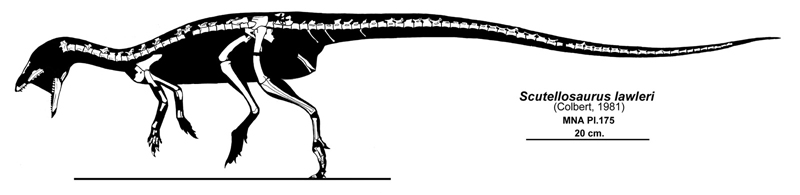
Unlike later members of its group, Scutellosaurus combined a bipedal posture with rows of small bony plates and scutes embedded in the skin. These osteoderms provided protective armour along the back and flanks but did not form the large plates or clubs seen in later species. The hindlimbs were longer than the forelimbs, indicating predominant bipedal locomotion, and the skull was lightly built and adapted for a plant-based diet.
Classification and relationships
Scutellosaurus is placed within the Thyreophora, the clade that includes all armoured dinosaurs (Thyreophora). It is regarded as one of the most basal, or primitive, members of this lineage (basal). Its anatomy links it to slightly later genera such as Emausaurus and Scelidosaurus and contrasts with the much larger quadrupedal forms like Ankylosaurus, Stegosaurus and Huayangosaurus.
Fossil record and discovery
Fossils of Scutellosaurus come from western North America. The preserved material includes partial skeletons that reveal both the skeleton and the distribution of osteoderms. Although remains are not as complete as those for some later thyreophorans, they are sufficient to characterise its unique combination of a bipedal frame and dermal armour.
Paleobiology and ecology
Functionally, Scutellosaurus was a low-browsing herbivore that likely fed on soft vegetation. Its small size and fleet legs would have helped it evade predators of the time, while the rows of osteoderms offered some protection. The animal’s anatomy shows an early stage in the evolution of defensive body armour, illustrating how armour developed before the transition to large, heavy, quadrupedal forms.
Importance and notable facts
Scutellosaurus is significant because it documents an intermediate condition in thyreophoran evolution: a combination of ancestral bipedal locomotion with the novel acquisition of osteoderms. This makes it a key taxon for understanding how later stegosaurs and ankylosaurs evolved their distinctive body plans. For concise summaries and further information see general dinosaur resources, introductions to the Thyreophora, and comparative pages on Scelidosaurus and Stegosaurus. Additional references and public resources include pages linked here: Early Jurassic context, armour structure, basal thyreophorans, ankylosaur overview, and Huayangosaurus comparison.
Questions and answers
Q: What is Scutellosaurus?
A: Scutellosaurus is a small bipedal herbivorous dinosaur from the Lower Jurassic period, 200–196 million years ago.
Q: How long was Scutellosaurus?
A: Scutellosaurus was about a metre long.
Q: What is the position of Scutellosaurus with other dinosaurs?
A: Scutellosaurus is placed in the Thyreophora with the other armoured dinosaurs.
Q: How is Scutellosaurus related to other dinosaurs?
A: The closest relatives of Scutellosaurus may have been Emausaurus and Scelidosaurus.
Q: Were all armoured dinosaurs quadrupedal like Ankylosaurus, Stegosaurus and Huayangosaurus?
A: Yes, all armoured dinosaurs, except for Scutellosaurus, were quadrupedal.
Q: What is the significance of Scutellosaurus's bipedalism?
A: The lightly built bipedal Scutellosaurus is similar in form to the ancestral dinosaurs, which were also bipedal.
Q: Why is Scutellosaurus considered the most basal (primitive) form of the Thyreophora?
A: Scutellosaurus was one of the earliest members of the Thyreophora group, and its form is similar to the ancestral bipedal dinosaurs, making it the most basal form of the group so far known.
Related articles
Author
AlegsaOnline.com Scutellosaurus — a small early armoured dinosaur Leandro Alegsa
URL: https://en.alegsaonline.com/art/88244