
Screw thread
A screw thread is a helical ridge used to convert rotation to linear motion, join parts, and provide mechanical advantage. This article explains forms, parts, manufacture, uses, and notable distinctions.
A screw thread is a raised helical ridge that runs around a cylinder or cone and converts rotational motion into linear motion. In simple terms, a thread is the spiral groove that allows a screw to advance when turned. A helical ridge may be formed on a straight cylinder (a straight or parallel thread) or on a cone (a tapered thread) that changes diameter along its length; this geometry affects how the thread mates and seals.
Image gallery
10 Images





Basic characteristics and terminology
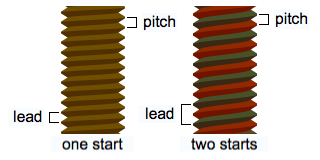
Key features of a thread include the crest (top of the ridge), the root (bottom of the groove), the pitch (the axial distance between adjacent thread crests), and the lead (the linear distance a screw advances in one full revolution). Pitch and lead are equal for a single-start thread; multiple-start threads advance more per turn. Threads are described by their form (cross-sectional shape), size, and direction — most are right-handed, but left-handed threads exist for specific uses.
Forms, hand, and sealing
Common thread forms include the V-shaped profile used for general fastening, trapezoidal profiles for power transmission, and specialized forms for pipe connections. Tapered threads help create a mechanical seal when tightened, while parallel threads usually require a gasket or washer for fluid-tight joints. The thread's handedness (right or left) determines which way it is turned to tighten.
How threads produce force
Mechanically, a screw thread is one of the classical simple machines: it transforms torque into an axial force and can provide mechanical advantage. Turning a nut on a bolt is analogous to driving a wedge into a gap; friction and small elastic deformations between mating surfaces determine how securely parts hold. The theoretical mechanical advantage depends on the lead of the thread and is reduced in practice by friction and surface finish.
Manufacture, standards, and variations
Threads are produced by cutting, rolling, grinding, or molding, depending on material and required precision. Cold rolling produces smooth, stronger threads for mass production, while single-point cutting or grinding is used for high-precision or large-diameter threads. Standardized systems (metric, unified, and pipe thread families) define basic dimensions and tolerances so parts from different manufacturers are compatible. For more on standards see simple machines and general references like mechanical advantage.
Applications and notable distinctions
- Fastening: bolts, machine screws, and self-tapping screws join components.
- Motion control: lead screws and jacks convert rotary input to precise linear movement.
- Sealing: tapered pipe threads create pressure-tight joints in plumbing and hydraulic systems.
- Adjustment: threaded knobs and collars allow fine adjustments in instruments and fixtures.
Practical distinctions include single-start versus multiple-start threads, right- versus left-handed threads, and straight versus tapered profiles. Terms and parts frequently discussed alongside threads include the nut, the interaction similar to a wedge, and the role of friction in holding a joint. For historical background and mathematical descriptions, readers may consult introductory engineering texts or more specialized resources linked under thread geometry and other technical references.
For concise definitions and comparisons among forms, see brief guides such as helical thread overview and manufacturer notes on standards. Additional introductory material and diagrams can be found via general technical resources and standards documents indicated by authoritative sources on wedges and screws and common reference collections about friction and thread performance.
Understanding screw threads is fundamental for mechanical design, manufacturing, and everyday repairs: their geometry, production method, and intended function determine how they should be selected and used.
Questions and answers
Q: What is a screw thread?
A: A screw thread is a helical structure wrapped around a cylinder or cone that gives mechanical advantage.
Q: What are the two types of screw threads?
A: The two types of screw threads are straight threads and tapered threads.
Q: How does tightening a nut to a bolt work?
A: Tightening a nut to a bolt is like driving a wedge into a gap until it sticks through friction and plastic deformation.
Q: What is the mechanical advantage of a screw thread dependent on?
A: The mechanical advantage of a screw thread depends on its lead, which is the linear distance the screw travels in one turn or revolution.
Q: How many simple machines give mechanical advantage?
A: Six simple machines give mechanical advantage, and a screw thread is one of them.
Q: What is a straight thread?
A: A straight thread is a screw thread wrapped around a cylinder in the form of a helix.
Q: What is a tapered thread?
A: A tapered thread is a screw thread wrapped around a cone in the form of a helix.
Related articles
Author
AlegsaOnline.com Screw thread Leandro Alegsa
URL: https://en.alegsaonline.com/art/88214
Sources
- books.google.com : Mathematics for Machinists