
Scottish Gaelic (Gàidhlig)
Scottish Gaelic (Gàidhlig) is a Goidelic Celtic language of Scotland, related to Irish and Manx. It has distinct dialects, a written tradition in Latin script, and ongoing cultural and revitalization efforts.
Overview
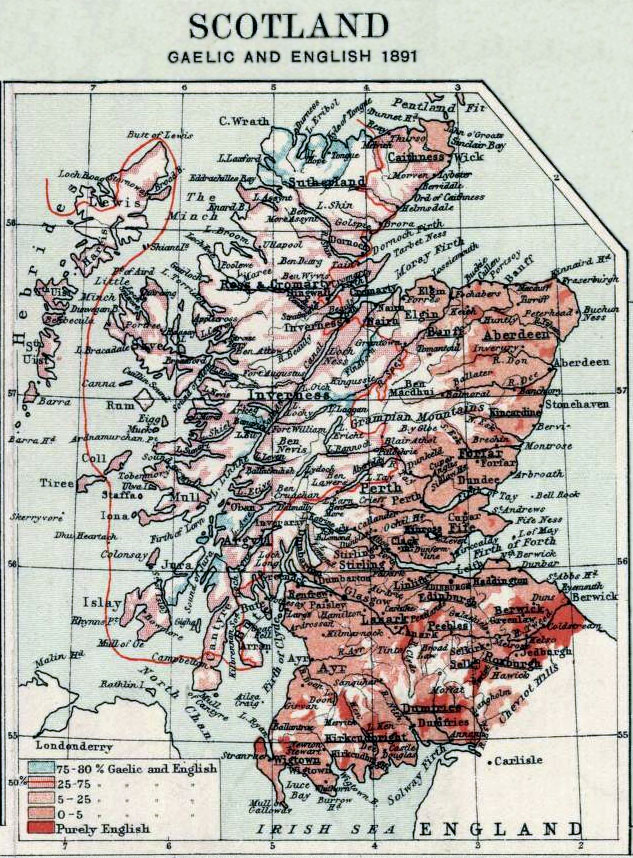
Scottish Gaelic, known in its own language as Gàidhlig and often called Scots Gaelic in Scottish English, is one of the native Celtic languages of Scotland. It belongs to the Goidelic branch of the Celtic family and is closely related to Irish and Manx; together these three are often grouped as the Goidelic languages. Its historical heartlands include the Highlands and the Hebridean islands, though Gaelic influence appears across many Scottish place names and traditions. For the Scottish English name see Scots Gaelic.
Image gallery
10 Images




Characteristics
Gàidhlig uses the Latin alphabet with a limited set of diacritics and conventions distinct from English spelling. Phonology features broad and slender consonant contrasts, initial consonant mutations, and a stress pattern typically on the first syllable. Grammatically it preserves a VSO (verb–subject–object) order in many constructions, uses prepositions that combine with pronominal forms, and distinguishes noun gender. For linguistic classification see Goidelic languages.
History and development
The language developed from Old Irish brought to Scotland in the early medieval period and evolved its own regional dialects over centuries. It once served as a dominant everyday language across much of Scotland before social and political changes — including the spread of Scots and English — reduced the number of speakers. Place names, folklore, poetry and song preserved many Gaelic elements even in areas where everyday use declined. Celtic relatives include Welsh, Cornish and Breton, which belong to the Brittonic branch.
Contemporary use and revitalization
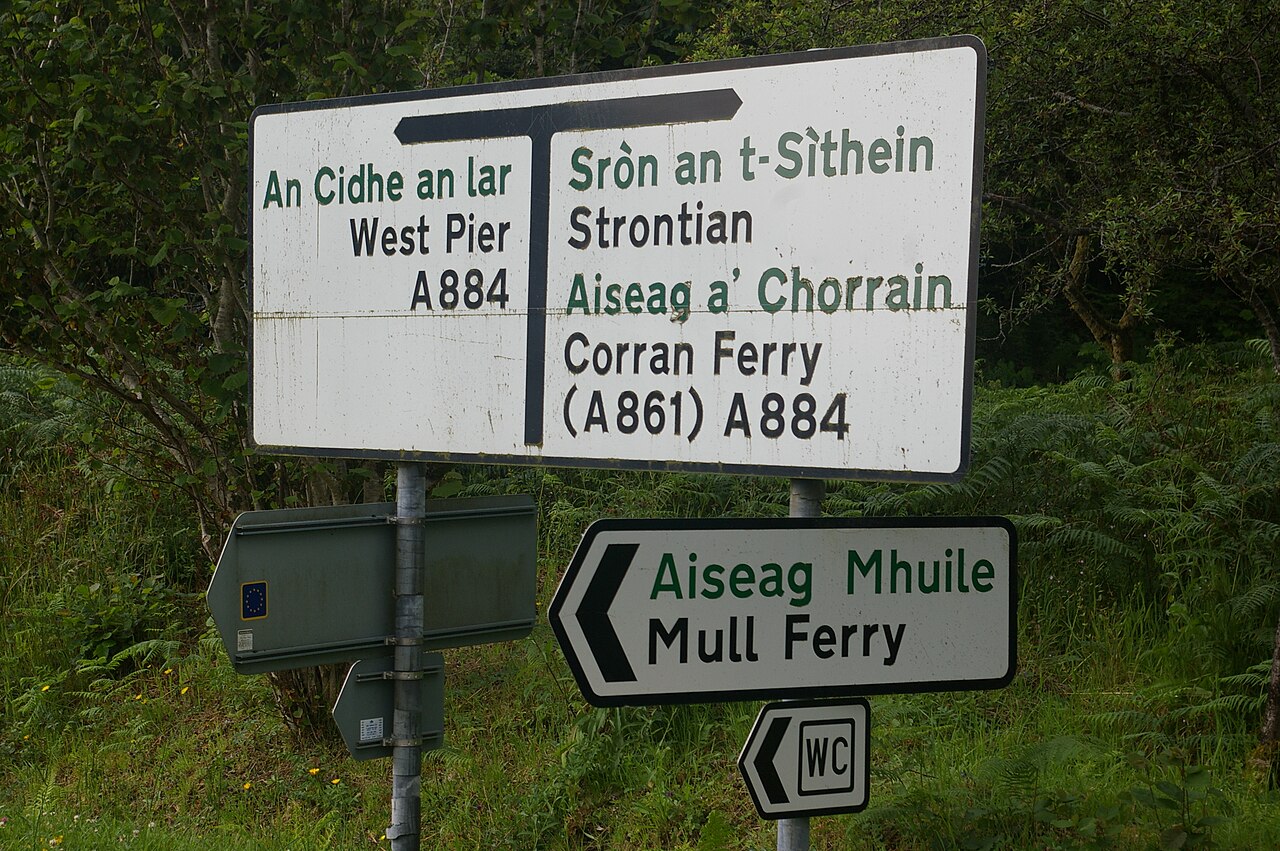
In recent decades there has been renewed public and institutional interest in supporting Scottish Gaelic. Efforts include Gaelic-medium education, broadcasting, publishing, and cultural programs aimed at increasing transmission to younger generations. Gaelic remains central to many cultural practices — music, storytelling and festivals — and appears on road signs and official documents in parts of Scotland where it is actively promoted.
Applications and cultural importance
Beyond everyday communication in communities where it survives, Gaelic plays a role in scholarship, the arts and regional identity. It is used in modern literature, song, broadcasting and academic study. Learning resources and community classes exist both within Scotland and among diaspora communities, and the language is often a focal point for heritage and tourism.
Distinctions and notable facts
- Scottish Gaelic is distinct from Scots (a Germanic language variety) and from Scottish English; these are separate linguistic traditions.
- Dialectal variation remains important: island and mainland varieties can differ noticeably in pronunciation and vocabulary.
- Orthography reflects traditional forms but adapts to modern media, and contemporary signage often uses bilingual presentation.
Questions and answers
Q: What is Scottish Gaelic?
A: Scottish Gaelic, also known as Gàidhlig, is a Celtic language.
Q: How is Scottish Gaelic commonly referred to in Scottish English?
A: Scottish Gaelic is commonly referred to as Scots Gaelic in Scottish English.
Q: What is the relationship between Scottish Gaelic, Irish Gaelic, and Manx Gaelic?
A: Scottish Gaelic, Irish Gaelic, and Manx Gaelic are all Goidelic languages and sister languages.
Q: What are the Welsh language, Cornish language, and Breton language related to?
A: The Welsh language, Cornish language, and Breton language are Brittonic or Brythonic languages.
Q: What is the pronunciation of Scottish Gaelic?
A: Scottish Gaelic is pronounced "Gah-lick."
Q: Is Scottish Gaelic a widely spoken language?
A: No, Scottish Gaelic is not a widely spoken language.
Q: What is the significance of the relationship between Scottish Gaelic and other Celtic languages?
A: The relationship between Scottish Gaelic and other Celtic languages highlights the close cultural and linguistic ties of the Celtic world.
Related articles
Author
AlegsaOnline.com Scottish Gaelic (Gàidhlig) Leandro Alegsa
URL: https://en.alegsaonline.com/art/88133
Sources
- cnag.org.uk : Census 2001 Scotland: Gaelic speakers by council area
- gro-scotland.gov.uk : "News Release – Scotland's Census 2001 – Gaelic Report"
- museum.gov.ns.ca : Nova Scotia Museum's Curatorial Report No. 97
- gov.ns.ca : Gaelic in Nova Scotia
- mla.org : "Language by State – Scottish Gaelic"
- omi.wa.gov.au : "Languages Spoken At Home"
- lrrc3.sas.upenn.edu : "Census 2001 Scotland: Gaelic Language – first results"