
Bantu languages: distribution, structure, history and significance
Overview of the Bantu languages: their geographic range, linguistic features, historical expansion, major languages, and cultural importance across central, eastern, and southern Africa.
The Bantu languages form a major branch of the Niger–Congo family and are spoken by hundreds of millions across central, eastern and southern Africa. Estimates vary, but linguists commonly count roughly five hundred to six hundred distinct Bantu languages within the wider Southern Bantoid grouping. Their speakers occupy a vast area stretching east and south from the forested regions near Cameroon and adjacent parts of West Africa. Bantu varieties differ greatly in size: some, like Swahili, function as regional lingua francas with many second-language users, while others are spoken by a single community.
Image gallery
3 Images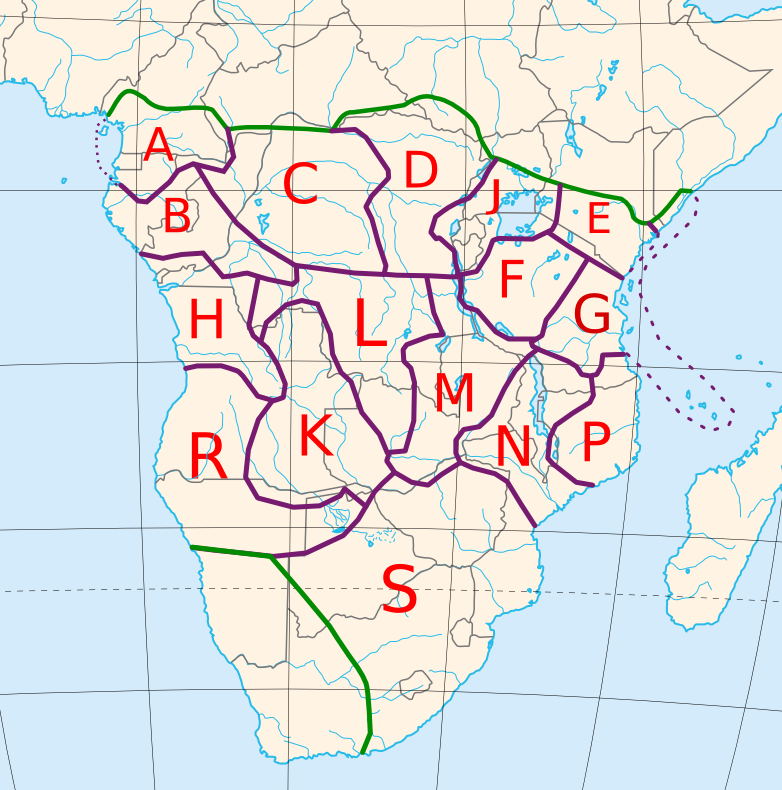


Key linguistic characteristics
Bantu languages share several structural traits that help linguists group them together. A prominent feature is a system of noun classes—sometimes described as grammatical genders—that mark nouns and require concord on adjectives, verbs and other modifiers. Many Bantu tongues are agglutinative, forming words by stringing together affixes with relatively predictable meanings. Tone plays an important role in meaning and grammar in many languages, although the exact tonal systems vary. Verbal morphology tends to be elaborate: tense, aspect, mood, negation and subject or object agreement are often expressed with affixes attached to a verb stem.
History and the Bantu expansion
Most scholars trace the origins of proto-Bantu to a region near the borderlands of modern eastern Nigeria and eastern Nigeria and Cameroon. Beginning several thousand years ago, speakers of early Bantu varieties spread eastward and southward in what is commonly called the Bantu expansion. This movement carried farming, ironworking and new social networks into areas previously inhabited by hunter-gatherer and pastoral groups. Dates and routes of the expansion remain active topics of research, and the picture includes multiple waves of contact, local adoption and language shift.
Major languages and distribution
- Swahili – widely used as a second language and a trade language along the East African coast and beyond; it has the largest total number of speakers among Bantu languages (Swahili).
- Shona – one of the largest native-speaker Bantu languages, widely spoken in Zimbabwe and neighboring countries (Shona, Mozambique, Botswana, Zambia).
- Zulu – a major southern African language with many native speakers and significant cultural influence (Zulu).
Uses, literacy and cultural roles
Bantu languages serve varied social functions: local communication, oral literature, ritual speech, and increasingly formal roles in education, media and government where national language policies permit. Some have standardized orthographies and a growing body of written literature; others remain primarily oral. Contact with colonial languages—English, French and Portuguese—and with pan-African lingua francas has shaped vocabulary and usage patterns in many communities.
Classification and notable distinctions
Within the Bantu family, linguists use comparative methods to group languages into geographic series and subgroups. The term "Narrow Bantu" often refers to the core languages traditionally assigned to Guthrie’s zones, while broader classifications place Bantu inside the Southern Bantoid branch of Niger–Congo. Important contrasts exist in phonology (tone, consonant inventories), morphology (degree of agglutination, noun-class systems) and syntax (word order tendencies), so Bantu is best understood as a diverse family rather than a single type.
Research continues to refine the history, internal classification and sociolinguistic status of Bantu languages. For accessible further reading and country-specific information, see resources associated with the regions mentioned above: Cameroon, eastern Nigeria, Swahili, Shona, Mozambique, Botswana, Zambia, and Zulu.
Questions and answers
Q: What are the Bantu languages?
A: The Bantu languages are a branch of the Niger-Congo languages, spoken largely east and south of the present day country of Cameroon, in the regions commonly known as central Africa, east Africa, and southern Africa.
Q: How many languages are there in the Bantu family?
A: There are about 520 languages in the Bantu family.
Q: How many languages are there in the Southern Bantoid branch?
A: There are 670 languages in the Southern Bantoid branch which includes Bantu.
Q: Where did the Bantu languages come from?
A: The Bantu languages came from the region of eastern Nigeria or Cameroon.
Q: Which Bantu language has the largest total number of speakers?
A: Swahili is the Bantu language with the largest total number of speakers.
Q: Which Bantu language has the largest number of native speakers?
A: Shona is the Bantu language with the largest number of native speakers with 13.8 million speakers in Zimbabwe, Mozambique, Botswana and Zambia.
Q: When did the Bantu people spread southwards and eastwards?
A: About 2000 years ago the Bantu people spread southwards and eastwards, introducing agriculture and iron working, and colonizing much of the continent.
Related articles
Author
AlegsaOnline.com Bantu languages: distribution, structure, history and significance Leandro Alegsa
URL: https://en.alegsaonline.com/art/8807
Sources
- ethnologue.com : Ethnologue report for Southern Bantoid