
Scissor-tailed flycatcher (Tyrannus forficatus)
A North American flycatcher noted for its very long forked tail, aerial courtship display and insect diet; common on open prairies and the state bird of Oklahoma.
Overview
The scissor-tailed flycatcher (Tyrannus forficatus) is a distinctive passerine native to parts of the southern United States and Mexico. Easily recognized by its extremely long, forked tail and graceful flight, the species is an aerial insectivore belonging to the tyrant flycatcher family. It is sometimes called the Texas bird-of-paradise or swallow-tailed flycatcher in popular usage; ornithologists place it with the kingbirds and other members of the genus Tyrannus. For general information and species accounts see resources such as species overview and regional bird guides for United States and Mexico.
Image gallery
7 Images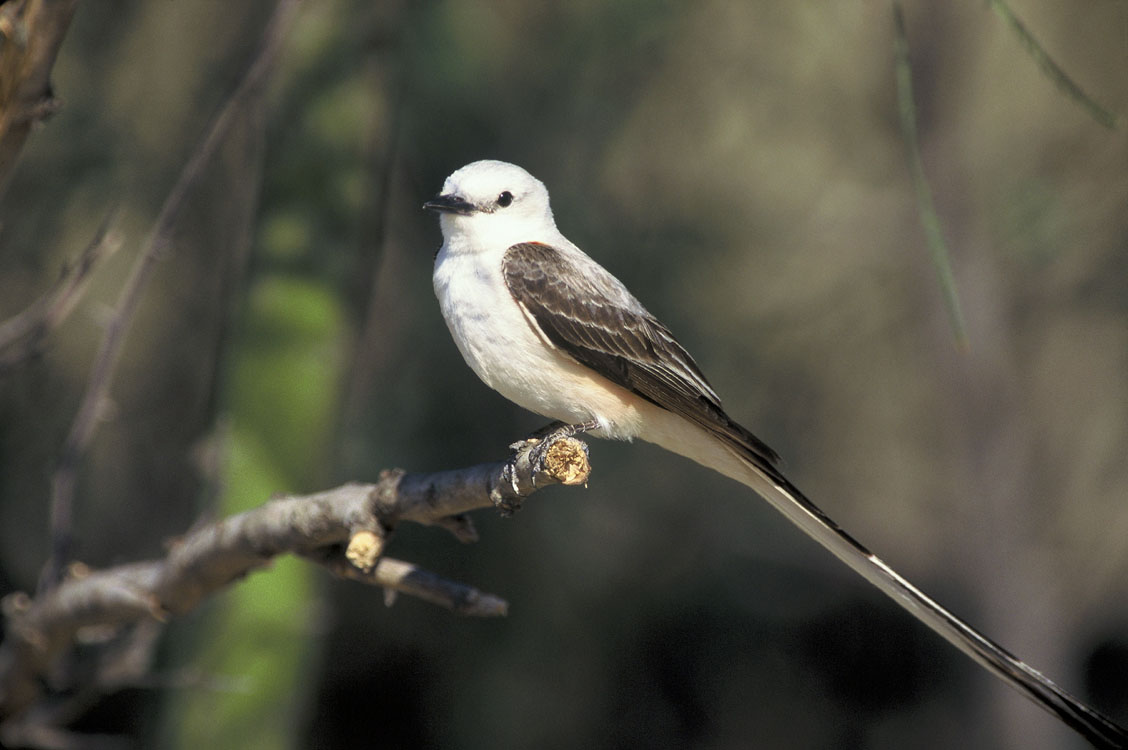


Identification and physical characteristics
Adults have a pale gray head and back with a whitish to pale gray breast and belly. A subtle pink or salmon wash on the flanks and underwing coverts is often visible at close range. The wings are darker, appearing sooty or blackish, and the long tail is jet black when viewed from a distance. Juveniles resemble adults but show a shorter tail and duller coloration until they reach maturity. Tail streamers are the most notable field mark: when spread in flight they create the scissor-like silhouette that gives the species its common name. Typical tail length in adults can reach up to about nine inches (roughly 23 cm), a dramatic proportion relative to the bird's body.
Behavior and diet
Scissor-tailed flycatchers hunt primarily by sallies from exposed perches, launching into the air to capture flying insects and returning to the same perch. Their diet consists largely of grasshoppers, crickets, flies, beetles and other arthropods, and they will also take spiders and occasionally small fruits. Because of this feeding habit they are often considered beneficial to agriculture; farmers and ranchers value their role in reducing pest insects. When perched, the tail is typically folded closed; in active flight the pair of long streamers open and close with each maneuver.
Breeding, display and nesting
During the breeding season males perform an energetic aerial courtship often called a "sky dance": climbing high above open areas, making V-shaped flights and plunging in zigzag dives while calling. This display is especially conspicuous in spring and early summer on roadside trees and fence posts. Nests are built in isolated trees or shrubs, commonly between about 2 and 9 meters (7–30 feet) above ground. Clutch size is commonly three to six eggs, and pairs may raise one or two broods in a season. Young birds develop the long tail gradually; immatures appear less showy than adults until their tail feathers grow.
Distribution, habitat and movements
The species breeds in open country across parts of the south-central United States, favoring prairies, savannas, farm country and roadside trees. Outside the breeding season many individuals move south into Mexico and adjacent regions. Habitats that offer scattered trees or fence posts for perching and open spaces for aerial foraging are preferred. For habitat descriptions and range maps consult regional resources such as field guides and conservation sites like habitat summaries.
Conservation and cultural importance
Historically, scissor-tailed flycatchers were sometimes targeted by collectors for their long tail feathers; poaching and localized persecution posed threats in the past. Today the species is commonly reported across much of its range and is generally regarded as stable, though local declines can occur where habitat is lost. It has cultural significance in parts of the United States: notably, it is the state bird of Oklahoma and features in local wildlife appreciation and tourism. Photographs and accounts of the species' aerial displays and nesting behavior are widely available; for further reading see avian behavior resources and regional conservation pages.
Notable facts
- Common name derives from the scissor-like appearance of the long, deeply forked tail; scientific and former Latin names also reference this feature.
- Because they catch many pest insects, scissor-tailed flycatchers are often welcomed by agricultural communities.
- Watching the male's "sky dance" is a popular springtime wildlife activity along roads and open country; birders often seek these displays in breeding areas.
For local observation tips, seasonal timing and identification comparisons with related kingbirds and flycatchers consult regional birding guides or online databases: state and local birding resources.
Questions and answers
Q: What type of bird is a scissor-tailed flycatcher?
A: The scissor-tailed flycatcher (Tyrannus forficatus) is a type of bird that lives in North America, in the United States and Mexico.
Q: What does the scissor-tailed flycatcher eat?
A: The scissor-tailed flycatcher eats insects.
Q: How does the scissor-tailed flycatcher get its name?
A: The scissor-tailed flycatcher is named "scissor-tailed" because its tail looks like a pair of scissors.
Q: Where can you find scissortails in Oklahoma?
A: In Oklahoma, scissortails can be found on open prairies, along tree-lined roads, and along roadsides perched on fences, limbs and in isolated trees.
Q: What kind of performance do male scissortails put on during spring and early summer?
A: Male scissortails perform their famous "sky dance," which involves climbing about 100 feet in the air before making a series of V-shaped flights followed by an erratic zigzag course often somersaulting while uttering a rolling, cackling call.
Q: How high up do they usually nest?
A: Scissortail Flycatchers usually nest 7–30 feet above ground in an isolated tree.
Q: What are some distinguishing features of this bird species?
A: Scissors tailed Flycatchers are easily identified by their long scissor like tail which may reach nine inches long. During flight they open their tails like a pair of scissors and fold or close them when perching. They have pearl gray napes and backs with white breasts and sooty black wings with scarlet at the shoulders.
Related articles
Author
AlegsaOnline.com Scissor-tailed flycatcher (Tyrannus forficatus) Leandro Alegsa
URL: https://en.alegsaonline.com/art/88055