
Schwaz District, Tyrol, Austria
Alpine administrative district in Tyrol, Austria, centered on the town of Schwaz. Known for mountainous terrain, historic silver mining, tourism and cross‑border links. Area 1,887.49 km²; pop. ~83,873 (2019).
Overview
The Schwaz District is an administrative district in the federal state of Tyrol in Austria. The district covers 1,887.49 km² and had a population of about 83,873 people in 2019. Its administrative centre is the town of Schwaz, a historic market town that remains the district's cultural and economic hub.
Image gallery
2 Images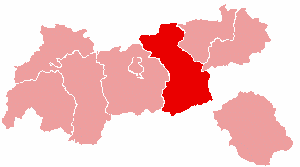
Geography and borders
Schwaz occupies a large portion of the Eastern Alps and includes steep mountain slopes, deep valleys and river corridors shaped by glacial and fluvial processes. It lies against international and regional boundaries: to the north it borders Bavaria and therefore Germany, to the east it meets the districts of Kufstein and Kitzbühel as well as portions of the Pinzgau region, to the south it reaches the frontier with South Tyrol in Italy, and to the west it borders Innsbruck‑Land. The Inn river and its tributaries provide major transport corridors through the district.
History and cultural features
The district has a long history shaped by alpine mining, agriculture and trade. In the late Middle Ages the Schwaz area became famous for extensive silver and copper mines; the wealth generated then supported local towns and monasteries and left a visible cultural legacy. Many villages retain traditional Tyrolean architecture, folk customs and seasonal festivals that reflect a blended rural and mining past.
Economy, tourism and land use
Today the local economy is a mix of tourism, light industry, agriculture and energy production. Winter sports and summer hiking are important—mountain resorts and alpine trails attract visitors for skiing, climbing and trekking—while forestry and high‑alpine pastures continue to support rural livelihoods. Hydropower installations and small manufacturing enterprises also contribute to the regional economy.
Transport and settlements
Good road and rail connections link Schwaz District with the Tyrolean capital and neighbouring countries, supporting commuting, freight and tourism. Prominent towns include the administrative centre of Schwaz and market towns such as Jenbach that serve as local service centres. Numerous smaller villages and seasonal settlements are scattered across valleys and high meadows.
Notable aspects and conservation
Parts of the district encompass nature reserves and protected alpine habitats, where conservation policies aim to balance tourism and environmental protection. The historic mining sites and local museums preserve the industrial heritage, while contemporary initiatives promote sustainable mountain tourism and regional culture.
- Border neighbours: Bavaria (Germany), South Tyrol (Italy).
- Adjacent Tyrolean districts: Kufstein, Kitzbühel, Innsbruck‑Land.
- Administrative centre: Schwaz; other local towns include Jenbach and regional communities.
For further regional details, official statistics and visitor information consult local administrative and tourism sources linked through regional portals and municipal pages.
Questions and answers
Q: Where is the Schwaz District located?
A: The Schwaz District is located in Tyrol, Austria.
Q: What are the borders of the Schwaz District?
A: The Schwaz District borders Bavaria (Germany) in the north, the districts of Kufstein, Kitzbühel and Pinzgau (Salzburg) in the east, South Tyrol (Italy) in the south, and the Innsbruck-Land district in the west.
Q: How big is the Schwaz District?
A: The Schwaz District has an area of 1,887.49 km².
Q: How many people live in the Schwaz District?
A: As of 2019, 83,873 people lived in the Schwaz District.
Q: What is the administrative center of the Schwaz District?
A: The administrative center of the Schwaz District is Schwaz.
Q: Which country borders the Schwaz District to the south?
A: South Tyrol (Italy) borders the Schwaz District to the south.
Q: Which other Austrian district borders the Schwaz District to the west?
A: The Innsbruck-Land district borders the Schwaz District to the west.
Related articles
Author
AlegsaOnline.com Schwaz District, Tyrol, Austria Leandro Alegsa
URL: https://en.alegsaonline.com/art/88005