
Schwarzschild metric — the spherically symmetric vacuum solution in general relativity
Metric that describes the spacetime around a non-rotating, uncharged spherical mass. First exact solution of Einstein’s equations; defines event horizon and Schwarzschild radius.
Overview
The Schwarzschild metric is the simplest nontrivial exact solution of Einstein's field equations describing the spacetime outside a static, spherically symmetric mass. Derived in 1916, it models the gravitational field of an isolated, non-rotating, uncharged body in vacuum and forms the baseline description for objects ranging from planets to black holes. It provides a coordinate expression for the invariant interval ds that governs how clocks tick and how objects move under gravity in the relativistic regime.
Image gallery
2 Images
Form and key features
In standard Schwarzschild coordinates (t,r,θ,φ) the line element can be written in words as: the time component is multiplied by (1 − 2GM/(rc^2)), the radial component by its reciprocal, and the angular part by r^2 times the standard sphere metric. The length scale r_s = 2GM/c^2 is called the Schwarzschild radius. At r = r_s the metric components in these coordinates diverge, signaling the event horizon of a black hole; at r = 0 there is a curvature singularity where classical general relativity breaks down.
The apparent singularity at r = r_s is a coordinate singularity, removable by changing coordinates (for example to Eddington–Finkelstein or Kruskal–Szekeres coordinates), whereas the divergence at r = 0 is a genuine physical singularity indicated by invariants such as the Kretschmann scalar.
History and derivation
The solution was obtained by Karl Schwarzschild in 1916 as an exact solution to the equations introduced by Einstein. It occupies a central place within general relativity and in modern astrophysics because it provides a simple model of a gravitational field in vacuum. Birkhoff's theorem shows that any spherically symmetric vacuum solution must be static and asymptotically flat and therefore equivalent to the Schwarzschild form outside the source region.
Physical consequences and observable effects
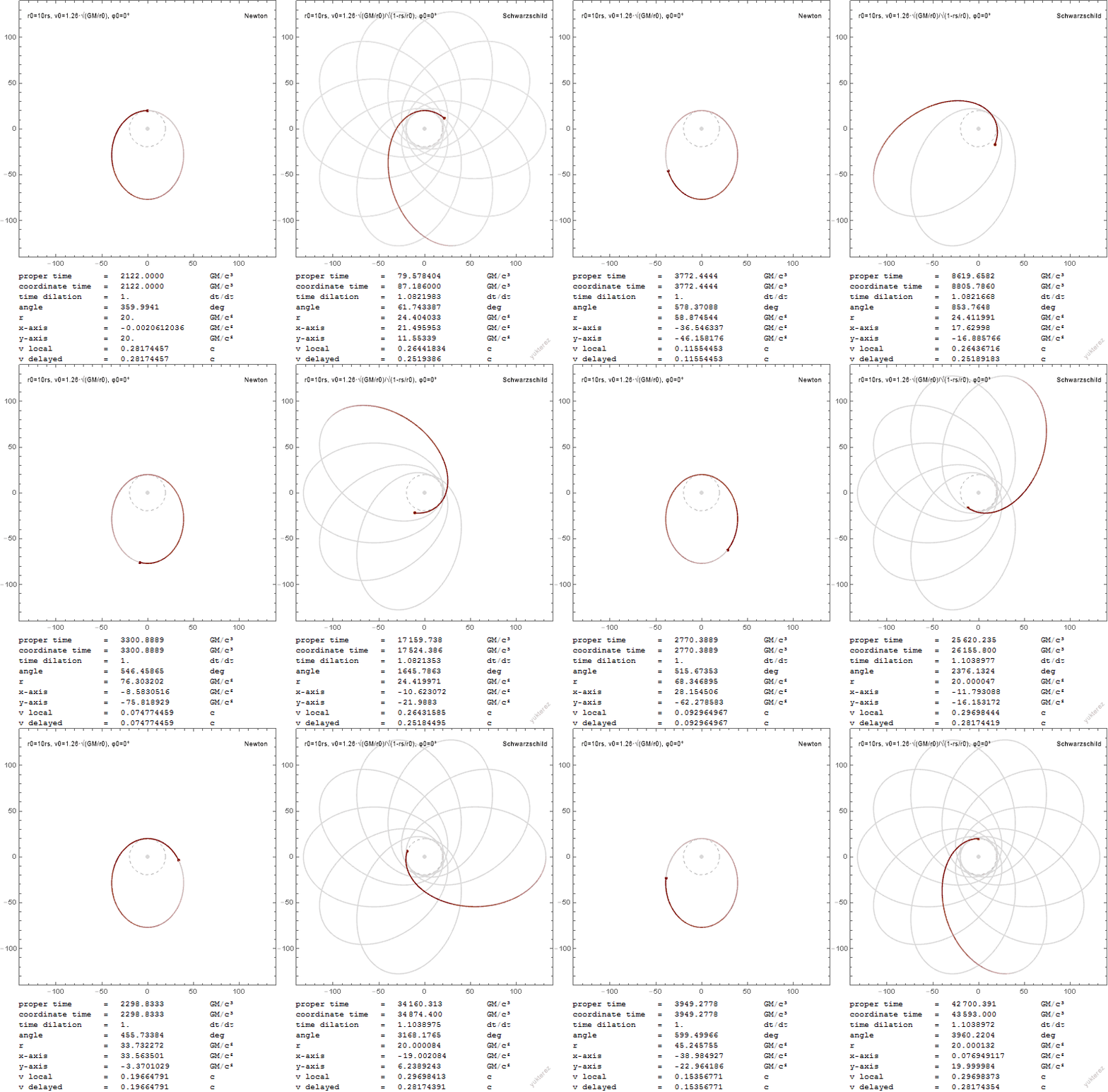
The Schwarzschild metric predicts several measurable phenomena: the advance of planetary perihelia, gravitational deflection of light passing near a mass, gravitational redshift of light climbing out of a potential well, and the existence of an event horizon for sufficiently compact objects. These predictions were among the first successful tests of relativity and remain important for modern experiments and observations, from solar-system probes to studies of compact objects.
- Perihelion precession of Mercury: secular shift explained by curved spacetime.
- Light bending: used in gravitational lensing and tests of deflection.
- Gravitational time dilation: relevant to clocks in orbit and GPS.
Uses, limitations and related solutions
As a vacuum, spherically symmetric solution it models the region outside an isolated star or black hole but excludes rotation, electric charge, or cosmological constant. Rotating objects require the Kerr metric; charged objects the Reissner–Nordström metric. The Schwarzschild solution assumes no large-scale magnetic fields and zero cosmological constant, properties often summarized when referring to a "Schwarzschild black hole" — a non-rotating, spherical black hole with no net charge or magnetic field (non-rotating spherical black hole, no magnetic field).
For pedagogy and practical modelling it remains widely used because of its relative simplicity and because many phenomena outside compact, rapidly rotating systems are well approximated by it. Extensions or coordinate choices make it suitable for describing horizon crossing and for numerical relativity initial data. For background reading on the gravitational field in the Schwarzschild context see sources that discuss the gravitational field in general relativity.
Further reading and context
The Schwarzschild solution is often presented together with discussions of experimental tests of relativity, methods to remove coordinate singularities, and comparisons to metrics that include rotation or charge. More technical expositions explore geodesic motion, photon spheres, and maximal analytic extensions. Introductory and advanced treatments are available in textbooks and reviews connected to the original derivation and to subsequent developments in relativistic astrophysics.
For foundational material and historical context consult sources on Schwarzschild, the original formulation of Einstein's field equations, and general reviews of general relativity and its applications in astrophysics.
Questions and answers
Q: What is the Schwarzschild metric?
A: The Schwarzschild metric is an equation from general relativity in the field of astrophysics that describes how a particle moves through the space near a black hole. It was calculated by Karl Schwarzschild as a solution to Einstein's field equations in 1916.
Q: What does a metric refer to?
A: A metric refers to an equation which describes spacetime; in particular, a Schwarzschild metric describes the gravitational field around a Schwarzschild black hole.
Q: What are some characteristics of the Schwarzschild black hole?
A: The Schwarzschild black hole is non-rotating, spherical, and has no magnetic field. In addition, its cosmological constant is zero.
Q: How can we describe the gravitational field around a Schwarzschild black hole?
A: We can describe it using the Schwartzchild metric equation which describes how particles move through space near this type of black hole.
Q: Who first calculated this equation?
A: Karl Schwartzchild first calculated this equation as a solution to Einstein's field equations in 1916.
Q: What does (ds)^2 represent in this equation?
A:(ds)^2 represents the distance between two points on spacetime measured with respect to time and space coordinates.
Related articles
Author
AlegsaOnline.com Schwarzschild metric — the spherically symmetric vacuum solution in general relativity Leandro Alegsa
URL: https://en.alegsaonline.com/art/88002
Sources
- arxiv.org : arxiv.org/pdf/physics/9912033.pdf
- sites.math.washington.edu : sites.math.washington.edu/~morrow/336_19/papers17/carson.pdf
- arxiv.org : arxiv.org