
Schist — Foliated Metamorphic Rock Rich in Platy Minerals
Schist is a medium- to high-grade foliated metamorphic rock dominated by platy and elongated minerals. It forms from mudstones or volcanic protoliths and is named for its ease of splitting along mineral layers.
Schist is a type of metamorphic rock characterized by a pronounced foliation and an abundance of plate-like or elongated minerals. As a member of the broader group of metamorphic rocks, schist typically displays visible mineral grains and a texture that permits it to be split into thin slabs. The term derives from the Greek root shown in the etymological record, connected with splitting, and is reflected in the common field description of the rock's tendency to part along mineral-rich planes (schíxein).
Image gallery
9 Images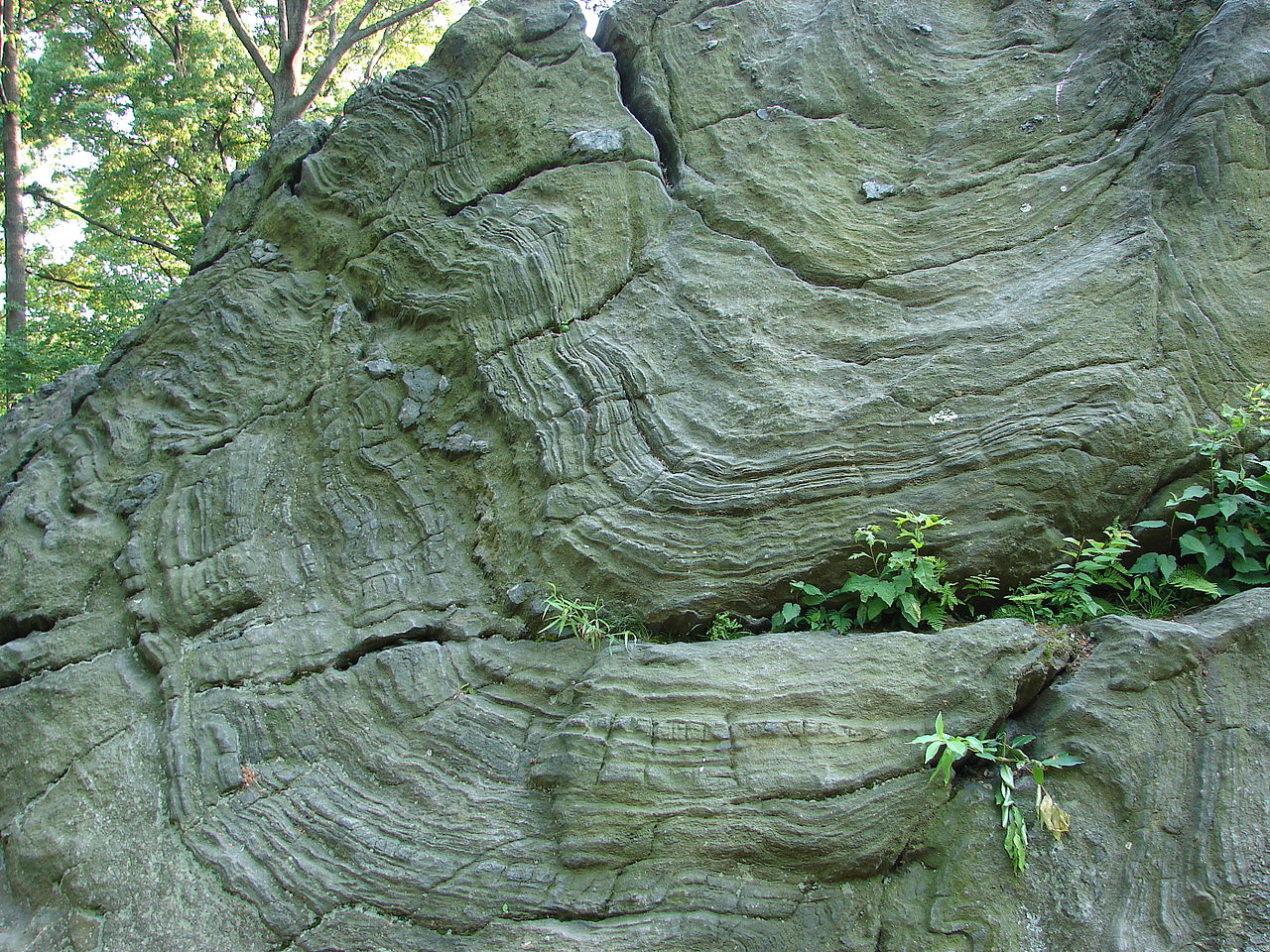


Characteristics and common minerals
By definition, schist contains more than half of its volume in platy or elongate minerals, which arrange themselves in parallel or subparallel layers under directed pressure. Typical constituents include:
- Micas (biotite and muscovite), which give schist its flaky appearance.
- Other sheet silicates such as chlorite and talc, common in lower-grade varieties.
- Silicate minerals like quartz and feldspar, which often occur as interleaved grains or ribbons.
- Amphiboles such as hornblende and accessory phases including graphite or garnet, which may grow as porphyroblasts.
Formation and metamorphic context
Schist commonly develops from clay-rich sediments such as mudstones and shales that undergo progressive metamorphism. Typical transitions pass from shale to slate to phyllite and then to schist as temperature and pressure increase; these stages record recrystallization and realignment of minerals (shale, slate). Schist can also form from fine-grained igneous precursors, including altered basalts or volcanic tuffs, when those rocks are subjected to regional metamorphism or contact metamorphic effects. The range of metamorphic conditions producing schist spans facies commonly described as greenschist through amphibolite grade, and the precise mineral assemblage reflects pressure-temperature history and chemical composition.
Classification and names
Schists are often named for their dominant or diagnostic minerals: for example, mica schist, garnet schist, or tourmaline schist. A protolith-based descriptor may be used when the original rock is known, but standard practice emphasizes the rock's present texture and mineralogy. The pronounced schistosity—an easily observed planar fabric—is the field criterion that separates schists from finer-grained phyllites and coarser gneisses.
Uses, engineering aspects, and notable facts
Because many schists split cleanly into slabs, they are used as dimension stone for facing, paving, and decorative work. Their mechanical behavior in construction and slope stability depends on the orientation and continuity of foliation planes; properly oriented schist can be strong, while unfavorably oriented foliation may create planes of weakness. Schists can host economic mineralization where fluids have concentrated metals along foliation or in porphyroblasts, and they contribute to scenic outcrops in mountain belts worldwide.
Field identification combines observation of foliation, visible mineral grains, and reaction to hand specimens (splitting, hardness, and lustre). Geologists routinely use thin section microscopy and chemical analysis to refine classifications and to reconstruct the metamorphic history recorded in a schist.
Questions and answers
Q: What are schists?
A: Schists are a group of metamorphic rocks which have lamellar (plate-like) minerals, such as micas, chlorite, talc, hornblende, graphite, and others.
Q: What type of mineral grains can be seen in schist?
A: The individual mineral grains in schist can be seen by the naked eye and are drawn out into flaky scales by heat and pressure.
Q: How is the word "schist" derived?
A: The word "schist" is derived from the Greek word σχίζειν schíxein meaning "to split", referring to how easily schists can be split along the plane in which the platy minerals lie.
Q: How do schists form?
A: Schists typically form from clays and muds that have gone through a series of metamorphic processes involving shales, slates and phyllites as intermediate steps. Some may also form from fine-grained igneous rocks such as basalts and tuffs.
Q: Are there different types of schists?
A: Yes, there are different types of schists including mica schists, graphite schists and chlorite schists. They are named after their mineral constituents such as garnet or tourmaline.
Q: What is dimension stone?
A: Dimension stone is stone that has been selected and cut to specific shapes or sizes.
Related articles
Author
AlegsaOnline.com Schist — Foliated Metamorphic Rock Rich in Platy Minerals Leandro Alegsa
URL: https://en.alegsaonline.com/art/87876