
Scheherazade
Scheherazade is the legendary storyteller of the One Thousand and One Nights whose cunning and narrative gift save her life and transform a vindictive king; she is a lasting symbol of storytelling and female agency.
Scheherazade is the central narrator and a legendary figure associated with the medieval collection commonly known in English as One Thousand and One Nights. In the frame story she volunteers to marry a king who has been executing his brides each dawn. By telling a series of tales and deliberately breaking them off at suspenseful moments, she prolongs her life night after night and, according to the best-known versions, eventually persuades the king to spare her.
Image gallery
6 Images


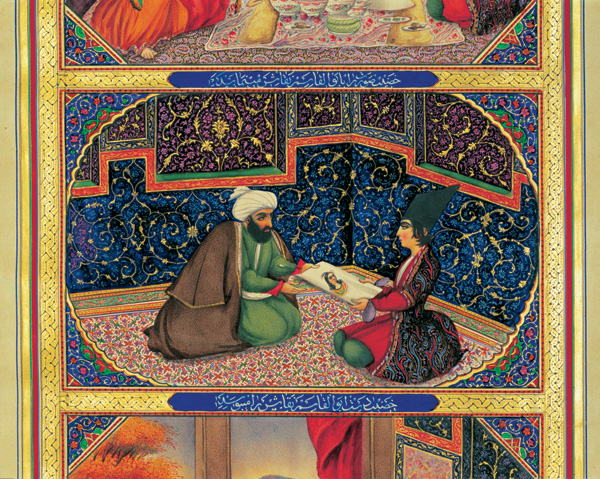
Origins and textual history
The character of Scheherazade and the frame that surrounds the tales developed over many centuries across the Middle East and South Asia. The Nights is a composite collection with material drawn from Persian, Indian and Arabic oral and written traditions; the form of the frame story varies between manuscripts and translations. The name appears in several spellings — often as Shahrazad or Shahrazād — reflecting transmission through Persian and Arabic languages. Scholars emphasize that the extant corpus reached its familiar shape only after successive additions, redactions and translations.
Frame narrative and plot
In the best-known outline, a ruler — commonly called Shahryar — has been betrayed and reacts by marrying a succession of women and ordering their execution the morning after the marriage. Scheherazade, the vizier’s daughter, offers to wed him. During the night she tells the king an engrossing tale but stops at daybreak at a moment of high tension, promising to finish the story the following evening. This tactic of serial cliffhangers continues for 1,001 nights in most late versions. The gradual effect of her storytelling is moral and humanizing: the king becomes curious, entertained and ultimately transformed, leading to a reprieve and later reconciliation. The episodes Scheherazade narrates range widely in tone and content, from adventure and romance to moral exempla.
Themes and interpretation
Scheherazade embodies several interlocking ideas: the power of narrative to postpone violence or death; the intellectual agency of a woman who uses wit rather than force; and the role of storytelling as social instruction and entertainment. Literary critics and historians have read the frame as a commentary on monarchy, justice and the ethics of listening. Because the Nights grew out of oral and courtly cultures, the frame also highlights the exchange between performer and audience — Scheherazade’s tales are a workplace for persuasion, pedagogy and cultural memory.
Legacy and adaptations
The figure of Scheherazade has inspired artists, composers, filmmakers and writers for two centuries. Notable responses include orchestral music, stage productions, novels and films that reimagine her voice and perspective. Some of the most famous individual stories associated with the Nights, such as Sinbad, Ali Baba and Aladdin, became widely known through later European translations and additions rather than the earliest Arabic manuscripts. Modern adaptations often emphasize Scheherazade’s resourcefulness and interpret her as a symbol of resistance or creative survival.
Notable facts and distinctions
- Name and meaning: The Persian-derived name is often taken to mean something like "born in the city" or "noble-born," though exact etymologies vary with language and spelling.
- Variations: Manuscripts differ in the number and order of tales; some well-known episodes entered the European imagination only after translators and travelers popularized them.
- Symbolic use: Scholars, feminist critics and storytellers have adopted Scheherazade as a figure representing verbal skill and moral persuasion.
- Popular motif: Her use of interrupted stories to postpone punishment is one of the most cited examples of the cliffhanger device in world literature; readers and audiences continue to find the frame resonant.
Because the Nights survived through a mixture of oral transmission, manuscript copying and cultural exchange, Scheherazade’s portrait is both specific and fluid: she is a named protagonist in a particular frame yet also an archetype of the storyteller whose voice reshapes a violent world into a space for narrative resolution. For more on the collection and its transmission see related overviews, and for discussions of the dramatic stakes in the frame see commentary that treats the king’s executions and reprieve as central to Scheherazade’s strategy in the frame story.

Questions and answers
Q: Who is Scheherazade?
A: Scheherazade is a legendary Persian queen who is the storyteller in One Thousand and One Nights.
Q: What is the story of One Thousand and One Nights about?
A: The story tells of an Arabian king who married a young girl every night and would have her head chopped off the next day. Scheherazade tells stories to the king to keep him interested and prolong her life.
Q: How many women had the Arabian king killed before meeting Scheherazade?
A: The Arabian king had already killed 3000 women before meeting Scheherazade.
Q: Why did Scheherazade tell stories to the Arabian king?
A: Scheherazade told stories to the Arabian king to keep him interested and prolong her life.
Q: How long did Scheherazade keep telling stories to the Arabian king?
A: Scheherazade kept telling stories to the Arabian king for 1001 nights.
Q: Did the Arabian king fall in love with Scheherazade?
A: Yes, the Arabian king fell in love with Scheherazade.
Q: What was the outcome for Scheherazade?
A: The Arabian king did not have Scheherazade executed, and they had three children together.
Related articles
Author
AlegsaOnline.com Scheherazade Leandro Alegsa
URL: https://en.alegsaonline.com/art/87846