
Scallop (Pectinidae): biology, ecology and human uses
Scallops are marine bivalve molluscs (family Pectinidae) known for their ribbed shells, ability to swim by clapping valves, numerous species worldwide, and importance as seafood and cultural symbol.
Overview
Scallops are marine bivalve molluscs belonging to the family Pectinidae. They occur around the world in a range of marine environments, from shallow coastal waters to deeper continental shelves. The group is large and diverse, with several hundred living species recognized; many are ecologically important grazers, suspension feeders and prey for larger animals.
Image gallery
10 Images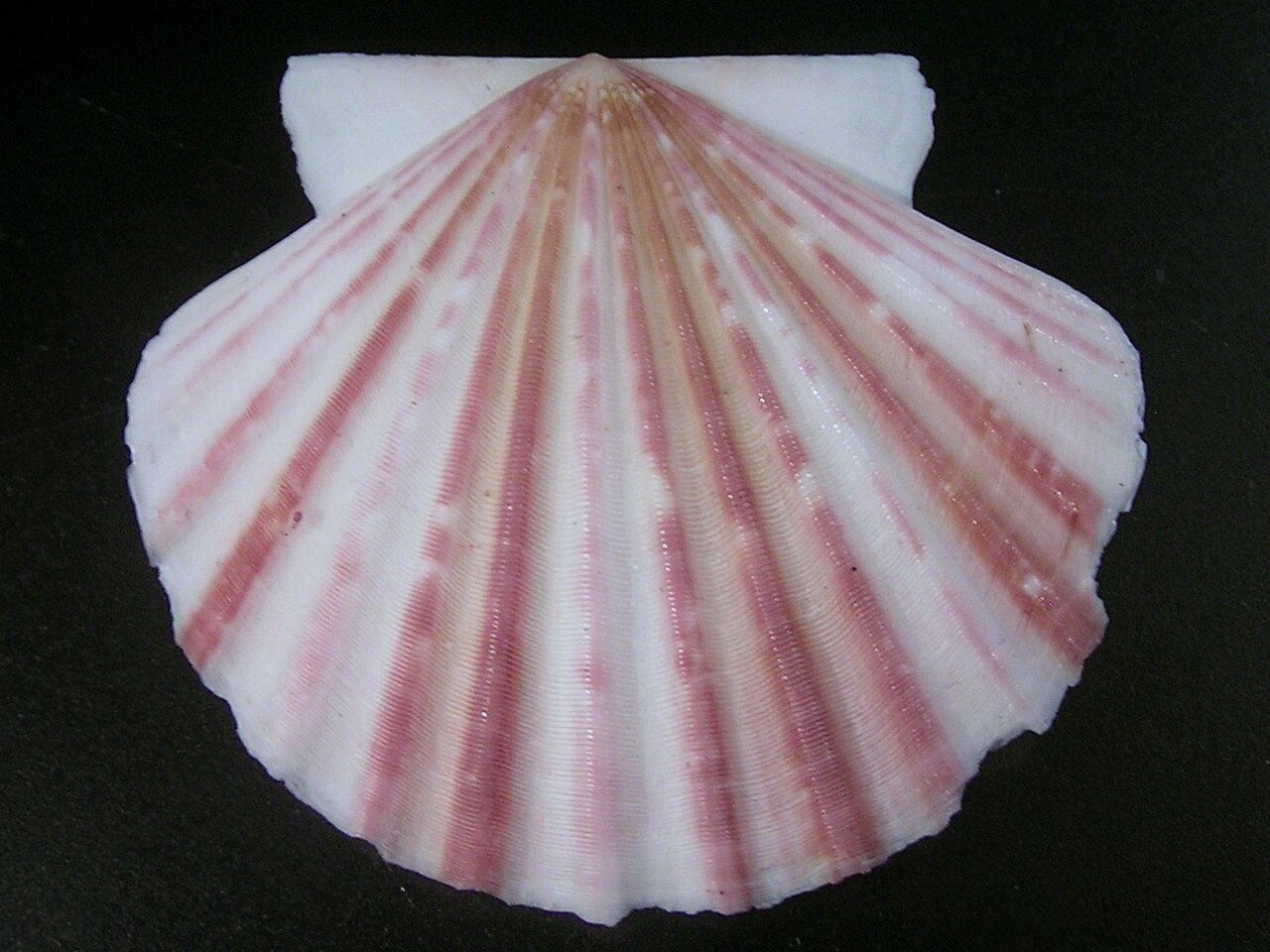


Form and behaviour
Like other bivalves, a scallop has two hinged shells called valves that enclose its soft body. The powerful central adductor muscle that closes the valves is the part most commonly eaten by humans. Scallop shells are typically fan-shaped and ribbed; sizes vary by species but many commercial types reach diameters of about 10–15 cm. The mantle edge bears dozens of simple, light-sensitive eyes that detect motion and changes in light. Many scallops can swim by rapidly clapping their valves together to expel water, a distinctive escape response that helps them evade predators.
Anatomical and ecological notes
Scallops have a range of lifestyles: some live free on sandy or gravelly bottoms, some rest on or under rocks, and juveniles of some species attach temporarily with byssal threads. They are filter feeders, using ciliated gills to capture plankton and suspended particles. Predators include starfish, crabs, fishes and sea birds; the swimming behaviour and quick shell closure are key anti-predator adaptations. Scallops can reproduce either seasonally or year-round depending on climate and species, and many form the basis of local benthic communities.
Human use, fisheries and aquaculture
Scallops are prized in many cuisines for their firm, sweet adductor muscle. In culinary contexts, the term "scallop" generally refers to this muscle; the attached gonad or "roe" is eaten in some cultures as well. Several scallop species support commercial fisheries and aquaculture operations worldwide. Management of wild stocks includes size limits, seasonal closures and quotas to reduce overfishing; aquaculture techniques aim to provide a stable supply and reduce pressure on wild populations.
History, names and cultural significance
The English name derives from Old French and earlier roots referring to the shell. Scallop shells have long been used as motifs in art and heraldry and are famously associated with pilgrimage—the stylized scallop shell is a symbol of the routes to Santiago de Compostela. The distinctive fan-shaped shells are also commonly found in decorative arts and architecture.
Notable facts and distinctions
- Scallops are unique among many bivalves for their active swimming capability rather than permanent attachment to a substrate.
- The numerous simple eyes on the mantle margin give scallops good sensitivity to light and motion but not sharp images.
- Shell coloration and patterns vary widely among species and populations; many shells show radial ribs and concentric growth lines.
Further information
- General taxonomy and classification
- Bivalve anatomy overview
- Mollusc diversity
- Family Pectinidae details
- Global distribution and habitats
- Adaptations and swimming mechanics
- Predator avoidance behaviours
- Culinary uses and recipes
- Seafood industry and fisheries
- Shell colour variation and pigment
- Reproductive biology of scallops
- Historical and cultural significance
- Conservation, management and aquaculture
For regional species, local field guides and fisheries reports offer species-level information and identification keys. Scholarly reviews and marine biology texts discuss the physiology, ecology and the role scallops play in coastal ecosystems.
Questions and answers
Q: What is a scallop?
A: A scallop is a marine bivalve mollusc of the family Pectinidae.
Q: Where do scallops live?
A: Scallops live in all the world's oceans.
Q: How many species of scallops are there?
A: There are over 300 living species of scallop.
Q: What is the main adaptation of scallops?
A: The main adaptation of scallops is the ability to swim by clapping their valves together.
Q: What is the reputation of scallops as a food source?
A: Scallops have a good reputation as a food source.
Q: What is a bivalve?
A: A bivalve is a type of mollusc with one hinged shell; each half is known as a valve.
Q: Why are scallops called "scallop"?
A: The name "scallop" comes from the Old French escalope, which means "shell".
Tags
Related articles
Author
AlegsaOnline.com Scallop (Pectinidae): biology, ecology and human uses Leandro Alegsa
URL: https://en.alegsaonline.com/art/87754
Sources
- books.google.com : International Wildlife Encyclopedia
- marinelab.fsu.edu : "Article about Scallops"
- etymonline.com : "Origin of the word "Scallop""
- asknature.org : Eyes detect changing movement patterns: queen scallop - Ask Nature - the Biomimicry Design Portal: biomimetics, architecture, biology, innovation inspired by nature, industria...
- redwood.berkeley.edu : The evolution of eyes
- naturalhistory.museumwales.ac.uk : "Bivalve shell structures"
- books.google.com : Journal of the Fisheries Research Board of Canada
- books.google.com : Marine fisheries ecology
- jstor.org : "The Mesozoic marine revolution; evidence from snails, predators and grazers"
- doi.org : 10.1666/07026.1
- researchgate.net : "The motile escape response of a sessile prey: a sponge-scallop mutualism"
- doi.org : 10.1016/0022-0981(75)90006-4
- sciencedirect.com : "Predation by asteroids, escape response, and morphometrics of scallops with epizoic sponges"
- doi.org : 10.1016/0022-0981(87)90071-2
- doi.org : 10.1016/0022-0981(79)90096-0