
Scale (music)
A musical scale is an ordered collection of notes by pitch that forms the basis of melody and harmony. This article explains structure, common types, history, uses and key distinctions.
Overview
A musical scale is a sequence of pitches arranged in ascending or descending order. Scales provide a framework for melodies, harmonies, and tonal centres used in many musical systems. The elements of a scale are individual notes ordered by pitch and related by specific pitch relationships; those relationships are often described in terms of frequency. Scales may be presented over a fixed span such as an octave, or they may be non-repeating collections used in certain traditions. When a scale is played from low to high it is called ascending; played from high to low it is descending. Some scales are identical both ways, while others differ in ascent and descent.
Image gallery
2 Images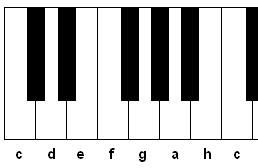

Structure and terminology
Scales are built from steps called intervals. An interval is the distance between two pitches and can be measured in semitones, whole tones, or more culturally specific units. The individual positions in a scale are often referred to as scale degrees; each degree has a functional role (for example, tonic, dominant, subdominant in many Western systems). Scales can be described by the number of distinct pitch classes they contain: pentatonic (five), hexatonic (six), heptatonic (seven), and chromatic (twelve) are common descriptors. Tuning—how the exact frequencies are spaced—also matters: equal temperament, just intonation and other systems alter the precise size of intervals and therefore the character of a scale.
Common types and examples
- Diatonic: A seven-note collection that includes major and natural minor scales, foundational in Western classical and popular music.
- Chromatic: Consists of all twelve semitones within an octave, used for full-palette melodic or harmonic color.
- Pentatonic: Five-note scales common in folk music worldwide, notable for their consonance and melodic simplicity.
- Modal: Scales built on different starting degrees of a parent scale (modes such as Dorian, Phrygian), historically important in medieval and modern music.
- Microtonal and non-Western: Many musical cultures use scales with more or fewer steps, unequal intervals, or tones smaller than a semitone.
History and cross-cultural development
Scales evolved independently in many musical cultures. In the Western tradition, theorists described modal systems in the Middle Ages and later codified diatonic patterns that led to the major-minor tonal system. Other regions developed distinct scale practices: Indian classical music uses raga systems with specific ascending and descending forms and ornamentation; East Asian music often features pentatonic or heptatonic collections with characteristic interval patterns. Ethnomusicologists study how scales relate to instruments, vocal technique, and cultural concepts of consonance and expression.
Uses, importance and examples
Scales guide composition, improvisation and ear training. Composers select scales to shape mood, tension and resolution: a major scale commonly conveys brightness, while certain modal or microtonal scales create exotic or ambiguous tonal colors. In improvisation, scale choices determine which notes fit well over given harmonies. Musicians also use scales as technical exercises to develop fingerings, intonation and familiarity with key signatures.
Notable distinctions and points to remember
It is important to distinguish between a scale and a mode: a mode is a type of scale with particular tonal focus and typical melodic behaviours. A scale is a set of pitches; its musical function depends on context, tuning, and cultural practice. Scales can be symmetric (repeating patterns) or asymmetric, and some scales change between ascent and descent. Understanding scales helps listeners and performers recognize structure in music across genres and eras.
For further reading, follow links about pitch, frequency, interval concepts and the octave.
Questions and answers
Q: What is a scale in music?
A: A scale in music is a set of notes ordered by their pitch (frequency).
Q: How can scales be classified?
A: Scales can be classified as either ascending or descending, depending on whether the notes start with the lowest pitch and go up to the highest, or start with the highest pitch and go down to the lowest.
Q: Are scales always the same when ascending and descending?
A: Not always - sometimes they are different.
Q: What interval do most common scales use?
A: Most common scales use intervals of five, six or seven different notes.
Q: Is an octave an example of an interval used for a scale?
A: Yes, very often a scale is defined over an octave interval.
Q: What does it mean when a scale starts with the note which has the lowest pitch?
A: It means that this note has the lowest frequency among all other notes in this particular scale.
Related articles
Author
AlegsaOnline.com Scale (music) Leandro Alegsa
URL: https://en.alegsaonline.com/art/87748
Sources
- gcide.gnu.org.ua : "scale - GNU Collaborative International Dictionary of English"
- collinsdictionary.com : "Ascending scale definition and meaning | Collins English Dictionary"
- collinsdictionary.com : "Descending definition and meaning | Collins English Dictionary"
- study.com : "Sharps and Flats: Reading and Identifying Sharp and Flat Notes in Music - Video & Lesson Transcript"
- piano-keyboard-guide.com : "What's the difference between sharp and flat?"