
Savio (river)
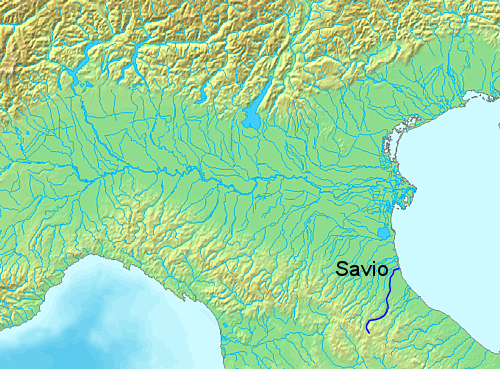
The Savio is a river in northern Italy that rises in the Apennines and flows eastward across Romagna into the Adriatic Sea; it is the longest river of the Romagna region.
Overview
The Savio (Latin: Sapis) is a river in northern Italy that originates in the Apennine Mountains and runs eastward to the Adriatic Sea. It is noted as the longest river entirely within the historical region of Romagna and has played a continuous role in the area's geography and settlement patterns.
Image gallery
2 Images
Course and characteristics
The Savio begins in upland springs of the Apennines and descends through steep valley sections before entering gentler lowland plains. Its course carries water from mountain catchments across agricultural and urban landscapes to the Adriatic coast. For precise location reference see coordinates. The river's regime is influenced by seasonal precipitation and snowmelt in the Apennines, producing higher flows in wetter months and lower discharge in dry periods.
History and human use
Known to the Romans as Sapis, the Savio has long been important for local communities. Historically it supplied water for mills, irrigation and small-scale transport. Over centuries people have altered its banks with embankments, diversion channels and other engineering works to reduce flooding and to support agriculture and towns along its valley.
Ecology and management
The river corridor supports riparian vegetation and aquatic habitats typical of Adriatic drainage basins, providing habitat for fish, birds and invertebrates. Contemporary management balances flood control, water supply and ecological conservation. Environmental projects and monitoring aim to maintain water quality and habitat continuity between the Apennines and the sea.
Significance and context
The Savio links mountain and coastal landscapes: its source areas in the Apennines feed a river that reaches the Adriatic Sea. As the principal river of Romagna, it is a geographic landmark and a focus for local history, land use and conservation efforts.
Questions and answers
Q: What are the coordinates of the Savio river?
A: The coordinates of the Savio river are 44°19′10″N 12°20′30″E.
Q: What is the origin of the Savio river?
A: The Savio river originates in the Apennines mountain.
Q: What direction does the Savio river flow in?
A: The Savio river flows to the east.
Q: What is the destination of the Savio river?
A: The destination of the Savio river is the Adriatic Sea.
Q: Which region is the Savio river the longest river in?
A: The Savio river is the longest river in the Romagna region.
Q: What is the Latin name for the Savio river?
A: The Latin name for the Savio river is Sapis.
Q: What is a unique feature of the Savio river?
A: There is no unique feature mentioned in the text about the Savio river.
Related articles
Author
AlegsaOnline.com Savio (river) Leandro Alegsa
URL: https://en.alegsaonline.com/art/87639
Sources
- treccani.it : "Savio"
- fumaioloturismo.it : "Sorgenti del Savio"