
Bank and Monument (Bank–Monument complex)
A central London Underground and DLR interchange in the City of London, linking multiple lines beneath King William Street and serving as a major commuter hub near the Bank of England and the Monument.
The Bank and Monument complex is a major interchange in the City of London formed by closely connected but separately named stations. Operationally treated as one linked complex, its entrances and platforms continue to bear the historic names Bank and Monument. The complex runs beneath King William Street and provides frequent interchange between deep-level and sub-surface lines, making it one of the busiest transport nodes in central London. For routeing and platform details see the tube map: official map.
Image gallery
10 Images


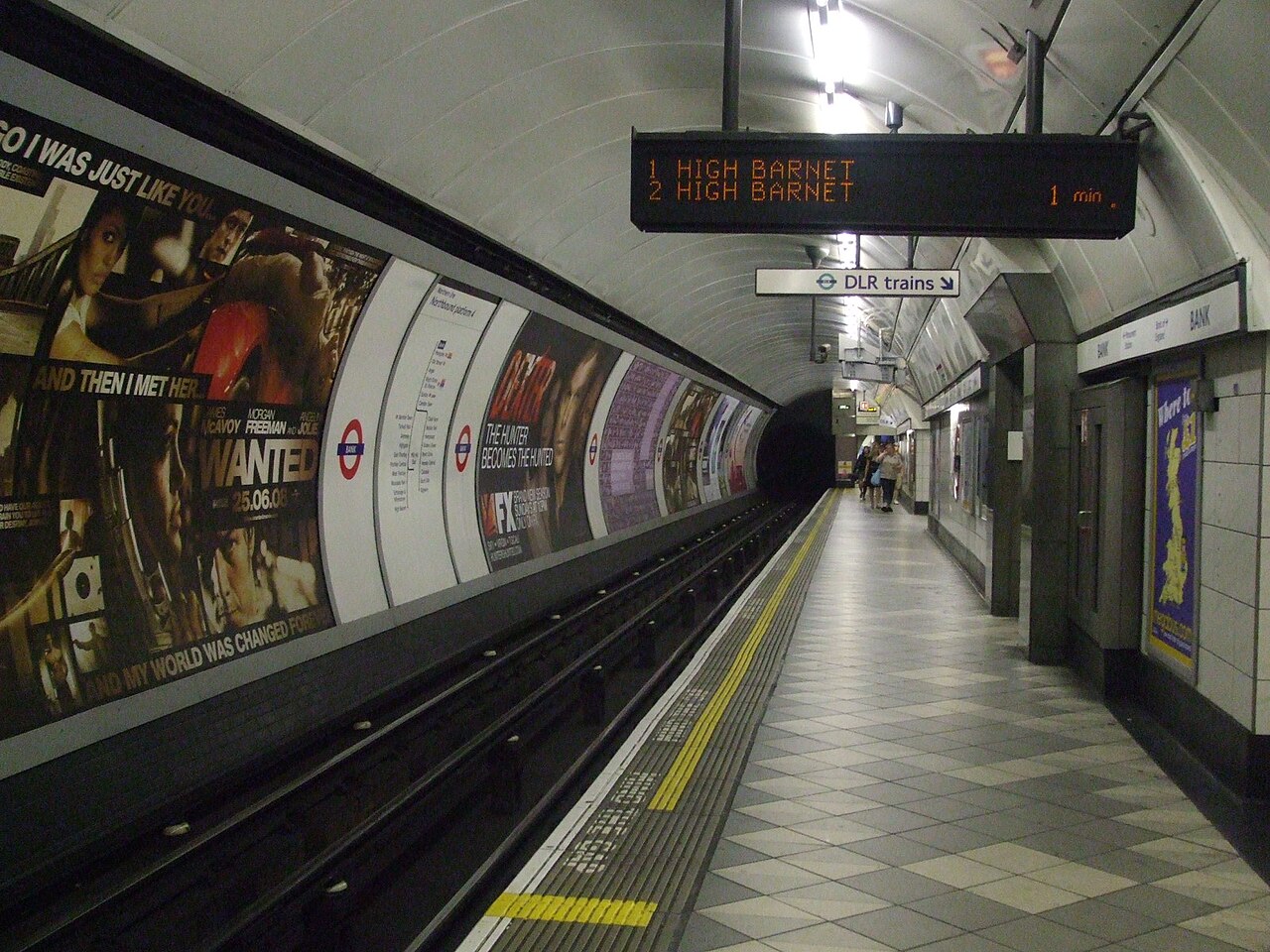


Layout and lines
The two stations are physically joined by pedestrian passageways that cross under the roadway. Together they are served by five London Underground lines: the Central line, the Northern line (Bank branch), the Waterloo & City line, the Circle line and the District line. The complex also includes a Docklands Light Railway (DLR) terminus and interchange. For official information about lines and services consult the network pages: Underground lines and DLR services. The street-level cluster of entrances follows the length of King William Street: station entrances.
History and development
The stations originated in different periods as London’s rail network expanded in the 19th and 20th centuries. Initially built to serve nearby financial and commercial districts, the separate stations were joined over time by pedestrian links and operational integration. Later improvements have focused on handling very large commuter volumes and linking sub-surface platforms with the deep-level escalators and tunnels below.
Bank takes its name from the adjacent Bank of England; Monument is named for the nearby Monument commemorating the Great Fire of London. The complex is in Travelcard Zone 1 and functions as a crucial access point for the financial district: Bank area and fare zone details.
Importance and passenger experience
The Bank–Monument complex handles heavy peak-hour commuter flows and is notable for its long interchange corridors and multiple escalator banks. Passengers should allow additional time to change between some platforms, particularly where transfers require walking along connecting passageways. Ongoing station upgrades and periodic maintenance aim to improve accessibility, signage and crowd management.
Beyond serving daily commuters, the complex is an important link to nearby mainline stations, bus routes and pedestrian routes across the City. Travelers can find up-to-date service information and planned engineering works through the official station and service pages linked above.
Questions and answers
Q: What are Bank and Monument stations?
A: Bank and Monument stations are two interconnected stations that are officially considered one station known as the "Bank-Monument complex".
Q: How many London Underground lines and DLR serve Bank and Monument stations?
A: Five London Underground lines and the Docklands Light Railway (DLR) serve Bank and Monument stations.
Q: What is the location of the Bank-Monument complex?
A: The Bank-Monument complex spans the length of King William Street in the City of London.
Q: What is the reason for the two parts of the combined station having separate names?
A: The two parts of the combined station have separate names because they are named after nearby landmarks - the Bank of England and the Monument to the Great Fire of London.
Q: What is the Travelcard Zone number for the Bank-Monument complex?
A: The Bank-Monument complex is in Travelcard Zone 1.
Q: How busy is the Bank-Monument complex?
A: The Bank-Monument complex is one of the eight busiest stations on the network.
Q: What is the significance of the Monument to the Great Fire of London?
A: The Monument to the Great Fire of London is a tall column designed by Christopher Wren to commemorate the Great Fire of London in 1666, which destroyed a large part of the city.
Tags
Related articles
Author
AlegsaOnline.com Bank and Monument (Bank–Monument complex) Leandro Alegsa
URL: https://en.alegsaonline.com/art/8754
Sources
- tfl.gov.uk : "Multi-year station entry-and-exit figures"