
Sargasso Sea
Distinct region of the North Atlantic gyre defined by floating Sargassum, deep blue oligotrophic waters and key habitat for migratory eels, sea turtles and diverse open‑ocean life.
Overview
The Sargasso Sea is a well‑known region near the centre of the North Atlantic Ocean, defined not by coastlines but by the circulation of surface currents that together form the North Atlantic Gyre. The area is notable for extensive floating mats of brown algae in the genus Sargassum, exceptionally clear blue water, and a distinct ecological community adapted to life on and among the drifting vegetation. Because it is enclosed by currents rather than land, the Sargasso Sea is often described as the only "sea" without shores.
Image gallery
4 Images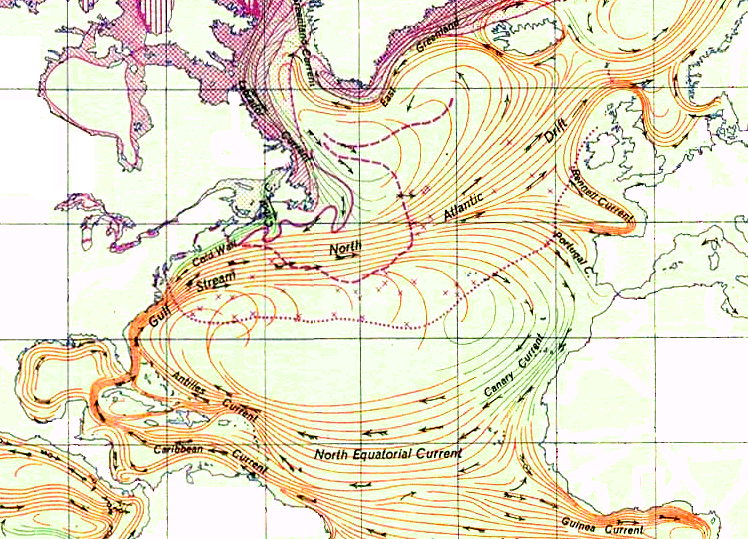

Geographic setting and boundaries
The region lies within the broader basin of the North Atlantic and is typically bounded by major surface currents: the Gulf Stream to the west, the North Atlantic Current to the north, the Canary Current to the east, and the North Atlantic Equatorial Current to the south. These currents concentrate floating material and influence temperature, salinity and nutrient dynamics across the central basin. The location and size of the accumulation zone can shift with seasonal and interannual variability in circulation.
Physical oceanography
Waters in the Sargasso Sea are characteristically oligotrophic—low in nutrients and phytoplankton—giving them a very deep blue colour and remarkable visibility. Surface temperatures are warm relative to higher latitudes but vary with season and latitude within the gyre. The central waters tend to be relatively saline and stratified, with a clear distinction between the warm surface layer and cooler, nutrient‑richer deeper waters. These physical properties shape the productivity and the types of organisms that can persist in the region.
Sargassum mats and biological communities
Floating Sargassum forms continuous and discontinuous mats that create a three‑dimensional habitat. The mats host a diverse assemblage of organisms—small fishes, crabs, amphipods, nudibranchs and a suite of epifaunal invertebrates—that use the algae for shelter, feeding and reproduction. The floating habitat is particularly important for juvenile life stages of many species that would otherwise be vulnerable in the open ocean.
Life cycles and migrations
The Sargasso Sea is central to the life cycles of some migratory species. Both the European eel and the American eel are believed to spawn in or near the gyre; larvae drift with currents before recruiting to coastal and freshwater habitats, and mature adults later return to the central Atlantic to spawn. Research into these migrations continues to refine where and how spawning occurs (eel migrations). Young sea turtles, including loggerheads, are carried by currents such as the Gulf Stream to shelter and forage among Sargassum until they grow larger.
Human history, threats and conservation
Early Atlantic sailors, including Portuguese navigators of the 15th century, noted the sea’s floating weed and region of calm. Today the Sargasso Sea faces modern pressures: accumulation of marine debris and plastics in the gyre’s relatively quiescent centre, potential changes in Sargassum distribution and abundance linked to climate and nutrient inputs, and broader impacts from warming and changing circulation. Conservationists and scientists have called for coordinated study and protection of this unique open‑ocean ecosystem, and a number of research initiatives focus on monitoring Sargassum dynamics, biodiversity and the role of the gyre in ocean biogeography (ocean gyres, Bermuda-area research).
Research and monitoring
Modern study of the Sargasso Sea combines ship‑based sampling, satellite observations and biotelemetry to track animal movements and floating vegetation. Long‑term datasets help scientists understand interannual variability, links to large‑scale climate patterns, and emerging threats. Summaries of recent work and ongoing projects are available through scientific networks and conservation groups that emphasize the region’s role in Atlantic ecology and the connectivity of ocean basins.
Further reading and resources
Readers looking for more information can consult oceanographic overviews of the North Atlantic, studies of Sargassum ecology, material on the surrounding currents such as the Canary Current, and summaries of migratory species and research on eel migrations. Historical perspectives include accounts from early Portuguese mariners and modern work by institutions studying the ocean gyres and marine debris. Regional projects based near Bermuda provide additional field research and long‑term observations.
Questions and answers
Q: What is the Sargasso Sea?
A: The Sargasso Sea is a region in the gyre in the middle of the North Atlantic Ocean. It is bounded on the west by the Gulf Stream; on the north, by the North Atlantic Current; on the east, by the Canary Current; and on the south, by the North Atlantic Equatorial Current. This system of ocean currents forms what is known as the North Atlantic Gyre.
Q: How big is it?
A: The Sargasso Sea is 700 statute miles wide and 2,000 statute miles long (1,100 km wide and 3,200 km long).
Q: Where is it located?
A: The Sargasso Sea is located in between Europe and America in an area of ocean called a gyre within the North Atlantic Ocean. Bermuda lies near its western fringes.
Q: Who discovered it?
A: Portuguese sailors were among some of first to discover this region back in 15th century. They named it after a type of seaweed growing there called sargassum.
Q: What makes its water unique?
A: The ocean water within this sea has a deep blue color with exceptional clarity that allows for underwater visibility up to 200 feet (61 m).
Q: What role does it play for certain species?
A: The Sargasso Sea plays an important role for two species - European eel and American eel - as their larvae hatch here before migrating to either Europe or East Coast of North America where they later return to lay eggs when they are mature adults. It also believed that young Loggerhead Sea Turtles use currents such as Gulf Stream to travel here where they can use sargassum as cover from predation until they become mature adults.
Related articles
Author
AlegsaOnline.com Sargasso Sea Leandro Alegsa
URL: https://en.alegsaonline.com/art/87351
Sources
- web.mac.com : "Flint Institute of Arts Vol 2 No 2"
- bookdrum.com : "Wide Sargasso Sea"
- news.bbc.co.uk : "Turtles return home after UK stay"