
Sarcosuchus — the giant Cretaceous crocodyliform
Sarcosuchus was a huge crocodile-like crocodyliform from the Lower Cretaceous of Africa, known from large skulls and several partial skeletons that reveal its size, ecology, and scientific importance.
Overview
Sarcosuchus is an extinct genus of very large crocodyliform that lived during the Lower Cretaceous period, roughly between 135 and 112 million years ago. It inhabited river systems and floodplains in what is now northern and central Africa. Although commonly called a "giant crocodile," Sarcosuchus is not a modern true crocodile but belongs to an earlier branch of crocodyliform reptiles closely related to the lineage that eventually produced living crocodilians. For an entry-level reference see genus overview and for its broader grouping see crocodile relatives.
Image gallery
10 Images


Anatomy and size
Sarcosuchus is famous for its extraordinary size compared with modern crocodilians. Estimates based on skulls and partial skeletons indicate a total length approaching or exceeding 11–12 meters in the largest individuals, with mass estimates that vary widely but are many times that of the largest living saltwater crocodiles. It had a long, broad snout and robust jaw musculature suited to powerful biting.
- Skull and snout: very wide and elongated, with numerous conical teeth for seizing prey.
- Body armor: rows of bony scutes (osteoderms) along the back provided protection and helped classify fossil fragments; see bony scutes.
- Postcranial remains: vertebrae and limb bones from a few specimens give clues to its overall proportions and swimming ability.
Comparisons are often made to the modern saltwater crocodile, but Sarcosuchus combined greater bulk with a differently shaped skull and a more primitive cranial anatomy.
Geological age and distribution
Fossils of Sarcosuchus come primarily from Lower Cretaceous rock formations in Africa. The sediments that preserve its remains are typically fluvial—deposited by ancient rivers and lakes—indicating it lived in warm, watery environments. For geological context see Lower Cretaceous and regional notes at Africa. True modern crocodiles appeared later, in the Upper Cretaceous, so Sarcosuchus represents an earlier experiment in large-bodied crocodyliform design.
Discovery and scientific study
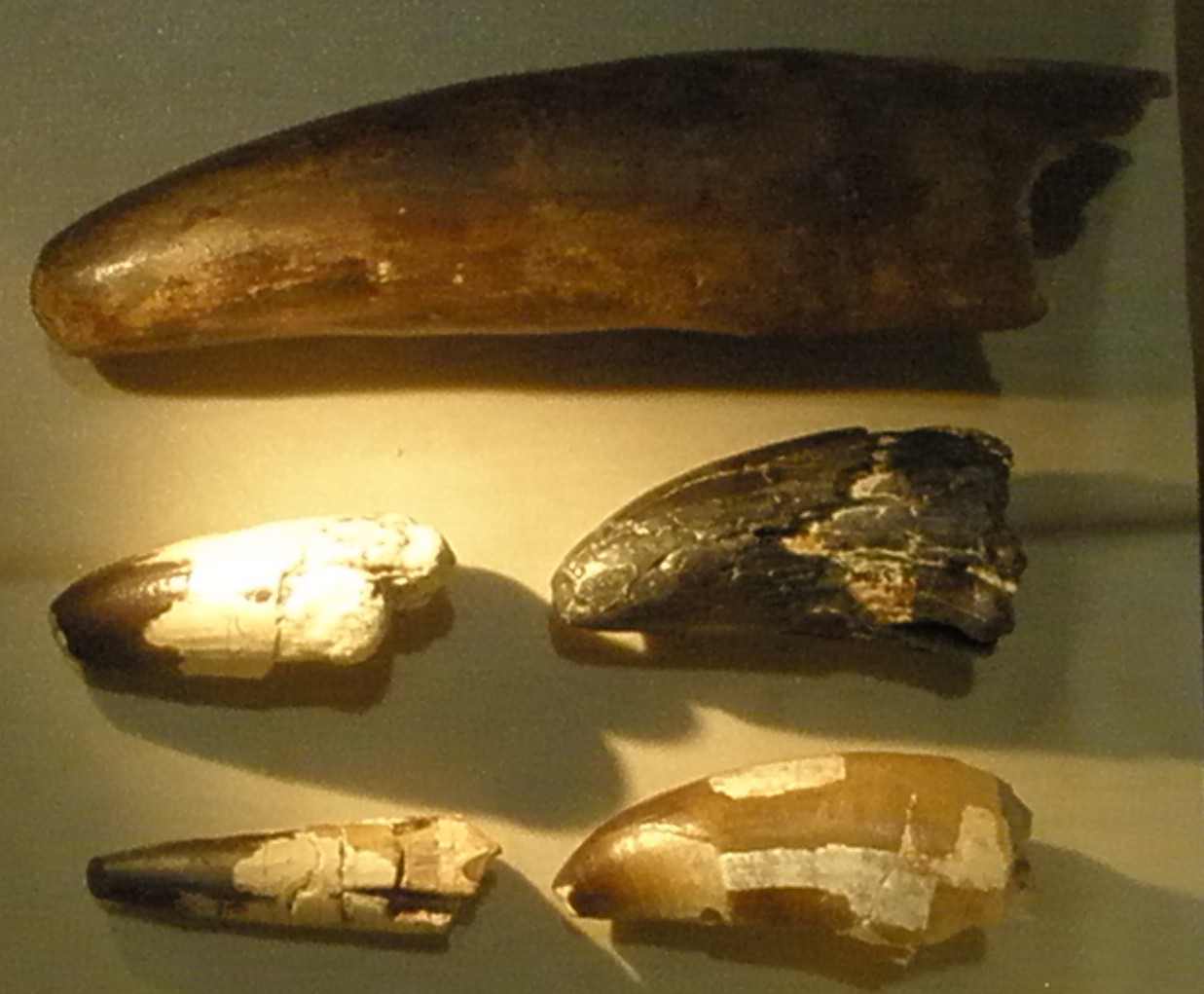
Early discoveries of Sarcosuchus were limited to a scattering of isolated teeth and osteoderms found in Sahara localities during mid-20th-century expeditions; details are summarized in accounts of fossils. More complete material emerged in fieldwork led by paleontologists in the late 20th and early 21st centuries. Notably, expeditions by Paul Sereno and colleagues recovered several important specimens that include partial skulls and substantial portions of the backbone, permitting more confident size and life‑history estimates; see Paul Sereno.
Ecology, behavior and importance
Sarcosuchus was likely an apex predator in its ecosystems, feeding on large fish and possibly ambushing dinosaurs or other terrestrial animals that came to water margins. Its robust jaws and teeth suggest a generalist ambush strategy rather than the narrow-fished snouts of specialized piscivores. Studying Sarcosuchus helps scientists understand patterns of gigantism, predator-prey dynamics in Cretaceous freshwater systems, and the evolutionary experimentation that preceded the modern crocodilian bauplan.
Notable facts and remaining questions
Although often presented in popular media as the "biggest crocodile ever," precise ranking depends on fragmentary evidence: several other large crocodyliforms are known from partial remains, so maximum size comparisons remain open to revision. Ongoing work aims to refine growth curves, habitat reconstructions and biomechanics. For general reference and comparative material consult overview and specialist summaries at comparative crocodyliform pages.
Questions and answers
Q: What is Sarcosuchus?
A: Sarcosuchus is an extinct genus of giant crocodile-like reptiles.
Q: When did Sarcosuchus live?
A: Sarcosuchus lived 135 to 112 million years ago during the Lower Cretaceous period.
Q: Was Sarcosuchus a modern type of crocodile?
A: No, strictly speaking, Sarcosuchus was not a modern type of crocodile but a pre-crocodile.
Q: What are earlier types of crocodile called?
A: Earlier types of crocodile are called Crocodylomorphs.
Q: When did true crocodiles arrive?
A: True crocodiles arrived in the Upper Cretaceous period.
Q: How large was Sarcosuchus?
A: Sarcosuchus was almost twice as long as the modern saltwater crocodile and weighed about 8 tonnes.
Q: When were new specimens of Sarcosuchus discovered, and what did they reveal?
A: In 1997 and 2000, Paul Sereno discovered half a dozen new specimens of Sarcosuchus, including one with about half the skeleton intact and most of the spine. All of the other giant crocodiles are known only from a few partial skulls, so which is actually the biggest is an open question.
Related articles
Author
AlegsaOnline.com Sarcosuchus — the giant Cretaceous crocodyliform Leandro Alegsa
URL: https://en.alegsaonline.com/art/87336
Sources
- sciencemag.org : The Giant Crocodyliform Sarcosuchus from the Cretaceous of Africa