
Sapphire — mineral, varieties, history and uses
Sapphire is the gem-quality variety of corundum (aluminium oxide) valued for its range of colors, hardness, historical symbolism and uses in jewelry and industry.
Overview
Sapphire is the gem-quality form of the mineral corundum, a crystalline aluminium oxide. Most people associate sapphires with a deep blue color, but the term covers any non-red corundum: red corundum is called ruby. Sapphires occur naturally and can also be produced synthetically. They are prized for their brilliance, durability and variety of hues, and are commonly used in jewelry as well as technical applications that take advantage of the mineral's toughness and optical properties.
Image gallery
10 Images




Composition and physical properties
Corundum is an aluminium oxide (chemical formula Al2O3) that forms hard, dense crystals. On the Mohs hardness scale it rates 9, making sapphire one of the hardest natural gemstones after diamond. This hardness contributes to resistance to scratching and wear, which is why sapphire has been used for watch crystals, optical windows and substrates for electronics. Tiny traces of other elements such as iron, titanium, chromium, vanadium or magnesium produce the range of colors found in different sapphires.
Colors, varieties and special effects
While blue is the classic and most recognized shade, sapphires can be yellow, green, purple, pink, orange, brown and even colorless. When a corundum specimen shows multiple colors it may be described as parti-colored. A notable variety is the padparadscha, a rare pink-orange sapphire historically associated with Sri Lanka. Another special type is the star sapphire, which displays asterism — a star-like pattern caused by aligned needle-like inclusions (often rutile) that reflect light across the cabochon surface.
Formation, sources and synthetic production
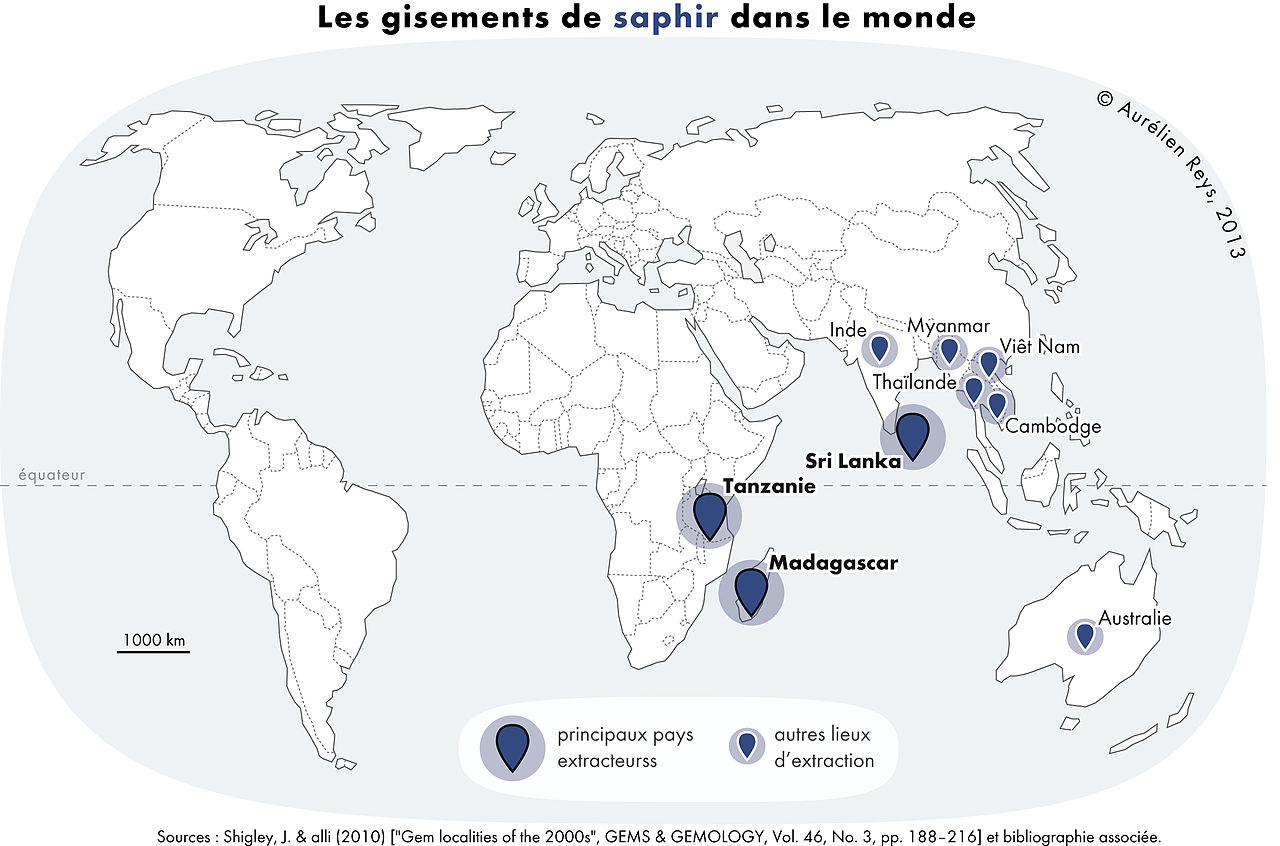
Sapphires form in metamorphic and igneous environments where aluminium-rich rocks are present. Gem-bearing deposits are often secondary placers where weathering concentrates durable corundum grains in gravel. Historically important sources include Sri Lanka, Myanmar (Burma), Kashmir, Thailand and India; more recent productive areas include Madagascar, Australia, East Africa and parts of North America. Synthetic sapphires have been manufactured since the early 20th century by methods such as flame fusion (Verneuil process), flux growth and hydrothermal synthesis. These lab-grown sapphires are chemically and physically similar to natural ones and are widely used in industry and jewelry.
Uses, symbolism and cultural importance
Sapphires are a traditional gem for rings, necklaces and crowns. They have long symbolized qualities like wisdom, virtue and fidelity, and are the birthstone for September. Beyond ornamentation, synthetic sapphire is used for scratch-resistant watch faces, scientific instruments, LED substrates and durable windows because of its hardness and optical clarity. Famous sapphires and historic pieces have helped shape public perception of the gem, reinforcing its association with royalty and ceremony.
Distinctions and notable facts
By definition in gemology, ruby and sapphire are the same mineral species (corundum); the distinction rests on color. Treatments such as heat are commonly applied to improve color and clarity; disclosure of treatments is a standard practice in reputable markets. Collectors value provenance, color saturation and clarity; certain geographic sources — for example, Kashmir sapphires — are historically prized for particular color qualities. Star sapphires and padparadscha stones are examples of specialized categories that command attention for rarity and effect.
- corundum — the mineral species for sapphire
- aluminium — the metal in aluminium oxide
- oxide — chemical class including Al2O3
- rubies — red corundum, same mineral family
- ground — reference to placer and primary deposits
- amber — an example of an alternate gemstone color term
- orange — color category that includes padparadscha
- Ten Commandments — historic tradition linking sapphire to sacred objects
- ancient — cultures that prized sapphires in antiquity
- kings and queens — royal use and ceremonial gems
- virtue — one of the symbolic associations
- engagement — common use for sapphire rings
- Crown Jewels — public collections that include sapphires
- symbol — how sapphire is interpreted culturally
For further reading on mineralogy, gem treatments and rehabilitation of historical pieces, consult reputable gemological resources and museum collections. Whether encountered as a deep velvety blue or a delicate pink-orange padparadscha, sapphire remains one of the most versatile and enduring gemstones in human culture.
Questions and answers
Q: What is sapphire?
A: Sapphire is a type of the mineral corundum, an aluminium oxide (Al2O3).
Q: How does sapphire differ from rubies?
A: Sapphires are the same as rubies, except that they are not red.
Q: Where can sapphires be found?
A: Sapphire can be found in the ground or it can be made in large crystal. Blue sapphires are the most famous kind, but they can be many different colors, like amber and orange. Sapphires are mostly found in Asia, but recent findings have taken place in Australia, Kenya and Tanzania.
Q: What is special about sapphire's history?
A: Sapphires have a long history. Tradition says that the tablets of the Ten Commandments were made of sapphire so strong a hammer could not break them and would break instead if it hit them. The ancient Persians believed that the earth sat on a big sapphire and that the big sapphire made the sky blue. A lot of ancient people thought rubies made people calm down as well as cure their bruises. Sapphires have been used by kings and queens for a long time as a symbol of luck, virtue, wisdom and holiness.
Q: What is Star Sapphire?
A: There is a specific kind of sapphire called Star Sapphire which has whitish pieces of rutile or silk as some call it. Star Sapphires can be heated to remove its blue color then heated even more to get back its blue color while removing its white silk at the same time.
Q: How hard is Sapphire on Mohs Hardness Scale?
A: Since Sapphire is one of second hardest minerals on Mohs Hardness Scale, it is sometimes used as polishing tool.
Q: How do we produce lab grown Sapphire ?
A: Lab grown Sapphires are produced using two strategies - "flame fusion" & "flux growth". Heating yellow , light yellow or colorless sapohire from 1500-1900oc can turn into dark yellow , gold , golden brown , orange or reddish brown colored sapohire .
Related articles
Author
AlegsaOnline.com Sapphire — mineral, varieties, history and uses Leandro Alegsa
URL: https://en.alegsaonline.com/art/87273
Sources
- geo.utexas.edu : geo.utexas.edu/courses/347k/redesign/gem_notes/