
Santa Fe de Nuevo México: from Spanish colony to American state
Historical region centered on Santa Fe that evolved from a Spanish provincial seat (1598) through Mexican administration to U.S. occupation, territorial organization, and statehood.
Overview
Santa Fe de Nuevo México—commonly shortened to Nuevo México and known in English as New Mexico—was a political and cultural region in the interior of North America whose institutional identity changed over more than two centuries. Established within the Spanish colonial system in the late 16th century, it remained a distinct province under the Viceroyalty of New Spain, passed to independent Mexico in the early 19th century, and later entered the United States after the Mexican–American War. The region's history is central to understanding lasting patterns of landholding, bilingualism and blended cultural traditions in the modern southwestern United States.
Image gallery
3 Images

Geography and society
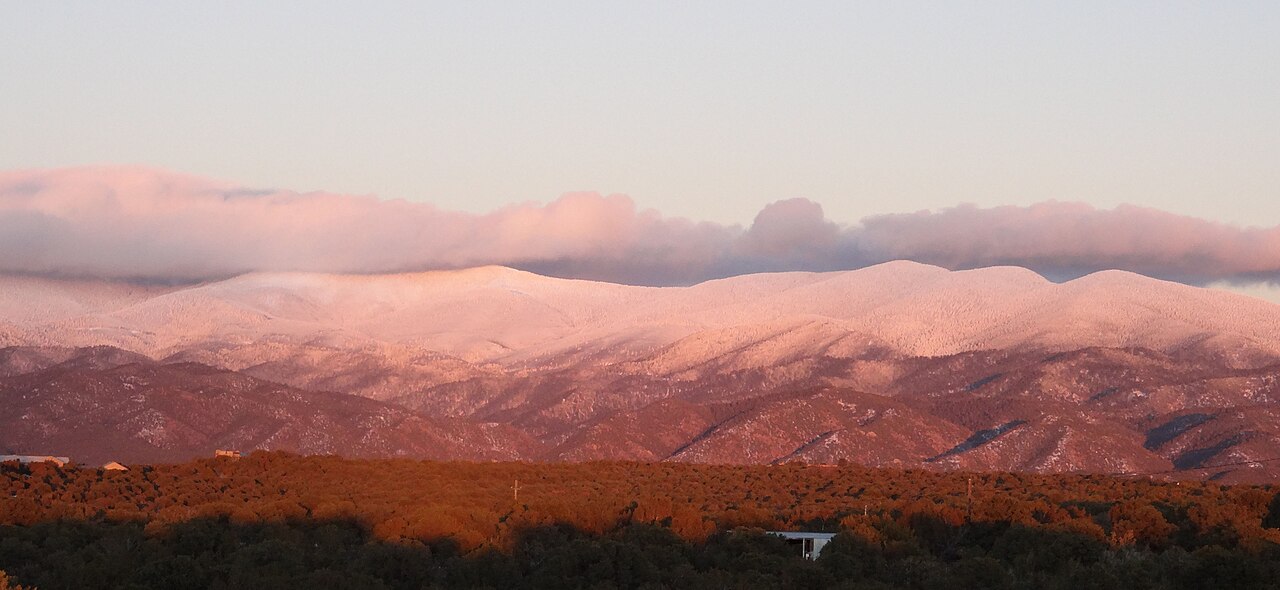
Centered on the colonial capital of Santa Fe, the territory encompassed upland plateaus, river valleys such as those of the Rio Grande and its tributaries, and a network of pueblos and other indigenous settlements. Society combined Puebloan, Apache and other Native American communities, Spanish colonists and settlers of mixed origin, and, later, Mexican and Anglo-American migrants. Economies were based on agriculture, herding, local crafts and trade, including long-distance routes like the Camino Real de Tierra Adentro and, in the 19th century, commercial links with the Great Plains.
Colonial era
Spanish expansion into the region accelerated at the end of the 16th century and continued under provincial administrations of New Spain. Relations between colonists and indigenous peoples alternated between cooperation, accommodation and conflict. A major example is the Pueblo Revolt of 1680, when several Pueblo communities expelled Spanish authorities for a period; the province was later resettled and partially reconquered in the late 17th century. Colonial institutions—missions, presidios, land grants and municipal forms—shaped local governance and property customs for generations.
Mexican and American periods
After Mexico achieved independence from Spain in 1821, the province became part of the Mexican nation and saw continued local autonomy alongside increasing trade and contact with Anglo-American traders. During the Mexican–American War (1846–1848) United States forces occupied the region; the Treaty of Guadalupe Hidalgo (1848) formalized its transfer to the United States. The area was then organized as the New Mexico Territory, a territorial government that persisted until admission as the state of New Mexico later in the 19th century.
Culture, law and legacy
Santa Fe de Nuevo México left enduring legacies in place names, architectural styles, agricultural and irrigation practices, and legal traditions such as land grant customs. Catholic religious institutions, bilingual oral and literary traditions, and localized municipal practices reflect a long continuity from the Spanish and Mexican periods into contemporary life. For broader background on the imperial and national contexts in which the province existed, see general overviews of New Spain and its provincial structures (general overview).
Distinction and nomenclature
The historical polity called "Santa Fe de Nuevo México" should be distinguished from the modern political entity named New Mexico. Scholarly studies typically treat the colonial and Mexican eras separately from the later American territorial and state phases, while recognizing cultural continuities across these political changes.
Questions and answers
Q: What was Santa Fe de Nuevo México?
A: Santa Fe de Nuevo México was a Kingdom of New Spain and a territory of Mexico from 1598-1846 which later became part of the United States.
Q: How long was Nuevo México a territory of Mexico?
A: Nuevo México was a territory of Mexico for 248 years, from 1598 until 1846.
Q: When did Nuevo Mexico become part of the United States?
A: Nuevo Mexico became part of the United States in 1846 after the Mexican-American War.
Q: How long was Nuevo Mexico a part of the United States before it became an official state?
A: Nuevo Mexico was a part of the United States for two years, from 1846-1848, before becoming an official state.
Q: What was Nuevo Mexico called when it was a territory of the United States?
A: Nuevo Mexico was called the New Mexico Territory when it was a territory of the United States.
Q: When did Nuevo Mexico officially become a state of the United States?
A: Nuevo Mexico officially became a state of the United States in 1912.
Q: What is the present-day name of Nuevo Mexico?
A: The present-day name of Nuevo Mexico is the US state of New Mexico.
Related articles
Author
AlegsaOnline.com Santa Fe de Nuevo México: from Spanish colony to American state Leandro Alegsa
URL: https://en.alegsaonline.com/art/87127