
Sandy, Bedfordshire
Market town and civil parish in Bedfordshire, England, situated on the A1 between Cambridge and Bedford. Noted for rail links, nearby nature reserves and a community of roughly 11,000 (2001 census).
Overview
Sandy is a market town and civil parish in the county of Bedfordshire, England. It lies on a principal north–south corridor between Cambridge and Bedford, beside the modern route of the A1 road, which broadly follows the historic Great North Road linking London and Edinburgh. At the 2001 census the parish had a population of about 10,887, reflecting its role as a local service centre rather than a large urban centre.
Image gallery
8 Images



History and character
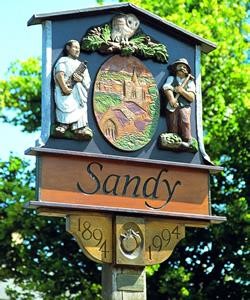
The town grew where sandy soils met river meadows, a feature that gave it its name. Traditionally a coaching and market settlement on the northbound route from London, Sandy retains a market-town atmosphere with small shops, civic buildings and an active town council. Its historic core is modest in scale but reflects centuries of local trade and agriculture.
Geography and nature
Sandy sits close to the River Ivel and borders areas of lowland fen and heath. The surrounding countryside contains pockets of wetland and mixed woodland that attract wildlife. The Royal Society for the Protection of Birds (RSPB) has a prominent reserve and headquarters nearby, making the locality important for birdwatching and conservation.
Transport and accessibility
The town is served by a railway station on the main north–south line, providing commuter and regional services into London and to destinations further north. Road links are dominated by the A1 corridor, which gives Sandy easy road access to neighbouring towns and larger cities.
Local life and notable features
- Market town services: shops, schools and community facilities.
- Nearby nature reserves and birdwatching opportunities (RSPB presence).
- Local broadcasting landmark: the Sandy Heath transmitter serves the region.
Sandy is often chosen by people looking for a small-town base with good transport connections to larger employment centres. For visitors the mix of countryside, local amenities and easy travel makes it a practical and quietly distinctive place to explore.
Questions and answers
Q: Where is Sandy located?
A: Sandy is located in Bedfordshire, England.
Q: What is Sandy?
A: Sandy is a town and civil parish.
Q: What is the population of Sandy, as of 2001?
A: As of 2001, the population of Sandy was 10,887 people.
Q: What is the location of Sandy between?
A: Sandy is located between Cambridge and Bedford.
Q: What is the name of the road that passes through Sandy?
A: The road that passes through Sandy is the A1 road.
Q: Where does the A1 road go from and to?
A: The A1 road goes from London to Edinburgh.
Q: Is Sandy a populous area?
A: Based on the population figure, Sandy can be considered relatively populous.
Related articles
Author
AlegsaOnline.com Sandy, Bedfordshire Leandro Alegsa
URL: https://en.alegsaonline.com/art/87009