
Salt evaporation pond
Artificial shallow ponds used to produce salt by evaporating seawater; notable for vivid colors produced by microorganisms and for their ecological, historical and economic roles.
Overview
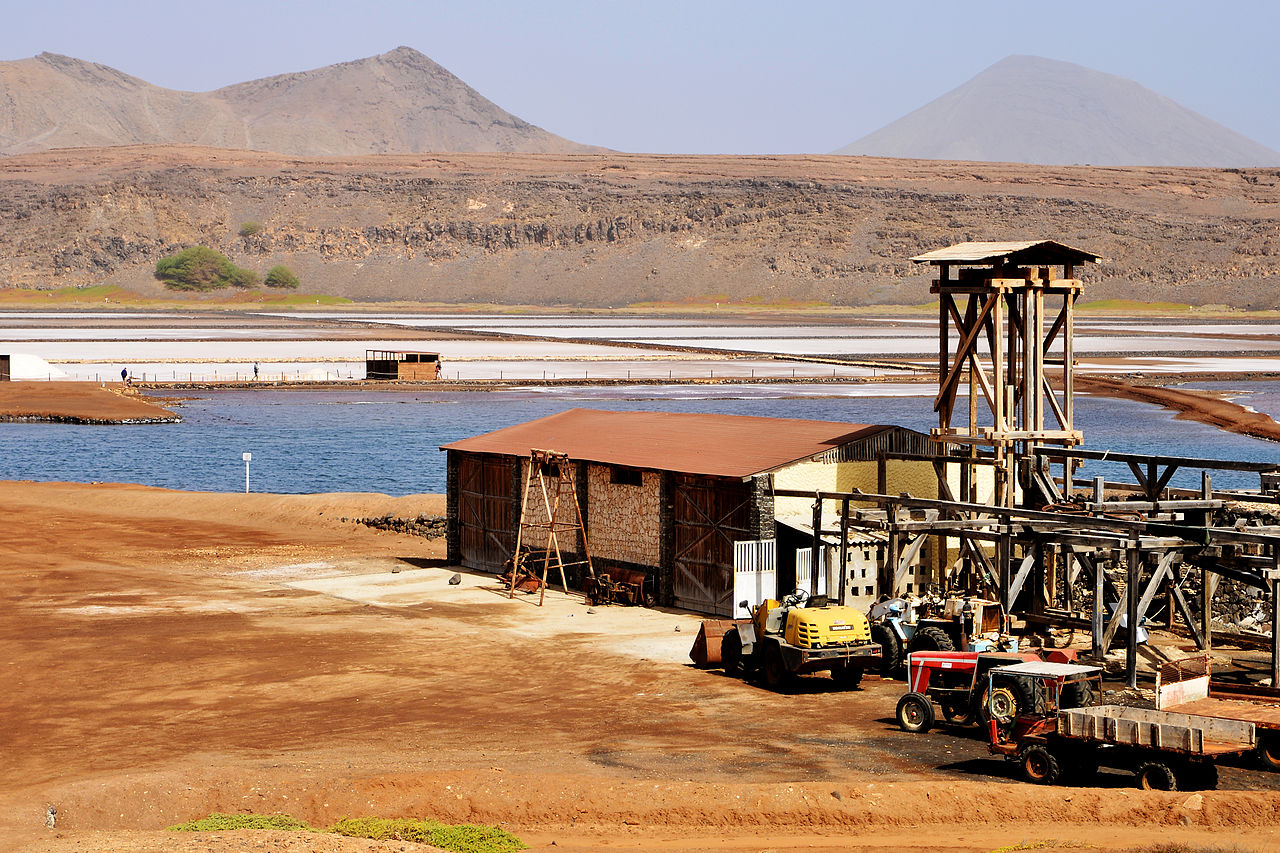
A salt evaporation pond, also called a saltern pond, is a shallow artificial basin constructed to concentrate and crystallize salts from saline water. These facilities are commonly sited near the sea to allow straightforward intake of salt water. Water is moved between a series of ponds and held until evaporation reduces volume and increases salinity, leaving sea salt or other mineral salts behind for harvest. Historically and today they vary from small hand-harvested pans to large commercial basins.
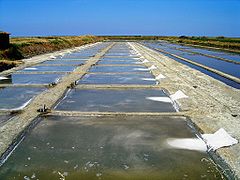
Image gallery
10 Images




Design and operation
Typical salterns are arranged as a sequence of shallow ponds: intake, concentration, and crystallizer ponds. Skilled management of water depth, flow, and time determines which salts precipitate and where. Practical considerations include pond lining, levees, channels, and gates that control movement. Simple stages can be described as:
- Intake and settling — seawater enters and solids settle.
- Concentration — evaporation raises salinity and concentrates brine (brine).
- Crystallization — salt precipitates and is collected.
The shallow depth increases surface area relative to volume, accelerating evaporation. Small, traditional ponds often involve manual raking and collection, while larger operations use mechanical harvesters and conveyors.

Colors and biology
One striking feature of many salt ponds is their spectrum of colors, produced by different microorganisms and the changing chemistry as salinity rises. In lower salinities, green algae and cyanobacteria dominate, while in higher salinities specialized organisms such as Dunaliella salina and halophilic bacteria lend orange, red or pink hues. Tiny crustaceans often called brine shrimp can give a warm orange tint, and other microbes and mats of cells create additional tints. Observers often note these patterns from the air because they form broad, geometric mosaics of color.

History, examples and cultural context
Salt production by evaporation is one of the oldest chemical industries, practiced wherever saline water and a dry climate coincide. Traditional saltworks remain in places such as Île de Ré and Aigues-Mortes in France, the terraced salinas of Algeria, and the high-Andean Salineras de Maras. Modern examples include large managed systems around the San Francisco Bay. These sites often have archaeological, economic and cultural importance because salt was historically a traded commodity and sometimes a local livelihood.
Uses, ecology and economic importance
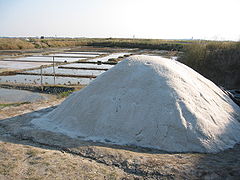
Primary use is salt production for food, industrial, and chemical uses. Salt ponds also provide habitat for a variety of species, supporting wildlife habitat and shorebirds that feed on brine invertebrates. The ponds can host animal species adapted to extreme salinity and diverse microorganisms that are of interest to ecology and biotechnology. Some ponds are managed to benefit migratory birds, and mixed-use systems may combine salt harvesting with conservation objectives.

Environmental considerations and distinctions
While salterns create productive land uses, they can affect local hydrology, salt balance and habitats if poorly designed. Saltworks differ from salt pans used in inland saline lakes and from industrial vacuum evaporation plants; their distinguishing features are shallow basins, solar-driven evaporation, and the stepped pond arrangement. Responsible management seeks to balance salt production with habitat protection and water quality, and several well-known saltworks now incorporate conservation measures or protected status.

For more technical or regional information consult resources on pond design and salt production methods (shallow pond), saltern siting (low to mid salinity), historical sites and contemporary operations (Aigues-Mortes, San Francisco Bay), and introductions to the organisms commonly found in salterns (microorganisms, brine). Additional regional studies describe traditional harvesting techniques in places such as Île de Ré and salt production in Algeria.
Other relevant topics include sustainable salt production, the role of salt in local economies, and research into extremophile microbes for industrial applications.
Questions and answers
Q: What is a salt evaporation pond?
A: A salt evaporation pond is a man-made shallow pond that is usually located near the sea. The ponds are filled with salt water and then left to evaporate, leaving behind the harvested salt.
Q: What kind of animals inhabit these ponds?
A: Most of the animals inhabiting these ponds are birds.
Q: How does the color of the water indicate how much salt there is in it?
A: Green colors come from special algae in low to mid salinity ponds (ponds with little salt in the water). In middle to high salinity ponds, an alga called Dunaliella salina shifts the color to red. Millions of tiny brine shrimp create an orange cast in mid-salinity ponds. Other bacteria such as Stichococcus also contribute tints.
Q: Where can we find examples of these kinds of ponds?
A: Examples of these kinds of ponds can be found on Ile de Ré in France, San Francisco Bay area, Aigues-Mortes in France, Batz-sur-Mer in France and Salineras de Maras, Maras, Peru.
Q: What happens after the salt has been collected from the pond?
A: After it has been collected, it can be used for various purposes such as seasoning food or other industrial uses.
Q: How do people harvest this type of salt?
A: People typically harvest this type of salt by manually scooping it out from the pond once it has been collected after evaporation.
Related articles
Author
AlegsaOnline.com Salt evaporation pond Leandro Alegsa
URL: https://en.alegsaonline.com/art/86540