
Bamboo: biology, uses, and cultural importance
Bamboo is a diverse group of woody grasses valued for rapid growth, building material, food, and cultural roles across Asia, Africa and the Americas. This article covers biology, varieties, uses and notable facts.
Overview
Bamboo is a common name for a large group of grass plants that includes more than 1,400 species arranged in over 115 genera. Botanically it belongs to the grass family and is often described as a type of giant grasses distinguished by its rigid, often woody culms (stems). Wild and cultivated bamboos occur naturally across much of the world, with important native concentrations in Asia, parts of Africa and the Americas, and they are grown successfully in many temperate regions, including Europe.
Image gallery
2 Images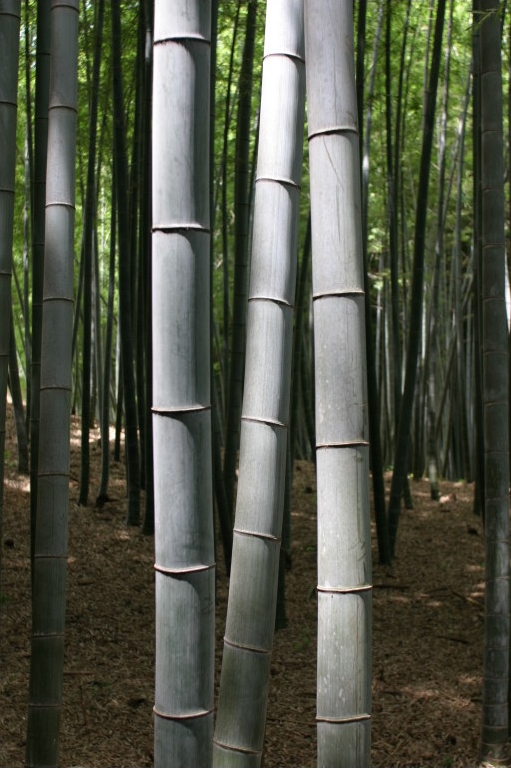

Botanical characteristics and growth
Most bamboos have hollow, jointed stems divided by nodes; the sections between nodes are called internodes. The stem diameter varies widely among species — in some large tropical forms a single culm may reach substantial girth — see references to typical diameter ranges for context. Each node can bear one or more buds, commonly a single lateral or side bud, and some of these buds develop into branches. Growth can be extremely rapid: while many garden bamboos grow a few centimetres per day, anecdotal and documented accounts (for example, those noted in horticultural literature) report exceptional bursts of growth of up to about 1.2 metres in 24 hours in certain species under ideal conditions.
Types, habits and flowering
Two broad growth habits are recognised: clumping forms that expand slowly as tight tufts, and running types that send out long underground stems (rhizomes) capable of producing new shoots many metres from the parent plant. Flowering is unusual and often unpredictable in bamboo. Many species exhibit mass or synchronized flowering across large areas, after which individual plants often die back — a pattern known as semelparity in ecological terms. The interval between flowering events varies by species, from several years to many decades.
Uses and cultural significance
Bamboo has a wide range of practical and cultural applications. It is used in construction, furniture, scaffolding, crafts and paper-making; young shoots from many species are edible and form an important seasonal food source in several Asian cuisines. Bamboo has long symbolic and practical importance in many cultures: it appears in architecture, poetry and daily life, and traditional crafts capitalise on its strength, flexibility and rapid renewability.
Environmental roles and cultivation
Bamboo can help stabilise soils, provide habitat for wildlife, and act as a fast-growing renewable resource for carbon capture and biomass. Because different species suit different climates and soils, growers choose clumping varieties for controlled landscapes or running varieties for rapid land coverage, taking care to manage invasiveness where appropriate. Cultivation practices, propagation techniques and harvest cycles vary by species and purpose.
Notable facts and measurements
Traditional and practical measurements sometimes use bamboo segments as convenient units: for example, in some cultures the length between two nodes was used as a rough measure similar to historical measures such as the shaku. For further reading and species lists consult regional floras and specialist references on bamboo diversity and uses. Useful starting points include resources on botanical classification, horticulture and sustainable bamboo management (species lists, grass family overview, and practical guides on culm properties wood-like stems).
- Native regions and distribution: Asia, Africa, the Americas, with cultivation in Europe.
- Growth habits: clumping versus running.
- Structural features: nodes, internodes and culm diameter.
- Reproductive note: many species flower infrequently and may die after seeding; branching from side buds creates a woody appearance.
For more detailed botanical descriptions, cultivation advice and regional species lists, consult specialist literature and horticultural databases indexed under genera and species names, or introductory resources cited in gardening and conservation publications (Africa, Americas, Asia references).
Questions and answers
Q: What is bamboo?
A: Bamboo is a type of giant grass that is composed of over 1,400 species in 115 different genera.
Q: Where does bamboo mainly grow?
A: Bamboo mainly grows in Africa, America, and Asia, but it can also grow in Europe.
Q: How does bamboo grow?
A: Bamboo grows in clumps, but running varieties exist. The runners of bamboo can reach up to 40 meters in length.
Q: How fast can bamboo grow?
A: Bamboo can grow up to 1.21 meters in a 24-hour period, but most varieties used for gardening will grow more slowly, at around 3 cm to 5 cm per day.
Q: What is the structure of bamboo stems?
A: Almost all species of bamboo have hollow stems divided into nodes or joints. Each node has a single side bud, which may develop into a branch.
Q: Does bamboo flower often?
A: Bamboo rarely flowers, and some species only flower once before dying off.
Q: What is the shaku?
A: The shaku is a traditional Japanese unit of measurement based on the distance between two joints in a bamboo stem.
Related articles
Author
AlegsaOnline.com Bamboo: biology, uses, and cultural importance Leandro Alegsa
URL: https://en.alegsaonline.com/art/8640
Sources
- species.wikimedia.org : Bambuseae