
Bambi (1942 film)
Bambi is a 1942 American animated coming‑of‑age drama produced by Walt Disney, adapted from Felix Salten’s novel; noted for its naturalistic animation, somber themes and lasting influence on cinema and conservation discourse.
Bambi is a 1942 American animated coming‑of‑age drama produced by Walt Disney and supervised by head director David Hand. The film adapts Felix Salten’s novel Bambi, A Life in the Woods and follows a young deer as he grows from a fawn into maturity while learning the rhythms and dangers of the forest. Released by RKO Radio Pictures on August 13, 1942, it is an early and enduring work in the Walt Disney animated feature canon.
Image gallery
2 Images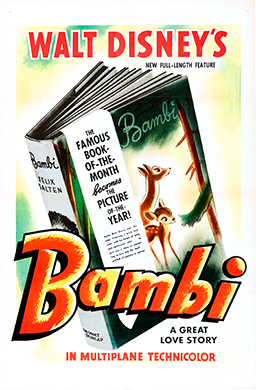

Synopsis
The narrative begins with Bambi’s birth and charts seasons of play, learning and loss. He befriends other young animals and gradually discovers the responsibilities of adulthood. A defining episode is the shooting of his mother by hunters, an event that profoundly alters Bambi’s understanding of humans and survival. The story culminates in Bambi assuming his role within the forest community.
Main characters
Principal characters include Bambi (the young deer), his mother and the Great Prince of the Forest (his father), and his companions Thumper (a rabbit), Flower (a skunk) and Faline (a doe who later becomes his mate). The animals are drawn with attention to species‑specific movement and behavior while retaining qualities that allow viewers to connect emotionally with them.
Production and artistic approach
Disney’s production emphasized studies of real animal movement and natural environments. Animators used extensive live‑action reference, sketches and careful observation to create lifelike motion and nuanced performances. Background painting and layered compositional techniques contributed to a sense of depth and atmosphere. In adapting Salten’s novel, the studio changed Bambi’s species from the European roe deer to a mule deer to reflect North American audiences’ familiarity with that animal.
Music and sound
The film integrates songs and orchestral scoring to shape mood and pacing; the song "Love Is a Song" appears in the picture and was recognized in awards season. The film earned Academy Award nominations for Best Sound, Best Original Song and Best Original Music Score, reflecting the importance of music and sound design to its expressive effect.
Release, reception and recognition
Released during World War II, Bambi met mixed reviews at first but gradually gained critical esteem. Over decades it has been reassessed as an influential work for its technical achievements and emotional directness. The American Film Institute later ranked it among the top animated films, and in 2011 the film was added to the National Film Registry for preservation because of its cultural, historical and aesthetic significance.
Legacy and influence
Bambi is often cited for advancing animation techniques, particularly in rendering realistic animal motion and painterly natural settings. Its frank portrayal of danger and loss in a family‑oriented film broadened the thematic range of animated storytelling. The film has informed generations of animators, conservation thinkers and scholars interested in how cinema represents nature, grief and maturation.
Adaptation choices and themes
The adaptation simplifies and reshapes episodes from the source novel to suit cinematic form and to emphasize visual storytelling. Central themes include the cycle of seasons and life, the moral and physical impacts of human activity on wildlife, and the passage from childhood dependency to adult responsibility. Critics and scholars continue to debate the film’s tone and its balance between realism and anthropomorphism.
Home media and preservation
Bambi has appeared in multiple home media editions and restorations; preserved prints and archival efforts reflect its recognized importance to film history. Its selection for long‑term preservation underscores the film’s status as a noteworthy work in animation and American cinema.
Further reading and resources
- Studio and production context
- Animation techniques and analysis
- Walt Disney (producer)
- Felix Salten's original novel
- RKO release information
- Disney Animated Classics sequence
- Mule deer (species shown in the film)
- Character: Bambi
- Character: Thumper
- Rabbit species and behavior
- Character: Flower (the skunk)
- Character: Faline
- Academy Award nominations
- Song: "Love Is a Song"
- American Film Institute recognition
- National Film Registry listing
- Library of Congress preservation notes
Bambi remains a central title for those studying animation, adaptation and the cultural representation of nature. Its mix of technical craft, evocative imagery and emotionally resonant moments continues to prompt discussion about how films address childhood, loss and the human relationship with the natural world.
Questions and answers
Q: Who was the head director of Bambi?
A: David Hand was the head director of Bambi.
Q: What is the movie based on?
A: The movie is based on a book called Bambi, A Life in the Woods by Felix Salten.
Q: When did RKO Radio Pictures send the movie to theatres?
A: RKO Radio Pictures sent the movie to theatres on August 13, 1942.
Q: What type of deer is Bambi in the movie?
A: In the movie, Bambi is a mule deer. In the book, he was a Roe Deer.
Q: How many Academy Awards was Bambi nominated for?
A: Bambi was nominated for three Academy Awards - Best Sound (Sam Slyfield), Best Song (for "Love Is a Song" sung by Donald Novis) and Original Music Score.
Q: Where does Bambi rank in American Film Institute's list of Top 10 movies?
A: In June 2008, American Film Institute wrote a list of its "Top 10" movies after asking over 1,500 people and ranked Bambi third in animation.
Q: When was it added to National Film Registry of Library of Congress?
A: In December 2011, it was added to National Film Registry of Library of Congress.
Related articles
Author
AlegsaOnline.com Bambi (1942 film) Leandro Alegsa
URL: https://en.alegsaonline.com/art/8638
Sources
- afi.com : "The Little Foxes: Detail View"
- books.google.com : Hollywood Cartoons: American Animation in Its Golden Age
- boxofficemojo.com : "Bambi"
- oscars.org : "The 15th Academy Awards (1943) Nominees and Winners"
- afi.com : "AFI's 10 Top 10"
- disney.go.com : Bambi
- cartoonician.com : "Animating Ideas: The John Sutherland Story"
- dvd.monstersandcritics.com : "How They Restored Bambi"
- dvd.ign.com : "Disney Closes the Vault"
- highdefdigest.com : "'Bambi (Two-Disc Diamond Edition)' Blu-ray Fully Detailed"
- cinemablend.com : "Bambi Returns From The Forest on Blu-Ray"
- usatoday.com : "Second Screen creates a 'Bambi' for multitaskers"
- hd.engadget.com : hd.engadget.com