
Sagrada Família: Gaudí's Unfinished Basilica in Barcelona
Large Roman Catholic basilica in Barcelona designed by Antoni Gaudí, celebrated for its inventive modernist architecture, symbolic façades and long, ongoing construction; UNESCO-listed and active as a place of worship.
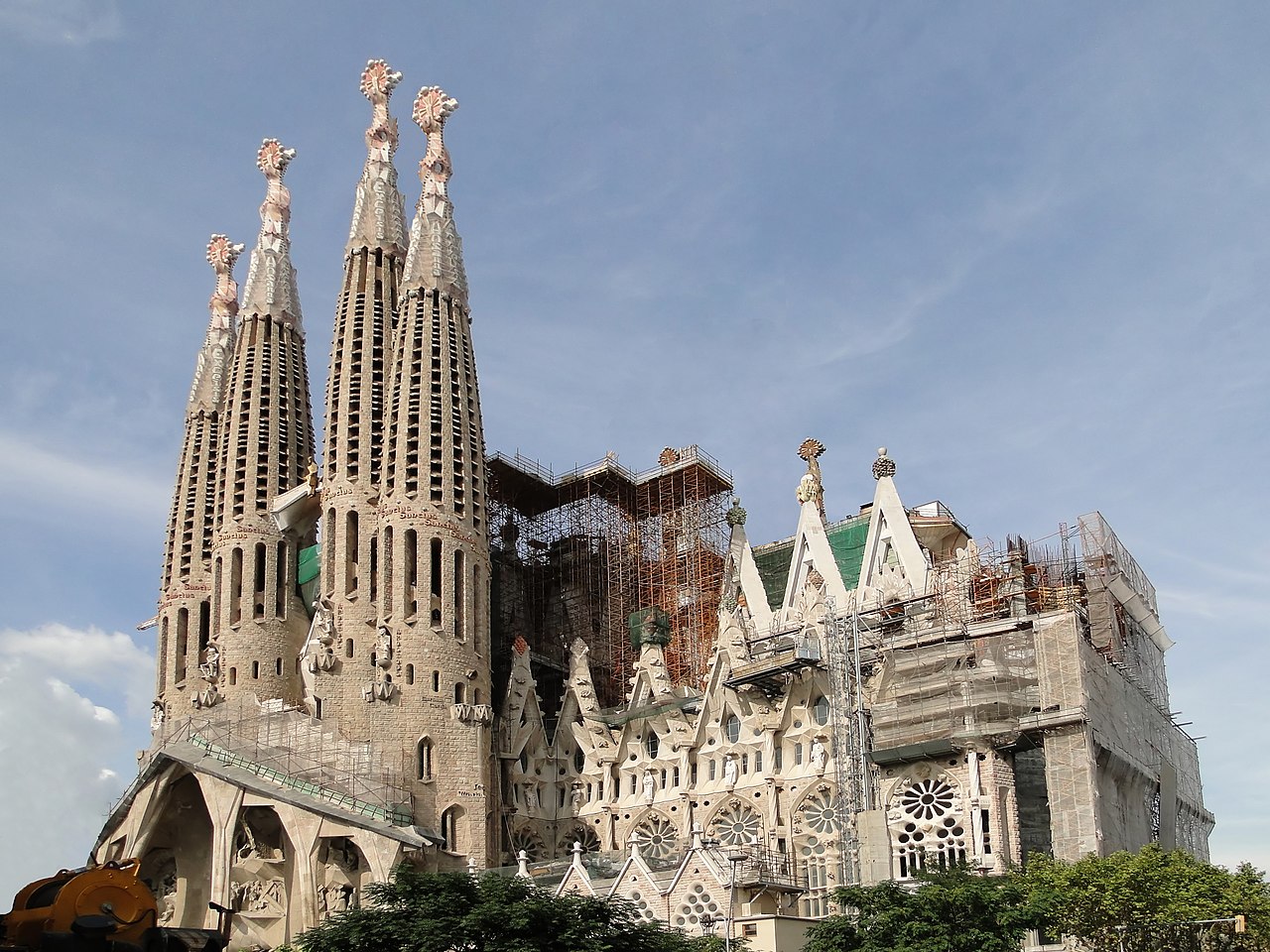
Basílica i Temple Expiatori de la Sagrada Família, commonly called the Sagrada Família, is a large Roman Catholic church in Barcelona, Catalonia, Spain. Commissioned in the late 19th century, the project became most closely associated with the Catalan architect Antoni Gaudí, who from 1883 transformed the original plan into a highly personal synthesis of architecture, craft and ornament. The building is unfinished but functions as an active place of worship and a major cultural landmark.
Image gallery
10 Images




Design, materials and architectural character
Gaudí's approach combined references to Gothic cathedral traditions with the expressive language of Catalan Modernisme, and an emphasis on organic geometry. Interior columns are designed to resemble branching trees; vaulting and surfaces often employ ruled geometries such as hyperboloids and helicoids to achieve strength with visual complexity. Materials range from local stone to newer engineered elements used by later teams; stained glass, sculptural reliefs and an abundance of symbolic detail shape the visitor's experience of light, color and form. Detailed design drawings and his models guided both his lifetime work and later architects who continued construction.
Façades, towers and symbolic program
Gaudí conceived the Sagrada Família as a threefold visual catechism. The principal façades narrate key episodes in Christian belief: the ornate Nativity Façade celebrates the birth of Jesus; the stark, angular Passion Façade evokes the suffering and death of Christ; and the planned Glory Façade is intended to address themes of resurrection, judgment and the road to God. Sculpture, inscriptions and iconographic programs were integrated into the architecture so that the façades and portals function as didactic surfaces.
The original project envisaged eighteen towers representing the twelve apostles, four evangelists, the Virgin Mary and Jesus Christ as the central tower. Tower design and ornamentation vary to signal hierarchy and theological meaning. Although not all towers were completed in Gaudí's lifetime, their planned layout continues to determine much of the building's geometry.
Construction history and continuity
Work began in 1882 and Gaudí took charge in 1883, ultimately devoting his later years almost exclusively to the church. When he died in 1926, only a fraction of the building was complete. The pace of construction has been episodic: funding initially relied on private donations, and later on visitor revenue. Progress slowed and in some phases halted; the Spanish Civil War notably interrupted work, destroyed parts of Gaudí's workshop and damaged models and plans. After the conflict, architects and artisans resumed construction using surviving sketches, photographs and reconstructed models to interpret Gaudí's intent.
Modern techniques, conservation and debate
During the late 20th and early 21st centuries, computer-aided design, 3D modeling and modern stone-working and construction methods were introduced to realize complex geometries while meeting contemporary safety and building codes. These technologies have accelerated some phases of work but also generated discussion among conservationists, scholars and architects about authenticity and the appropriate interpretation of Gaudí's unfinished designs. Some restorers emphasize strict fidelity to his surviving drawings, while others adapt solutions to present-day requirements in structure and materials. The interplay between continuity and adaptation remains central to debates about the project's stewardship.
Recognition, consecration and cultural role
Parts of Gaudí's work at the Sagrada Família are inscribed by UNESCO as World Heritage for their outstanding contribution to modern architecture. In November 2010 the church was consecrated and declared a minor basilica by Pope Benedict XVI, formally recognizing its liturgical role in addition to its cultural significance. The building continues to function as a parish church and a destination for pilgrims and tourists alike.
Gaudí's legacy and ongoing work
Gaudí's devotion to integrating architectural form, religious symbolism and innovative engineering solutions shaped the project's distinctive character and long-term influence. His life and methods are studied by architects, historians and engineers seeking to understand how craft, mathematics and religious narrative converge in built form. Contemporary teams aim to complete the basilica in a manner respectful of Gaudí's guiding principles while addressing modern conservation and safety standards.
Public access, scholarship and further resources
The Sagrada Família is an important element of Barcelona's urban identity and an active site of research into the intersection of art, technology and religion. Visitors can explore the façades, interior spaces and museum displays that present Gaudí's models and techniques; scholars continue to publish analyses of its sculptural program, structural innovations and the challenges of completing a major work begun in the 19th century. For more on the architect and the project's documentation, see materials relating to Gaudí's life, the architectural drawings that shaped the work, and studies of architecture and engineering in historic and contemporary practice.
Questions and answers
Q: What is the Sagrada Familia?
A: The Sagrada Familia is a large Roman Catholic church in Barcelona, Catalonia, Spain.
Q: Who designed the Sagrada Familia?
A: The Sagrada Familia was designed by architect Antoni Gaudi (1852–1926).
Q: Is the Sagrada Familia finished?
A: No, the Sagrada Familia is not finished.
Q: What is the status of the Sagrada Familia as a World Heritage Site?
A: The Sagrada Familia is a UNESCO World Heritage Site.
Q: When was the Sagrada Familia consecrated and what was it made?
A: In November 2010, the Sagrada Familia was consecrated and made a minor basilica by Pope Benedict XVI.
Q: When did the building of the Sagrada Familia start and who took over the project?
A: Building of the Sagrada Familia began in 1882 and Antoni Gaudi took over the project in 1883.
Q: Why was the building of the Sagrada Familia slow and when was it more than halfway done?
A: The building of the Sagrada Familia was slow because it needed private donations and was stopped by the Spanish Civil War, only to start again in the 1950s. Building was more than halfway done after 2010.
Related articles
Author
AlegsaOnline.com Sagrada Família: Gaudí's Unfinished Basilica in Barcelona Leandro Alegsa
URL: https://en.alegsaonline.com/art/85260