
Sächsische Schweiz (district)
Former rural district in southern Saxony, Germany, named for the Saxon Switzerland landscape. Centered on Pirna, bordering the Czech Republic; it was dissolved in 2008 during a regional reform.
The Sächsische Schweiz (Saxon Switzerland) was a rural district in the southern part of the Free State of Saxony in eastern Germany. The district took its name from the distinctive sandstone landscape known as Saxon Switzerland, a region celebrated for steep rock towers and deep river valleys. Administratively the district was centered on the town of Pirna and formed part of the modern Saxony state, often referred to as the Free State of Saxony.
Image gallery
1 Image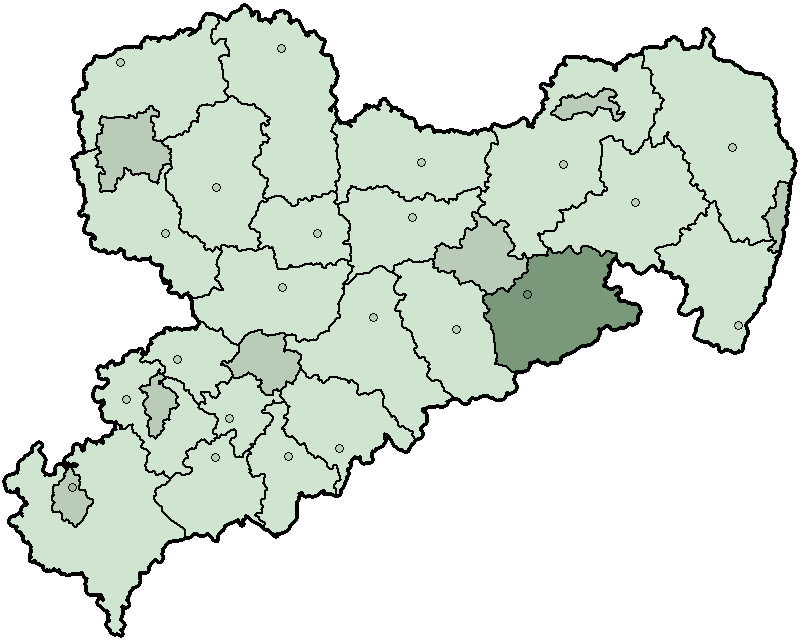
Geography and landscape
Sächsische Schweiz occupied terrain along the Elbe River and extended to the border with the Czech Republic. The area is characterized by weathered sandstone formations, broad river meanders and mixed forests. Much of the landscape is protected as part of conservation areas and the Saxon Switzerland park system, which supports outdoor recreation such as hiking, rock climbing and river excursions.
Administrative history
The district existed as a local government unit until a structural reform in 2008 reorganized Saxony’s rural districts. As a result it was merged into a larger administrative entity, which incorporated neighboring areas to reflect new municipal boundaries and to streamline regional services. During its existence the district government managed local planning, schools and infrastructure for towns and communities within its boundaries.
Economy, tourism and culture
Tourism was a major economic pillar: visitors come for the natural scenery, historic towns and cultural heritage. Notable local attractions include fortress sites, riverfront promenades and traditional market towns with timber-frame architecture. The mix of protected natural areas and small urban centers supported hospitality, leisure services and regional crafts.
Transport and symbols
Road and rail links connected the district to Dresden and to cross-border routes into the Czech Republic. Vehicle registration in the district used the code PIR, reflecting the administrative seat at Pirna. The more obvious abbreviation derived from the district name would have been SS, but this was not adopted because of its association with the historical Schutzstaffel, an obvious reason for avoiding that short form in public insignia and registration codes.
Notable distinctions
Although the Sächsische Schweiz district no longer exists as an independent administrative unit, the name remains in common use to describe the landscape and the tourist region. The combination of unique sandstone geology, cross-border location and close links with Saxony’s urban centers gives the area ongoing cultural and environmental importance.
Questions and answers
Q: What was the Sächsische Schweiz?
A: The Sächsische Schweiz was a rural district in the south of the Free State of Saxony, Germany.
Q: When did the Sächsische Schweiz end?
A: The Sächsische Schweiz ended in 2008.
Q: Which country did the Sächsische Schweiz border?
A: The Sächsische Schweiz borders the Czech Republic.
Q: What does the abbreviation PIR stand for?
A: The abbreviation PIR stands for the city of Pirna.
Q: Why is the district's own abbreviation not being used?
A: The district's own abbreviation, which would be SS, is not used because it is the same as the Nazi SS, the Schutzstaffel.
Q: What was the Nazi SS?
A: The Nazi SS was the Schutzstaffel, a paramilitary organization that played a key role in the Nazi regime in Germany.
Q: What was the importance of not using the SS abbreviation for the district?
A: The use of the SS abbreviation for the district would have been inappropriate since it would have evoked the Nazi SS, a widely-recognized symbol of fascism and genocide.
Related articles
Author
AlegsaOnline.com Sächsische Schweiz (district) Leandro Alegsa
URL: https://en.alegsaonline.com/art/85138